English
 Español
 Français
 Deutsch
 Italiano
 Português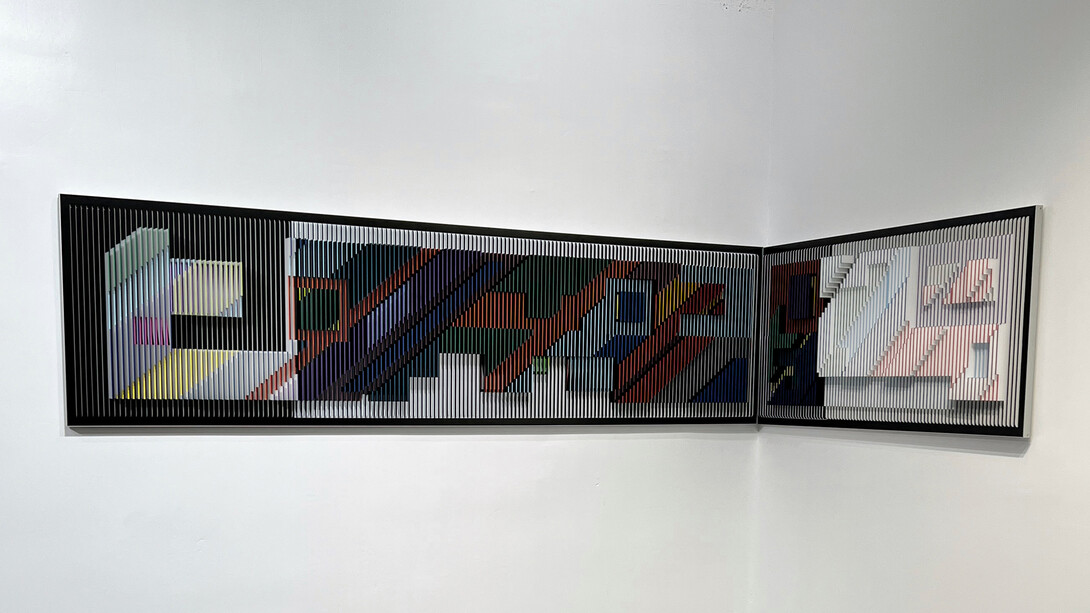
In the ever-evolving landscape of contemporary art, where the boundary between object and experience is continually being redefined, the works of Jose Margulis stand as a remarkable fusion of aesthetic precision and technological and conceptual rigour. Although initially interested in photography, Margulis started to explore his current discipline of kinetic art upon graduation. Since then, the artist has developed his own very specific methodology, which intersects geometric abstraction, kinetic and abstract art, as well as being sculptural in form. His medium is wide ranging, encompassing materials such as plexiglass, acrylic, metal and aluminium composites.
Kinetic art has roots in the avant-garde art of Naum Gabo and Antoine Pevsner, who moved back to Russia from Europe after the end of WWI. Influenced by the (at the time) revolutionary artistic movements of Constructivism and Suprematism, Gabo attempted to integrate the principles of architecture and engineering that were familiar to him into the new aesthetic. Referencing the groundbreaking approaches in science and technology, Gabo attempted to capture Einstein’s space-time relativity in artistic form, specifically negative space. Arguably, Gabo’s Kinetic construction (Standing wave) of 1920 (made from metal, painted wood and a fixed mechanism) was the first work of kinetic art ever made. Here, an oscillating strip of metal is displayed, which effectively shows a standing wave, thus creating the illusion of volumetric space. As will be shown in this exhibition, Margulis’s body of work also unequivocally incorporates the principles that were initially set out by Gabo, above all, the concept of negative space.
After Naum Gabo, the kinetic movement incorporated practises from other radical artistic groups such as Dada, Op Art and the genre-defining group exhibition Le Mouvement, held in Paris in 1955. The original kinetic maxims were then over time altered and elevated, decidedly so by world-renowned Venezuelan artists Jesús Rafael Soto and Carlos Cruz-Diez. The fundamental principle however, stayed the same: by creating sculptures, paintings and works that needed the presentation of motion for effect, this meant that the works extended both in time and space. The viewing experience was thus raised into a different dimension. Although typically reliant on mechanised movement, kinetic art also references contemporary scientific knowledge, which Jose Margulis also accounts for in his body of work.
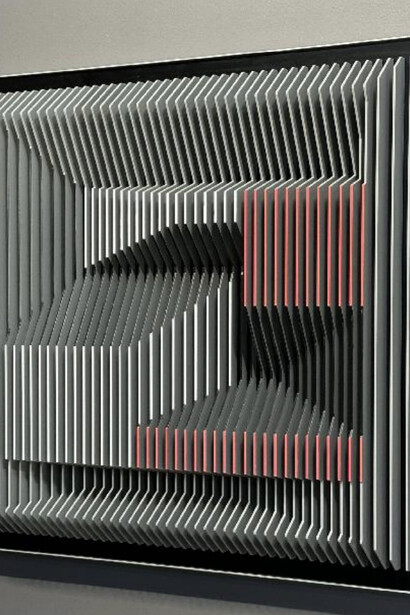
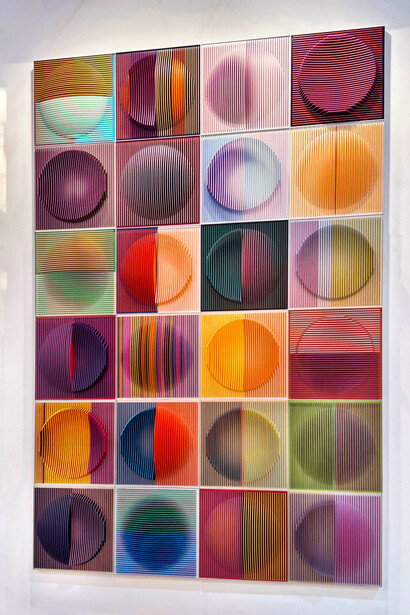
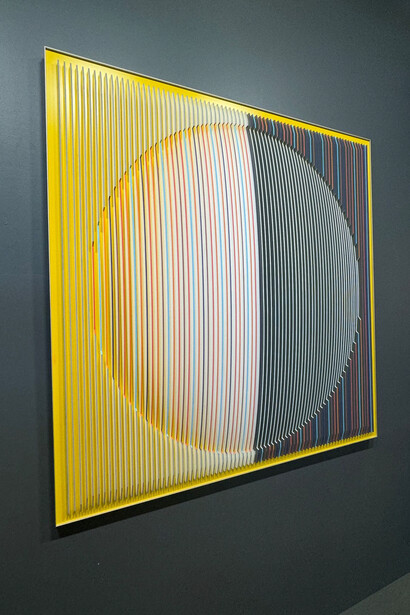
At the heart of Margulis’s practice is a concern with dimensional transformation: the collapse and expansion of spatial perception. His works are kinetic not because they move, but because they demand movement from the viewer. His signature medium – layered compositions of plexiglass, aluminium composite, and acrylic paint – become a tool for sculpting perception itself. The illusion of motion arises not from mechanical intervention, but from optical play and the subtle manipulation of geometric elements. These works shift with light and shadow, oscillating between stillness and dynamism as the viewer navigates around them. In this way, Margulis positions the observer not merely as a spectator, but as a co-creator of experience.
One of the most compelling aspects of Margulis’s oeuvre is his capacity to inject emotional and philosophical resonance into an otherwise formalist visual language. This is most apparent in his Writings on the wall, a masterclass in layered semiotics (from this series, the following works can be seen in this exhibition: But did you die, 2024, and It is gradual until it is sudden, 2024). These works offer a visual puzzle, in which geometric forms, optical illusions, and written language coexist in a delicate equilibrium. Here, the act of reading becomes one of discovery and confrontation: text emerges from abstraction, meaning reveals itself only to those willing to decode it. The title of the series itself is a prophetic warning of inevitable consequences, suggesting that what is most urgent is often hidden in plain sight. Margulis uses this conceptual layering to great effect, engaging the intellect without sacrificing his aesthetic principles.
A similar strategy animates his Portholes series. These circular compositions act as visual apertures – portals into alternative spatial dimensions. They are less about what is depicted and more about what is suggested: the fluidity of boundaries, the illusion of depth, the kaleidoscopic nature of perception. The artist’s engagement with light – ‘light as ink,’ as Margulis describes it – becomes an active material in the composition. The interplay of colour, shadow and transparency renders each work mutable and subjective, contingent on the surrounding environment and the position of the viewer. As the viewer moves, the pieces respond, revealing new constellations of colour and form. What begins as a flat surface evolves into a dynamic reality.