English
 Español
 Français
 Deutsch
 Italiano
 Português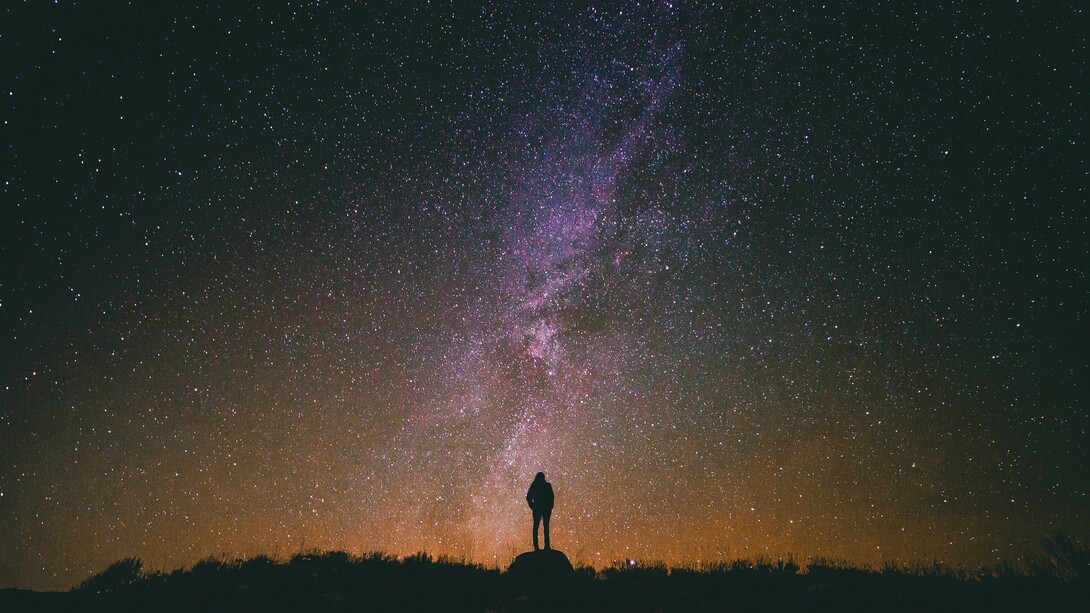
Roofs protect you from the weather, but they also prevent you from the caresses of the stars, and sometimes one needs to drink a few stars to cure heart loneliness. Yes, sometimes a few scoops of star-sprinkled space help a lot to ease the pain of waiting. So, take the handle of Ursa Major, use it as a ladle, and help yourself with a drink or two. Ah, the things that one can do, without that roof that delimits our space and our mind!
The other night, I got bored with being tired and old, with so many opinions, my own and those of others, newscasts, cell phones, and social networks. It was still early, and I had some energy left, so I went for a quiet walk by the beach near my house. It was a clear, moonless night, full of stars. Those sparkling silver dots, which appear at night, for those who look up to see; the bored, the lovers, and the astronomers. Stars are always there, but one takes them for granted.
Of course, when astronomers see stars with their large and small telescopes, they describe them, tell us how impossibly far they are, and how many they could be. They entertain themselves by counting stars while they live. Which is probably much better than entertaining yourself by criticizing others…
Out of curiosity, I looked up the last astronomical count of the stars. Current estimates say that in the observable universe there are about 2 trillion (2 × 10¹²) galaxies, with 100 to 200 billion stars per galaxy. That is a total estimate of 200 to 400 sextillion stars. To put it another way: there are more stars in the observable universe than grains of sand on all the beaches of the Earth (and they are a little larger than grains of sand, too).
From this countless universe of stars emerged the elements, the planets that, little by little, gave rise to life. Stars are basic components of the evolution of matter, from which planets are born, which are essential for the formation of life. And let us not forget that one star close to us (only 93,000,000 miles) that rises during the day and blinds us with its light, if we look at it, and sustains life on this planet.
As I walked under the magic starry night, I remembered a beautiful story that Deepak Chopra told, opening a talk. He said that he was walking on the beach near his house, under a sky full of stars, with his four-year-old granddaughter, Tara (which means star in Sanskrit), and he told her, “I love you so much, Tara.” And she, who was very alert and talkative, replied, “Why?” Then he said, “Because you are made of light.” And she said, “How?” And he thought, “How do I explain photosynthesis to a four-year-old girl?” and he said to her, “The stars wanted to see themselves, and they made you to look at them.” And the girl was silent all the way, while they finished the walk. But as they were returning to the house, she said to Deepak, “Grandfather, the stars want us to look at them again.”
I thought. Yes, we are all so engrossed with our egos, our ignorance, that we have lost our capacity to be amazed, as we dedicate ourselves to aggrandizing our personalities, believing that we know so much, and that the world revolves around our egos. We have forgotten the magic of life and the stars.
If we could really become aware of the magic of the stars, the universe, the endless symphony of nature, we would be more humble and less vain. Less stubborn in consuming more than is necessary for our survival and well-being, and control our selfish accumulation at the expense of the well-being of others and the environment that sustains us. We could live a more humanitarian and compassionate life. We would become aware that we are all in the same boat, floating in this ocean of light. Yes, that we are made of starlight, so we can see them, marvel at them, and learn to be.
At that thought, I looked up and took a few scoops of star-sprinkled space and drank some space with stars, as the opening verses say, and got drunk with optimism.
The next day after my walk, I was still drunk. I happened to read some facts about the world's economy and began to daydream. According to World Bank and International Monetary Fund data, total household consumption in the world is around sixty-four trillion dollars (64x1012). Of this amount, 40-45% ($25-28 trillion) goes to "luxury" goods and services such as fashion cycles, entertainment excesses, luxury items, cosmetics, and non-essential products.
The following table compares expenditures for necessities and well-being vis-à-vis vanity and luxuries. Even in the poorest countries, a lot is invested in luxury and vanity, although Paradise is the country with higher incomes.

Still star drunk, I dreamed. What if we could achieve a 50% reduction in spending on luxuries and vanities? This would free up about $12-14 trillion annually. And with this, according to various sources, we could fully finance the main global objectives of health, education, nature conservation, and global equity, and we still have a surplus to support the development of scientific research to generate more well-being. By reallocating just half of current consumption to satisfy our vanity, we could eradicate extreme poverty, achieve universal health and education, fully fund the climate transition, and double global funding for scientific research on global objectives.
And of course, by reducing "greed and vanity," it would not only reduce consumption; it would change social values. Success would no longer be measured in possessions and status but in education, health, and collective well-being. Advertising would no longer be focused on boosting our appetites for the trivial and would focus instead on promoting universal services (health care, housing, education) and the protection of the global commons.
I was thinking about this, high with stars and utopia, when I received a notification on my cell phone, leading me to a summary of Trump's speech to the United Nations. Especially with regard to climate change and migration.
My utopian dream ended with a bad hangover as I realized that the problem is not in the logic of things, but in our arrogance and lack of humility. We live more and more in arrogance and under the motto each one to his own. Our spirit is no longer amazed by the universe and life, the pride and emptiness of our egos; it is more important than that. I realized that the current global crisis is not of a material nature, or of a lack of intellectual capacity to solve problems, or ideas to organize society, but one of spiritual poverty: our selfishness, our lack of humility, solidarity, and reverence for life.
Perhaps the same powerful forces that generated the stars, through the violent convulsions and explosions, which eventually made possible the niches for the frailty of butterflies and the consciousness of love, will manifest again. An asteroid, coming out of the universe, ended the dominance of dinosaurs, and mammals then emerged with their capacity for greater empathy.
Perhaps human civilization will continue to progress beyond the Trumps in each of us, and will collectively discover the energies of love, through the manifestation of natural forces resulting from our ignorant excesses, which are undermining the intertwined fabric of nature and of life. And we might become conscious, through a major crisis resulting from our ignorance and arrogance, of our interdependence, that we are all made of starlight.
The disease of selfishness in humankind will need a cure, which is not only universal in its application but is drastic in its nature. It is so deep-rooted that it can be uprooted only if it is knocked from all sides. Real peace and happiness will dawn spontaneously when there is the purging of selfishness.
(Meher Baba)
Let us toast with a drink of space and some stars, that the forces of the universe save us from ourselves.