English
 Español
 Français
 Deutsch
 Italiano
 Português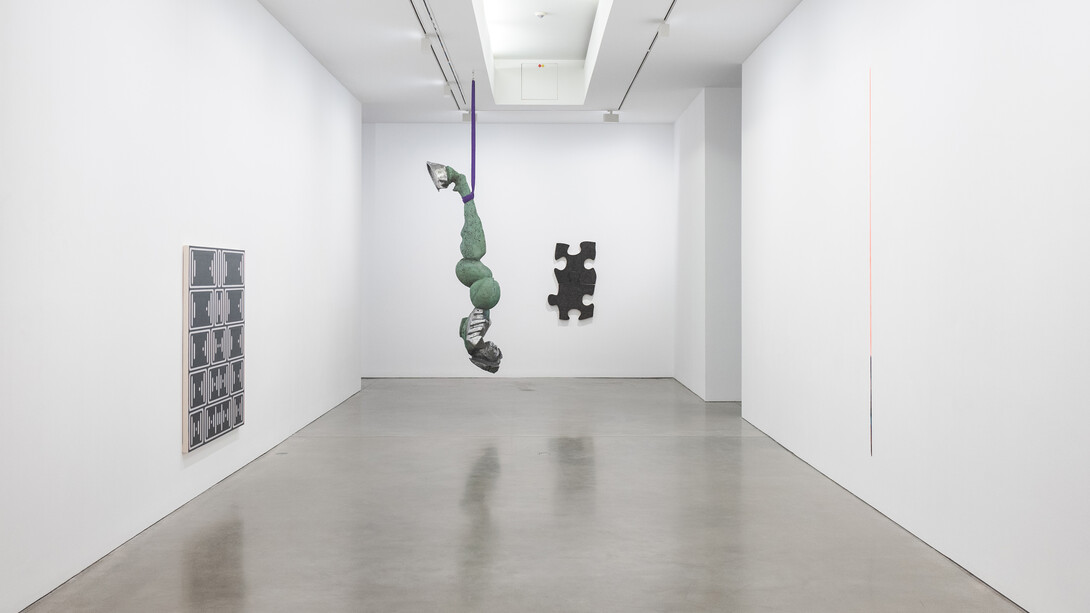
Galerie Thomas Schulte is pleased to present Rotation, a group exhibition featuring eight artists from its program, whose works—spanning from the late 1960s to today—highlight the dynamic exchange of artistic positions within the gallery. Across varied media and approaches, Richard Deacon, Lena Henke, Franka Hörnschemeyer, Matt Mullican, Leunora Salihu, Fred Sandback, Dan Walsh, and Jonas Weichsel explore the interplay of form and system as structuring principles in their artistic practice.
Rotation brings together a shifting constellation of voices within the gallery’s history. Here, form and system unfold as mutable conditions—revisited, reconfigured, and reimagined. The exhibition traces an ongoing movement between generations and artistic languages, where each position turns toward another in a continual state of renewal.
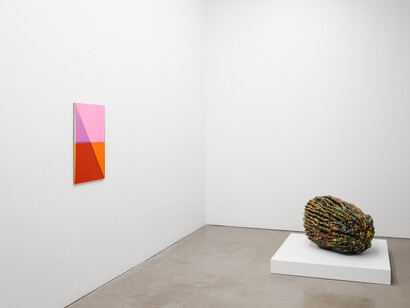
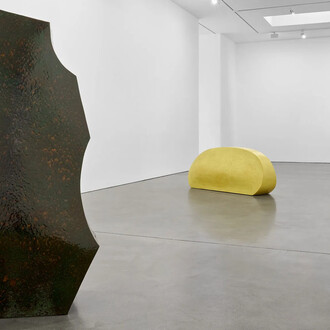
Engaging with paradoxical situations rather than established notions of form, Richard Deacon selects materials, processes, and methods as needed to create something without a predetermined result. No black (2013) belongs to a series of four biomorphic ceramic sculptures, each multicolored and glazed. Modeled from sheets of clay and glazed using different combinations of four out of a palette of five colors—always omitting the color mentioned in the title—the firing process allows the glazes to flow and merge across the surface, producing dynamic chromatic interactions.
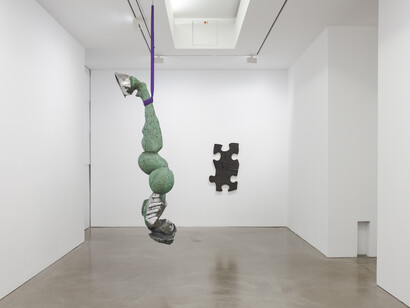
Material transformation takes another turn in Lena Henke’s sculpture Unforced error (2025). A more than 2.5-meter-long amorphous body unfolds in which animal form gradually transitions into the fragmented depiction of a female bust. Held by a violet polyester strap, the aluminum sculpture slowly evolves from a polished horse’s hoof into a visage. The figure depicted is Saint Barbara, the patron saint of those involved in building and the fabrication of sculpture—a recurring motif in Lena Henke’s work, and, like the horse’s hoof, one of personal significance to the artist.
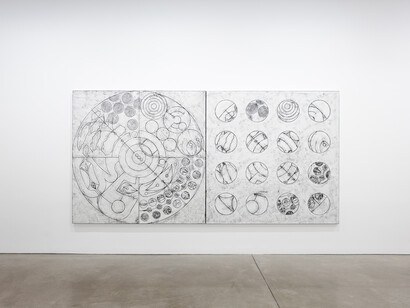
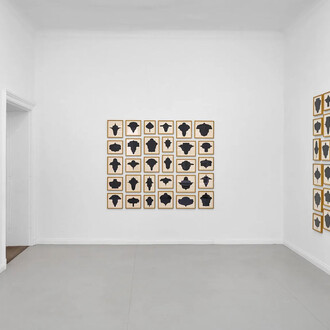
Alluding to American mathematician Claude E. Shannon’s information theory in its title, Franka Hörnschemeyer’s Slight discrepancy 67/68 (2025) consists of two interlocking, puzzle-like elements made of composite wood panels and bitumen sheets. Only the upper part is fixed to the wall, while the lower one is held solely through its connection to it—an interplay visible in the narrow gaps between the two forms. The work reflects Hörnschemeyer’s ongoing interest in the moment of contact between structures and the spaces that emerge in between. Also concerned with systems and perception, Matt Mullican employs one of the oldest known methods of reproduction in his two-part rubbing Untitled (Cosmology and details, b&w) (2024). Carved wooden boards are transferred onto canvas by rubbing with oil sticks, producing images that manifest assumed realities and Platonic idealism in a hybrid medium between drawing and print.
With Spine I (2025), Leunora Salihu extends the dialogue between structure and organic form. Combining glazed ceramic and wood, the sculpture is composed of repeated segments conceived as a movement that could continue infinitely in space. The spinal column’s precise regularity and upright stance are countered by the tactile warmth of terracotta. Depending on the viewer’s perspective, it might evoke an insect’s exoskeleton or even a chest of drawers, introducing ambiguity between function and vitality.
Representing a seminal historical position within the exhibition, Fred Sandback’s Untitled (Sculptural study, wall construction) (1995/2013) consists of two precisely joined strands—orange above and black below—forming a single, attenuated vertical line that subtly reconfigures the wall as a spatial plane. By stretching strands of yarn from point to point to create geometric figures, Sandback articulated a new form of “drawing in space,” defining volume through absence.
The presentation concludes with two painterly positions that reexamine the logic of systems through image-making. In Tactic (2025), Dan Walsh playfully unfolds seriality and its subtle variations, constructing internal rhythms only to subvert them. The work continues his process-oriented approach, generating images that are restrained in vocabulary yet intricately layered in structure.
Bringing together analog and digital techniques, Jonas Weichsel’s most recent work from his series of TC paintings extends his sustained analytic engagement with the conditions of painting. Through meticulous mixing, cataloguing, and arrangement of color, Weichsel examines the essence of the medium—its possibilities and limitations—as an ongoing inquiry into what an image can be today.
![Various artists, [ materialistin ], exhibition view. Courtesy of Hamburger Bahnhof](/attachments/fd8f4fd76b73be0a02d398535c29d017e1309b65/store/fill/330/330/3f54331fd7869a13166dfe67a9e91306c6e180b2e29b9fd308d958b87ad2/Various-artists-materialistin-exhibition-view-Courtesy-of-Hamburger-Bahnhof.jpg)