English
 Español
 Français
 Deutsch
 Italiano
 Português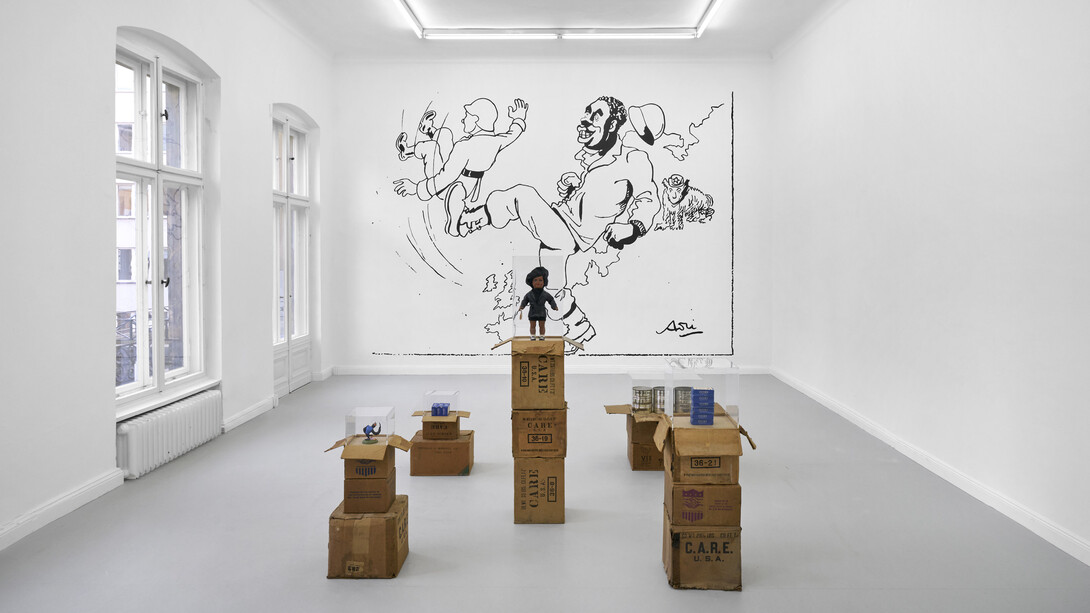
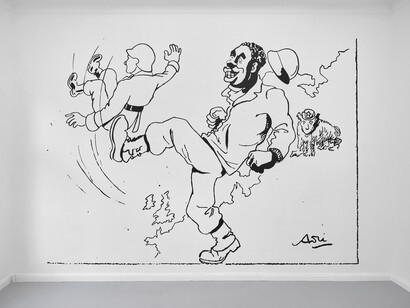
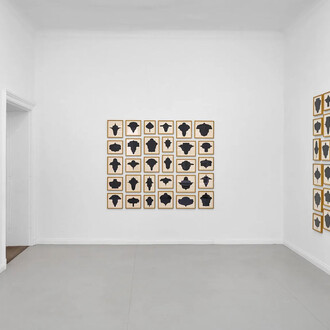
Galerie Thomas Schulte is pleased to present Ebenholz, a solo exhibition featuring the installations of James Gregory Atkinson, who further develops his research-intensive practice, delving into the histories of Black Germany after the Second World War. Atkinson salvages salient sounds, objects, documents, and thereby, legacies—which lend a palpable material presence to the histories that have shaped Germany but have often been placed outside of the official historical record.
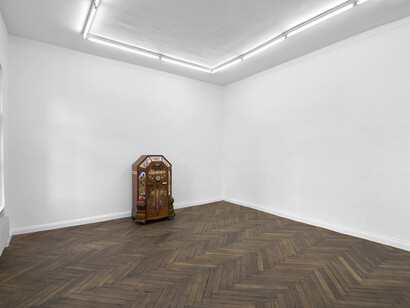
This latest iteration of Atkinson’s research unfolds at the intersection of biographical and historical narratives. The biographical aspect is filtered through numerous references to the musical career of Marie Nejar (1930–2025), who, after being compelled to act in Nazi propaganda films in the 1940s, performed as a “child star” under the stage name of Leila Negra in the 1950s. Nejar, who passed away in May 2025, was the last known Black survivor of Nazi Germany. Nejar’s life and voice—commemorated by a large gelatine print from an original negative and a jukebox with her discography—have served as reliable guides on Atkinson’s archival jaunts into post-war German history. They are presented here as a set of installations where nothing is out of place, and everything directly and intentionally connects to everything else, however mundane it may initially seem.
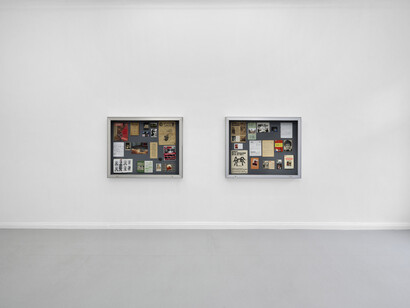
The exhibition’s name is a nod to Ebony magazine, the quintessential post-war monthly magazine first published in November 1945 and catering primarily to a Black US readership. The October 1948 issue is part of the installation presented in an original wall vitrine from the Ray Barracks in Friedberg where the artist’s father was stationed in the 1980s. It features an image of a little boy peeking from behind a door, and the headline “Homes needed for 10,000 Brown Orphans.” The “orphans” were the children of African American GIs and white German mothers who had been systematically pressured to give up their children for adoption or to dedicated “orphanages.” According to the German Federal Statistical Office, 5,000 “Brown Babies” were born in West Germany by 1956.
Initially, the children were seen as a symbol of Germany’s defeat in the war, but during a parliamentary debate on 12 March 1952, CDU politician Luise Rehling doubled down, claiming that the children constituted “a human and racial problem of a special kind ..., for which the climatic conditions in our country alone are not suitable.” The conclusion was that it would be best for the children to grow up elsewhere. That same year, the very popular film Toxi by R.A. Stemmle dramatized this trope for a mass audience, drawing the same conclusion. The star of the film, Toxi, played by Elfie Fiegert, was so popular that the Drei-M-Puppenfabrik issued Toxi dolls soon after the film’s premiere. The doll makes an auspicious comeback in one of Atkinson’s installations, but this time in a custom-made Black Panthers costume, a hint toward the political activism that some Afro American GIs were involved in at the time.
2025 also marks the 80th anniversary of the Care package programme, displayed in Atkinson’s work through (some) contents and the packages themselves as part of his history in objects. Between 1946 and 1960, ten million care packages were sent to Germany, a third of which landed in Berlin. Each contained essential items such as soap and powdered milk. Alongside these items in the installations, bars of Ivory Soap manufactured by Proctor & Gamble also make an appearance, a subtextual nod to Nejar’s autobiography in which she recalls scrubbing herself in the shower because she had been (mistakenly) led to believe that she was dirty. Layer by layer, item by item, document by document, Atkinson’s minimalist presentation reveals itself as a thick tangle of cross-references curated to appear serendipitous, only for the scale and depth of his artistic research to emerge in instalments. Atkinson’s archival work can be best described as a non-linear archival excavation that recontextualizes the post-war story of Germany, highlighting the dearth of archival traces in institutional repositories.
(Text by Dr. Eric Otieno Sumba)



![Various artists, [ materialistin ], exhibition view. Courtesy of Hamburger Bahnhof](/attachments/fd8f4fd76b73be0a02d398535c29d017e1309b65/store/fill/330/330/3f54331fd7869a13166dfe67a9e91306c6e180b2e29b9fd308d958b87ad2/Various-artists-materialistin-exhibition-view-Courtesy-of-Hamburger-Bahnhof.jpg)