English
 Español
 Français
 Deutsch
 Italiano
 Português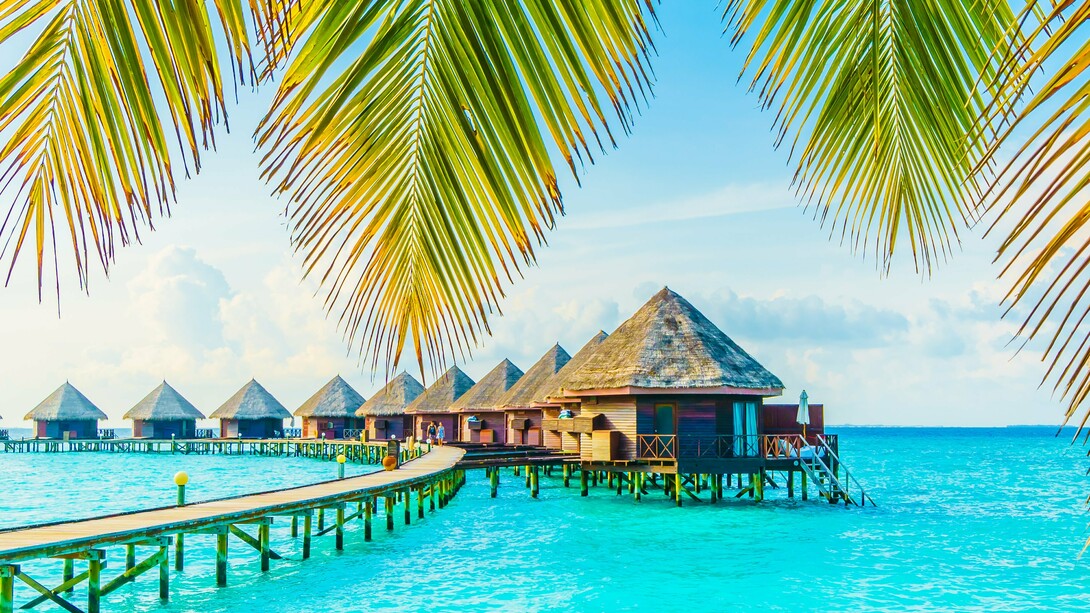
The Republic of Maldives is a nation of more than a thousand islands in the Indian Ocean, many of which are home to exclusive resorts on idyllic islands. Only about 200 of the islands are inhabited. Pronounced “maldeeves,” it is the smallest country in Asia and one of the world’s most geographically dispersed.
The Maldives gained independence from the United Kingdom in 1965. For 68 years prior to its independence, it was a British protectorate. Its closest neighbors are India and Sri Lanka. It is a melting pot of people and cultures in a spectacular setting.
It did not become known to tourists until the early 1970s. Most visitors arrive at Valana International Airport, adjacent to the capital, Male. Male is filled with busy fish markets, restaurants, and tourist hotels. From the airport, seaplanes and boats are offered to the resorts on other islands.
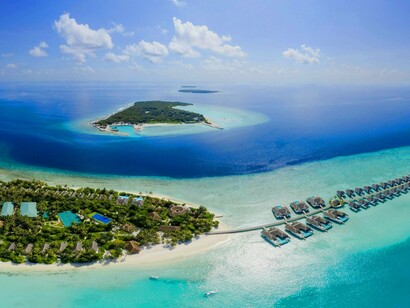
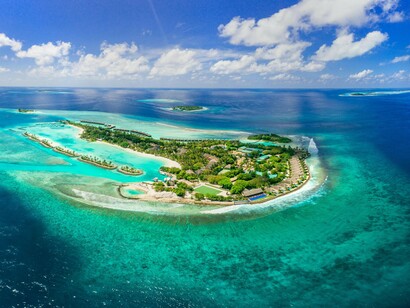
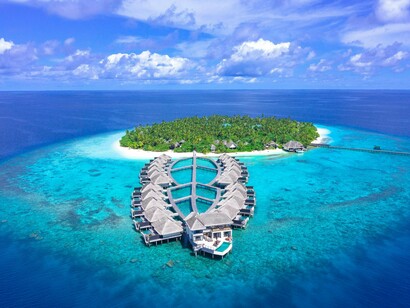
The Maldives is popular with honeymooners. The surrounding waters are clear with blue and green hues, and the resorts are well-appointed. Most resorts sprawl over an entire island.
Many of the Maldives’ resorts are all-inclusive and feature overwater bungalows. Most are luxurious accommodations surrounded by white sand beaches and palm trees. Private pools adorning bungalow decks are common. Prices are high by South Asian standards in areas that cater to tourists. A number of the resorts regularly appear on the world’s best lists.
Since my time was limited in the Maldives, I found a medium-priced resort not too far of a boat ride from the airport, Centara Ras Fushi Resort & Spa Maldives. After a 25-minute boat ride to the resort, I could still see Male in the distance.
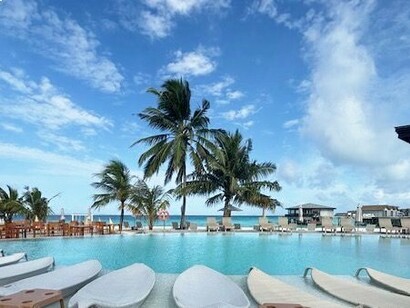
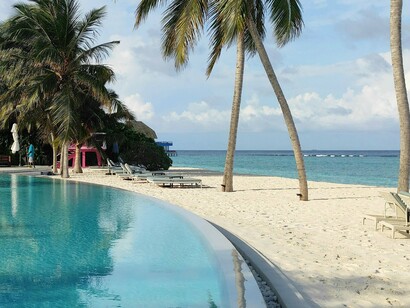
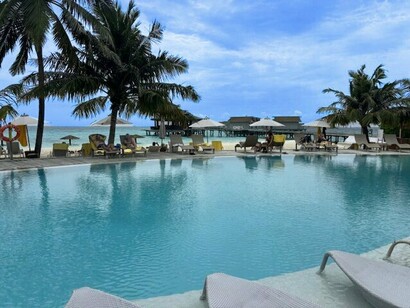
Centara Ras Fushi is an adults-only resort that boasts one of the top dive sites in the country. The powdery white sand and turquoise water did not disappoint. There were two beautiful pools, multiple restaurants and bars, a variety of events, water sports, a dive center, a spa, a gym, and excursions offered. Full board or partial board are options.
By law, resorts price services in U.S. dollars and require payment in hard currency or a credit card. Taxes are high. There is no need to change money into the local Maldivian rufiyaa if you will spend your time at a resort. Tips in U.S. dollars are welcome.
The local culture is primarily a mixture of Sinhalese, South Indian, and Arab influences. The Maldivian language is Dhivehi, an Indo-Aryan language with origins in Sanskrit and closely related to the Sinhala language of nearby Sri Lanka. As tourism is the main source of its economy, English is widely spoken. Arabic is taught in schools; however, because the official religion is Sunni Islam. The Maldives is the world’s smallest Muslim country. Since the adoption of its 2008 constitution, anyone wishing to become a Maldivian citizen is required, nominally at least, to follow Sunni Islam.
Public observance of non-Muslim religions is officially banned. Luggage screening takes place on arrival. Among items on the official prohibited list are narcotics, pornographic material (defined to include sex toys), “religious materials offensive to Islam,” and idols for worship. Restricted items that require permits include alcohol (so avoid purchasing liquor on the flight or duty free shops when en route to the Maldives), pork, chemicals, pets (without a health certificate from an authorized veterinarian), firearms, live plants, medicine (without a valid medical prescription), tobacco and communication equipment (with radio frequency exceeding a certain amount). The resorts, however, are permitted to exist in bubbles where almost anything is acceptable. Outside of the resorts, visitors are warned to cover up, even on beaches, and not to partake in public displays of affection.
The traditional cuisine of this nation of islands is heavily based on fish, particularly tuna, and coconut. It draws heavily from South Indian tradition. To try local food, go to the cafes, locally known as “hotaa.” Consider having afternoon or evening tea with Hedhikaa, traditional Maldivian short eats. Tuna is a staple in these bite-sized snacks.
The climate is hot and tropical. It has a wet season and a dry season. As in most places, it is less expensive to visit during the wet season, which is from May to October. I visited in July, and the rain episodes were brief.
Snorkeling and diving are popular in the Maldives. Rich marine life thrives in the underwater world of clear waters and abundant coral reefs. The underwater scene is dazzling with its stunning array of colors. I enjoyed being surrounded by colorful fish and observing the wide variety of coral.
As the world’s lowest-lying country, the Maldives faces water crises driven by climate change. With the majority of its islands less than half a meter above sea level, climate change also likely will render large parts of the archipelago uninhabitable by 2050. It is a serious threat.
You may want to visit this stunningly beautiful country before it sinks into the sea. The Maldives provides a gorgeous sanctuary from everyday life.