English
 Español
 Français
 Deutsch
 Italiano
 Português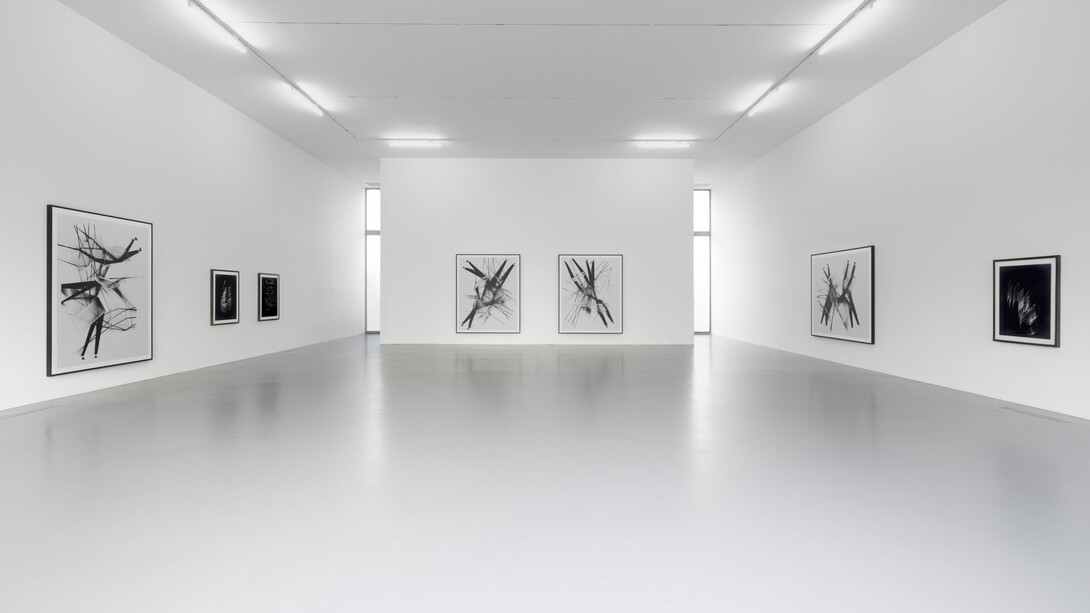
On Saturday, 15 November 2025, Lia Rumma Gallery opens in Milan Thomas Ruff’s sixth solo exhibition with the gallery, marking a long and fruitful collaboration that began in 1991 with a show at the Naples venue. Throughout his over forty-year practice, Ruff has ceaselessly explored the limits and structure of the photographic medium, developing a corpus organized into various typologies of works that have profoundly questioned our way of looking at images and have helped to redefine the very nature of what we call photography.
The exhibition unfolds across the gallery’s three floors and brings together works from seven series developed by the artist over the past 25 years using different techniques—from the nudes of the late 1990s, which draw from the vast reservoir of images found online, to the recent untitled# (2022) and expériences lumineuses (2024), created by Ruff in his studio using one of his cameras.
The exhibition begins on the ground floor with five works from each of these two most recent series. The untitled# are abstract photographs inspired by pioneering experiments such as Etienne Bertrand Weill’s Metaforms and the Rythmograms created by Peter Keetman and Heinrich Heidersberger in the 1950s and 1960s. Ruff uses long exposures to capture the rotational movement of a luminous body—in this case, a spool of silver thread— focusing on the resulting traces: lines, abstract forms, graphic structures. As with the untitled#, light is also the main subject of the expériences lumineuses, realized in the studio through a simple physical experiment that helps visualize the electromagnetic spectrum. The artist photographs the reflections and refractions of light beams passing through glass objects such as lenses, mirrors, and prisms, then digitally inverts the image before printing it on canvas, thus achieving an effect close to painterly abstraction derived from the documentation of a scientific phenomenon.
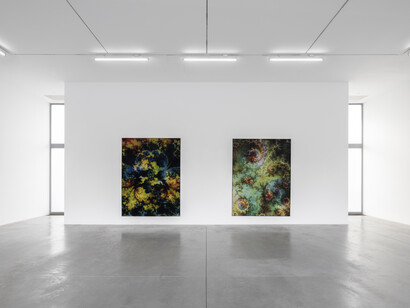
The exhibition continues on the first floor with works that explore the aesthetic potential of mathematical formulas and their capacity to generate images. The tapestries from the d.o.pe series—whose title refers to Aldous Huxley’s autobiographical essay The doors of perception—are made by superimposing enlarged portions of the Mandelbrot fractal, a set of complex numbers described by some scholars as “the most complex geometric object in mathematics.” The result is a group of psychedelic textile works of strong visual impact that might at first glance appear to depict scenes from the natural world, though they are entirely artificial.
Here the reference to the hallucinatory imagery of the 1960s and ’70s is striking—whether in the album covers of bands such as the Grateful Dead, King Crimson, Pink Floyd, or Jefferson Airplane, or in films like Stanley Kubrick’s 2001: a space odyssey—as well as to the fantastic worlds painted by Renaissance artists such as Bosch and Grünewald. In the same room, the photographic works from the zycles series share a mathematical origin, though unlike the d.o.pe, they take inspiration from nineteenth-century illustrations of electromagnetic fields. Starting from algorithms and using 3D modeling software, Ruff creates dynamic virtual compositions whose lines evoke planetary orbits and minimalist drawings.
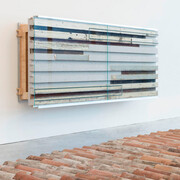
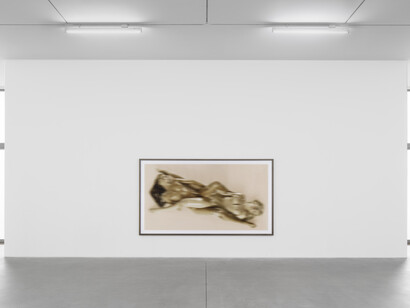
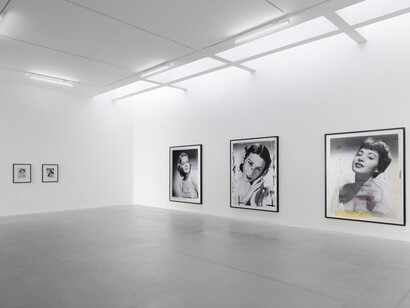
Completing the exhibition on the second floor are works from the photograms series—digital photograms also constructed with the aid of 3D software—and from the press++ series, in which the technical and contextual information annotated on the back of press photographs is transferred to the front and overlaid onto the corresponding image. The exhibition also includes a photograph from the celebrated nudes series, created from images of naked bodies found online and enlarged to the point of blurring, in order to emphasize their aesthetic value rather than the explicit nature of their source.