English
 Español
 Français
 Deutsch
 Italiano
 Português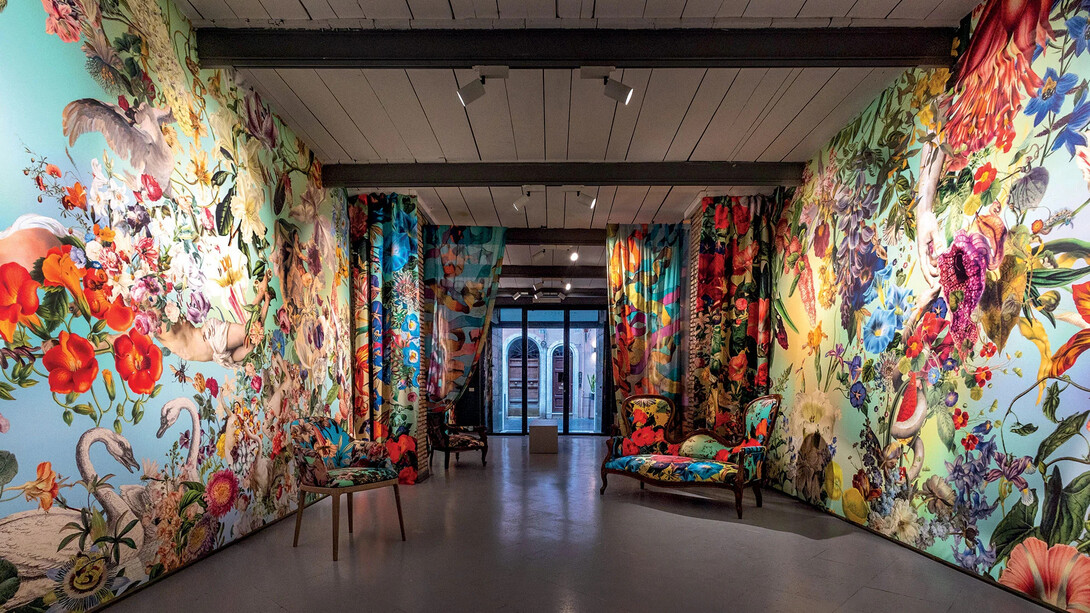
The solo exhibition Beauty! by Austin Young opens on Friday, September 26 at 6 pm (and runs until November 29) at Mucciaccia Gallery Project.
A multidisciplinary artist whose unique style has stood out in both international and national contemporary art scenes for his ability to blend, using different expressive languages, pop culture and high art, underground exuberance and rigor, queer imagery and symbolism, Austin Young returns to the capital after the success of Temple of flowers at the Chiostro del Bramante, with a new site-specific project.
With this new installation, conceived for the gallery space in the historic center of Rome, the artist, who has chosen the city as a second home after Los Angeles, continues his exploration of the beauty of nature and flowers as universal symbols with multiple meanings: from resistance to spirituality, from love to conflict, from science to ecology. In his continuous search for beauty and the sublime, Young, who describes himself as an activist for beauty, presents a new body of work inspired by cosmology and the symbolic power of nature, transforming the space into a lush garden where flowers, human elements, and nature merge to create an engaging atmosphere that stimulates all the senses. The title of the exhibition is already a statement of intent: Beauty! not only evokes the beauty of nature but aims to use it as a powerful tool to address the ecological and social challenges of the present.
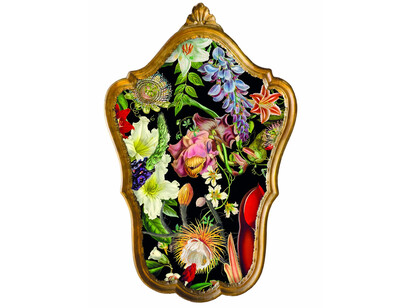
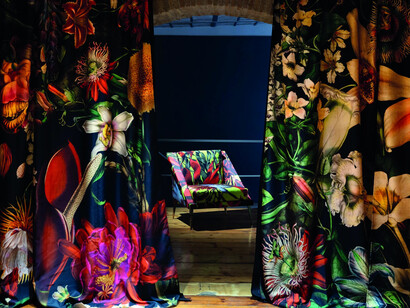
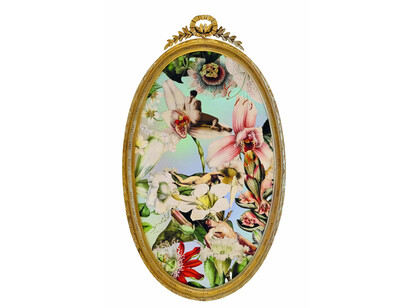
Claudia Gioia, author of the exhibition essay, states: For this new project in Rome, Austin Young adopts a more contemplative pace, as if guided by a suspended desire. It begins with a mirror, half-shrouded in shadow, where one might recognize oneself before surrendering to temptation and the freedom to become something else. Then we are invited into a transformed space, crossing a curtain of drapery that offers a counterpoint to the unfolding of the environment. Everything is enveloped in the artist s imagination. Chairs, furniture, gilded-framed paintings, and surfaces all enter the same visual blender, interacting with the architecture, which shifts into theatrical backdrops and then into a single, immersive scenario to be inhabited.
The artist's research continues in the wake of the work of Fallen fruit, the contemporary art collective co-founded by Young that since 2004 has focused its artistic practice on Like culture, agriculture moves along routes of territorial expansion, international trade, and migration: they are seeds that travel across the world. From this perspective, engaging in the production of beauty becomes, for the artist, a form of political resistance, a way to shift perception, alter emotional states, and open the mind to new possibilities. A recent internal study by META confirms that content evoking fear, anger, or outrage "keeps users engaged and increases time spent on the platform." In contrast, Beauty, joy, love, and the sublime disr , the artist comments on the use of social media in our society.
Austin Young (Tranimal, Fallen fruit) is a multidisciplinary artist whose distinctive style fuses beauty, pop culture, art history, folk art, and exuberant underground transgression into a unique visual language. Through photography, video, performative portraiture, and public art, Young explores queer visibility, community engagement, and the sublime potential of collective humanity. Originally from Reno, Nevada, Young now lives between Los Angeles, Rome, and Puerto Vallarta. From a young age, he forged innovative ways to integrate diverse influences into an artistic practice that is celebrated for challenging genres. He is also the co-founder of Fallen fruit, the internationally renowned artistic duo (with David Allen Burns) that explores collaboration, urban space, and collective memory. Through photography, mapping, video, and participatory actions - such as public fruit parks, tree adoptions, and jam-making events - Fallen fruit investigates the cultural and political histories of land use, agriculture, and colonialism. Their projects range from site-specific installations in museums, gardens, and public spaces from Los Angeles to Palermo and London. Recent solo projects include immersive installations at the 60th Venice Biennale, Tempio di Fiori for the Flowers exhibition at the Chiostro del Bramante in Rome, and an ongoing site-specific commission at the Church of Sant'Aniello in Calabria, blending sacred space with contemporary artistic practice.
The exhibition is accompanied by a catalogue published by Silvana Editoriale, with an exhibition essay by Claudia Gioia