English
 Español
 Français
 Deutsch
 Italiano
 Português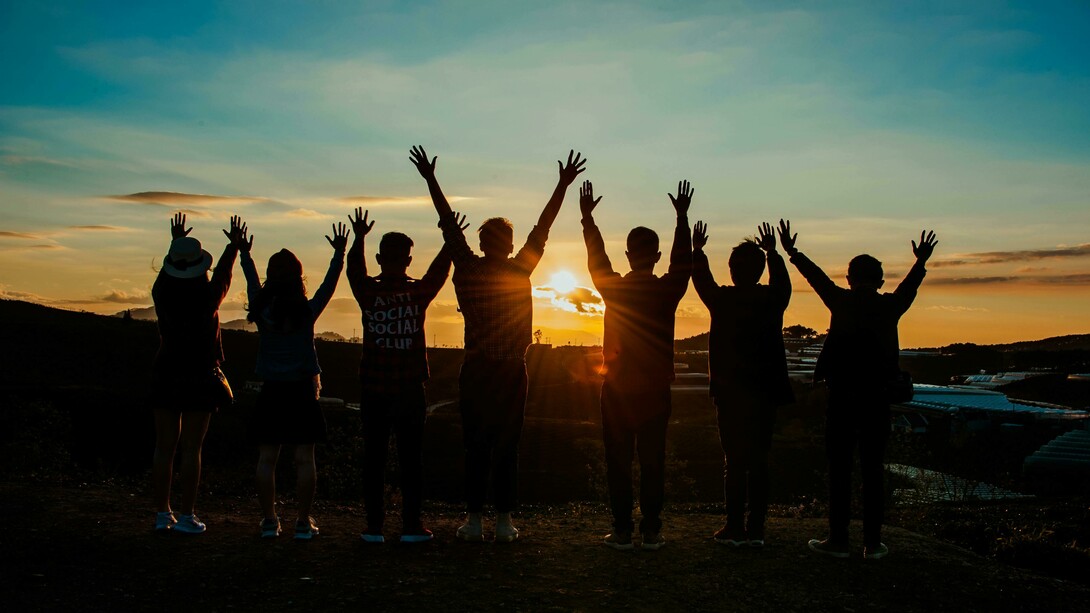
Why do so many of us feel the need to belong to something, a group, or a community? Is it perhaps a necessity, a need dictated by not feeling alone, or something else?
It seems that since time immemorial, human beings have gathered in groups that then gave rise to villages, cities, and even the modern concept of the nation and even beyond, supranational organizations.
Of course, each of these ways of coexisting arose for different reasons: initially, we gathered in packs to survive in a world where we risked being eaten; then in small groups or villages to ensure food and protection; later, we formed cities... well, essentially for the same reason. And, if you think about it, nations were also formed fundamentally to protect their citizens from invaders and ensure they could obtain the necessities of life. And, aside from the obvious speculative purposes of many supranational businesses like multinationals, these entities also protect their—our—markets from those of potential invaders who could take away our jobs and, consequently, jeopardize our comfortable way of life.
If these considerations contain even a modicum of truth, then we could say that the fundamental reasons for our need for unity are to feel protected and to ensure our livelihood.
But I don't want to always be so cynical. It's also true that over the centuries, humans have felt the need to create groups with goals and objectives beyond mere survival, such as cultural, sports, religious, spiritual, trade union, political, and many other associations.
Indeed, man does not feed on bread alone, and it's equally true that when many people pursue a common goal, their strength and conviction to do so multiply exponentially.
Furthermore, nowadays, there's a growing sense of alienation some of us feel toward today's society. Many feel uncomfortable in this world where profit and competition are the dominant drivers, where war is still thought to be the only way (or perhaps the most convenient) to resolve problems we've been dragging on for centuries, where we're making this planet uninhabitable, where our productive and extractive activities are disrupting the climate and wiping out hundreds of life forms, and where trust in institutions is at an all-time low, given their supposed inability to address real needs.
Simply put, the reality around us is not the one we would have liked to live in and raise our children in.
But this is déjà vu.
In the 1960s and 1970s, several communities emerged, formed by people who were struggling to adapt to a society that, even then, was showing signs of wear and tear. These communities aspired to self-sufficiency, especially in food, where food was grown and produced naturally (organic was not yet the term), and even to total self-sufficiency, where, in addition to food, everything needed for survival, from clothing to housing, was produced, and where information was self-managed. These communities included mystical-religious communities, generally founded by a "spiritual leader," most of which relied on donations. These communities also included therapeutic communities, such as rehabilitation centers and many others.
Today, this desire, this longing, this need, is experiencing a second youth, or perhaps a third or even a fourth. The fact is that I increasingly come into contact with people who want to create communities with different goals but who all start from the same motivation: not recognizing themselves in this society.
I'm not an expert on what are called "social" platforms, so I can't know if those who frequent these virtual environments are motivated by the same impulse mentioned above, but the fact remains that simply downloading an app is enough to become a member of a "community." Indeed, if I think about it, I'm sure that those who spend their days on these platforms perfectly identify with this society, given that these tools are its most advanced and sophisticated products.
For one reason or another, it seems we all need to feel part of something greater than ourselves. Could it be said that this desire arises not from necessity, but from an unexpressed, forgotten reality, like the fact that everything is one, as age-old philosophies and even quantum physics tell us?
Maybe, and to be honest, I hope so. But everything is one doesn't mean we all have to live in a community. Similarities like "we are particles that make up a much larger, complex, and multifaceted organism," or "we are drops that make up an ocean," or "we are parts of a much larger mechanism," in my opinion, generate confusion, because reality, assuming it exists in a single, univocal form, could be even more complex. In this possible reality, human beings aren't exactly comparable to individual elements of a mechanism.
Humans, and perhaps not only them, are not only part of a vast system but also possess the capacity to choose and decide: free will. In contrast, drops, cogs, or particles are what they are because they cannot do otherwise.
This means that everything is one, and it is likely true that our purpose—or at least one of the purposes—in life is to evolve, in my opinion, above all spiritually. However, each of us can achieve this by choosing our own path in our own way.
By chance, just as I was writing this article, I came across a phrase by Sri Aurobindo, which goes like this: “[…] the individual […] acquires the freedom to evolve, no doubt, according to the general law of Nature and that of his type, but also according to the individual law of his being.”1
Of course, as I said before, unity is strength, and being part of a group motivates us more to pursue a goal, making everything easier. But I fear that this ease prevents us from being more serious and stricter with ourselves.
Without reaching the extremes of a hermit, I think that before joining groups and communities, we should not only have a clear idea of what we want and what our goal is, but also have already worked on it and spent time on it; to put it in Gurdjieff's words, we must have immersed ourselves in the prophet's galoshes.
Many years ago, I too was part of a spiritual community for a few years, and its founder and guru insisted that no one should ask him questions just out of trivial curiosity, but out of a real need for knowledge, and only after having examined the potential problem alone and having reached no conclusions.
Here, in the same way, I believe that, for an individual, it is desirable and, perhaps, necessary to be part of a community, but only after having given oneself completely in the search for the deepest self, after having plumbed the seriousness of one's convictions, and after having "felt" the truth of what one seeks.
In this way, it can be truly helpful for others and for one's own evolution, as it involves being part of a community and helping oneself and others in their own growth, whether in spiritual, political, religious, social, or other fields.
Don't be towed.
References
1 Sri Aurobindo, The Human Cycle, Arka Edizioni, Milano, 1985, page 69.