English
 Español
 Français
 Deutsch
 Italiano
 Português
This year, I found myself in Sicily—one of the most symbolically charged and geopolitically complex regions in Europe. As someone who was never particularly enchanted by the mythos of the mafia, I arrived with an open mind but also with a certain degree of detachment. After all, how bad could it be in 2025, in a founding state of the European Union?
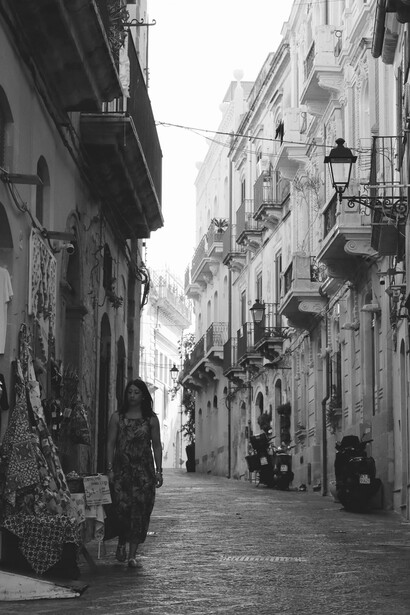
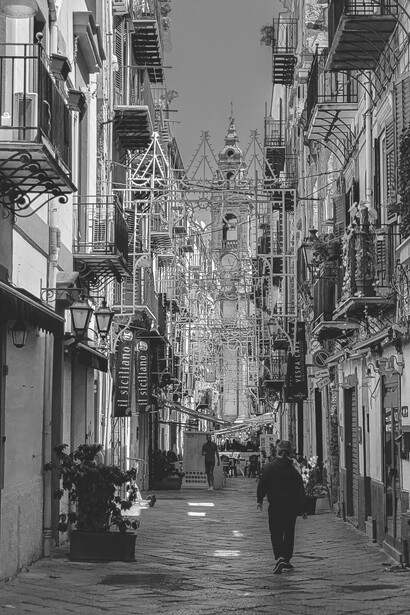
But the reality unfolded from the very first step off the plane. Inequality in Sicily is not hidden in statistics or historical archives—it shouts at you from every corner. On one side of the coast, luxury hotels with private beaches—locations of countless Hollywood films—stand in glaring contrast to sunburnt fishermen casting their nets for tomorrow’s market. By evening, the towns divide again: wine bars with three-digit price tags serve products likely made just 30 kilometers away, while across town, queues form outside church-run food banks.
The visual contradictions are endless. Seaside mansions dot the coast like monuments to wealth, while the inland countryside is scattered with abandoned houses—many of them uninhabited for decades, slowly decaying. And then it hits you: the mafia is not a cinematic myth; it is a deeply embedded structure—an echo of centuries of inequality, political instability, and economic abandonment.
We often think of the mafia as a relic of the past because the gunfights have subsided, and because tourists feel safe walking the streets. But is it really over? Or has it simply evolved?
From guns to governance
The classic image of the mafia—families warring in the streets, silencing dissent with violence—has largely disappeared. But the structures of power that enabled the mafia to thrive remain very much alive. The mafia today has upgraded. It’s more invisible, more embedded, and—arguably—more powerful.
What was once a turf war between clans has morphed into a more sustainable business model. Organized crime has matured. Drug trafficking, once rooted in the Sicilian ports, has expanded across Europe. Trade routes now link not just Italy but also France, Germany, and beyond. And the strategy? Shift the danger far from home. Move the production and violence elsewhere—Afghanistan, South America, the Balkans—so local populations are spared the bloodshed. It’s not unlike multinational corporations: extract wealth far from where you live, and reap the profits in peace.
But why settle for the streets when you can influence parliaments? Why use bullets when you can buy influence? The new mafia is no longer seeking to rule neighborhoods; it seeks access to power—politicians, institutions, even the EU apparatus.
Everyday mafia: embedded in systems
Today’s organized crime does not always wear a black suit or carry a gun.
It runs illicit pig-breeding operations, just as today we see agricultural monopolies exploiting EU subsidies, using loopholes to mass-produce livestock in unsanitary, unregulated conditions — often with political protection and at the expense of smaller farmers and public health.
It offers high-interest loans, not unlike the legal payday lending industry or microcredit schemes in marginalized communities, where interest rates can reach 300% annually. These businesses prey on poverty, often supported by banking deregulation or weak financial oversight.
It controls local markets, just as many multinational corporations dominate food supply chains, squeezing out local producers through predatory pricing and exclusive distributor agreements — often in collusion with municipal officials who turn a blind eye to anti-competitive behavior.
It wins municipal contracts, echoing the public procurement scandals in cities across Europe and beyond, where infrastructure, waste management, or construction tenders are granted through opaque processes, sometimes with political donations or "consulting fees" involved behind the scenes.
It capitalizes on privatizations, the way state assets—from transport systems to energy networks—are sold off to private companies at undervalued prices, often benefiting a narrow elite with political ties, while the public loses control over essential services.
It sits in the backrooms of real estate deals, just as urban gentrification is negotiated in private, displacing vulnerable communities and laundering money through luxury property developments—frequently with the silent complicity of mayors, notaries, and planning boards.
It controls energy tenders, not unlike how global oil, gas, and renewable contracts are awarded to firms with links to politicians or former ministers, often ignoring environmental risks or community consent.
It’s quiet. It’s clean. And it’s everywhere.
Only now, it often hides behind corporate logos, legal jargon, and PR campaigns.
And what of the institutions? Churches caught in corruption scandals. Politicians implicated in backdoor dealings. Law enforcement is underfunded or complicit. The system has not been cleansed—it has adapted.
Even morally, the lines are blurred. The poor, disillusioned by failed governments and crushed by generational poverty, are vulnerable to recruitment. They don’t necessarily condone violence, but in the absence of opportunity, adrenaline and survival take precedence. Respect for institutions fades when those institutions have failed you for decades.
The silent collapse: when poverty rewrites morality
There is a deeper architecture behind the quiet persistence of the mafia—a structure built not of guns and blood, but of neglect, political failure, and economic despair. The cycle begins with poverty, which remains entrenched across large parts of southern Italy. When poverty persists long enough, it begins to erode the foundations of social trust. Without stable employment, without reliable public services, without safety nets, people grow disillusioned—not only with politicians, but with the very idea that the system could ever serve them.
A poor political regime only reinforces this. Corrupt or incompetent governance fails to address the root causes of inequality and, instead, often benefits from maintaining the status quo. Stability—both economic and institutional—becomes elusive. What fills the vacuum is not hope, but fear. Not community, but competition. And eventually, when people feel completely abandoned, they begin to rewrite the rules of morality just to survive.
In that space, crimes no longer feel like crimes. They become a means of coping, of feeding a family, of asserting control in a world that otherwise offers none. Political distrust transforms into moral confusion. A stolen contract, a silent bribe, a “favour” exchanged for silence—these acts become normalised. Social activity diminishes. Civic life disappears. And with it, the possibility of collective resistance or solidarity.
People are left alone, confused, and anxious—not about ideals, but about survival. When the state feels like a fiction, the alternative powers—the criminal networks—start to look like the only ones capable of offering structure, loyalty, and even justice.
This is not unique to Sicily. It is a global pattern. But Sicily makes it visible, traceable through centuries of colonial conquest—by the Arabs, Normans, Spanish, Bourbons, and eventually the Italian state itself—each imposing systems of power without ever investing in local sovereignty. The island became an afterthought. And in that vacuum, alternative structures grew.
The mafia didn’t invent this system. It merely inherited it.
The cycle continues
Sicily’s modern reality is not so different from its past. Poverty breeds crime. Political instability erodes trust. A lack of education makes manipulation easier. The absence of social activity creates isolation. These aren’t just conditions for mafia growth—they are the very soil in which it continues to thrive.
And in the end, one thought remains: it is easy to dream of a better life when you are safe.
But in Sicily—as in many parts of the world—safety is a luxury, not a given. And where there is insecurity, inequality, and power vacuums, there will always be someone willing to fill them.
The mafia, it seems, never left. It simply learnt how to blend in.