English
 Español
 Français
 Deutsch
 Italiano
 Português
We are the quiet daybreak paling the dark lagoon. We are the shadow-ghosts creeping back as the campfire burn low.
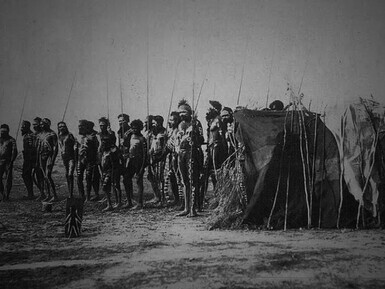
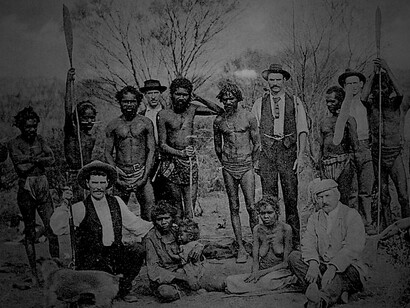
So wrote Oodgeroo Noonuccal, mourning the oldest continuous culture on Earth, and one that would be shattered by a peculiar kind of warfare that Australians still struggle to acknowledge. When the British First Fleet arrived at Botany Bay in 1788, it inaugurated not just a colony but a century of frontier violence that would kill tens of thousands and birth a nation in blood rather than glory.
This wasn't war as Europeans knew it. There were no armies, no declarations, and no diplomats crafting peace treaties. Instead, Australia's founding violence unfolded in the isolated scrublands and pastoral districts, largely unseen by urban populations in Sydney and Melbourne. It was private, intimate, and fluid—following patterns that emerged from the collision of two utterly incompatible worldviews.
What made this violence particularly insidious was how it radicalized over time. Far from starting from a departure point of maximal violence, they ebbed and flowed in their rhythm of conflict, escalating sometimes, intensifying, and then transforming as legal doctrines, economic pressures, sexual violence, and cultural misunderstandings compounded into something increasingly apocalyptic for Aboriginal peoples across the Australian frontier.
Understanding how and why this happened reveals uncomfortable truths about how seemingly rational systems—that of property law, pastoral economics, and reciprocal justice—can spiral into catastrophe when imposed across deep cultural divides.
The legal fiction that made everything possible
Before the first shot was fired, before the first spear was thrown, the violence was already encoded in law.
In 1835, New South Wales Governor Richard Bourke officially declared Australia terra nullius—"land belonging to no one." It was a radical legal innovation that set Australia apart from other British colonial projects in the extremity of its legal overreach, even by the standards of its time.
In North America and New Zealand, the British Crown at least nominally recognized Indigenous land ownership and proceeded through treaties and exchanges. These were often violated, certainly, but the framework acknowledged that someone had been there first, with rights that required negotiation.
Australia's Terra Nullius doctrine was different. By asserting that Aboriginal Australians had no property rights because they hadn't "improved" the land through European-style agriculture, the entire continent was declared legally vacant. The Crown became both sovereign and landlord in a single stroke. As historian Henry Reynolds argues, "The Aborigines lost at one and the same time their right to exercise authority over their territory and their customary title to the land."
The implications downstream from this legal declaration were staggering. There was no need for treaties, no framework for negotiation, and no legal mechanism for Aboriginal people to assert claims. Settlers pushing into the interior believed, because the law told them so, that they were moving into empty land. Aboriginal people defending their territories weren't enemy combatants in a recognized conflict; they were merely criminals interfering with legitimate settlement.
This legal framework sanctioned private violence. Squatters and pastoralists could venture far ahead of government control, claim whatever land they wanted, and use whatever force necessary to clear it of "trespassers." The killing became decentralized, privatized, and largely invisible to official record-keeping. When records were kept, they were often deliberately destroyed, such as in the case of the Native Police archives in Queensland, which were burned.
Terra Nullius wouldn't be overturned until 1992's landmark Mabo v Queensland decision. For over 150 years, it provided the philosophical foundation for treating Indigenous resistance as criminal rather than political, making massacre legally defensible as the "dispersal" of troublemakers.
The land itself as a radicalizing force
If Terra Nullius set the legal conditions, the land itself, or rather, how Europeans chose to exploit it, determined the intensity of violence.
The Australian frontier wasn't uniform in its brutality. Coastal farming districts often saw more accommodation and negotiation. But pastoral regions—the vast grasslands of the interior beyond the Great Dividing Range where sheep and cattle ranged—became killing zones. Mining districts would prove the most bitter zone of conflict of all.
The pattern reveals how economic incentives shaped violence more than simple racism. Though racial animus was omnipresent, the specific form and intensity of conflict followed the contours of resource extraction.
The pastoral catastrophe
From 1812 onward, once Australian wool proved profitable in English mills, venture pastoralists flooded into the colonies. Many arrived with just enough capital to run a tiny herd. They pushed far beyond official settlement boundaries, squatting on land they claimed under Terra Nullius.
What made pastoralism particularly devastating was its ecological impact. Sheep and cattle befouled traditional water sources. Degrassing and herd-induced climate change destroyed native food sources. By 1830 in Van Diemen's Land (Tasmania) alone, over one million sheep grazed within half a million hectares—more than all of New South Wales at the time.
For Aboriginal peoples, the arrival of herds heralded ecological apocalypse. Traditional food chains collapsed. Starvation drove desperate raids on livestock and crops. Each raid triggered overwhelming retaliation. The pattern repeated endlessly: environmental destruction leading to Aboriginal resistance leading to settler massacre.
The violence had a terrible predictability to it. As settler-politician Edward Curr observed, "The meeting of the Aboriginal tribes of Australia and the White pioneer results as a rule in war, which lasts from six months to ten years, according to the nature of the country, the amount of settlement which takes place in a neighborhood, and the proclivities of the individuals concerned.”
Everyone knew how this story ended. The only variable was how long it took.
The farming exception
Coastal farmland presented a different dynamic. Where intensive agriculture dominated, Aboriginal labor was economically valuable. Farm owners made deals with local tribes about land use. One Queensland pioneer in 1861 explained he'd negotiated that he was "master on the open ground and they were masters of the scrub and the mountains."
Economic interdependence provided a brake on violence. You don't massacre people whose labor you need. The frontier could be brutal, but it wasn't uniformly apocalyptic.
The mining hell
Then gold was discovered in 1851 in Victoria.
Mining districts experienced the most extreme violence because miners had zero incentive to accommodate Aboriginal people. They arrived en masse, polluted waterways with their fossicking, subsisted entirely on factory-produced food from the cities, and had no use for Aboriginal labor or field knowledge.
The journey to the Palmer goldfield in Queensland was described as "a warpath on which every white man risks his life." The advice to miners was blunt: "Shoot, and shoot straight, otherwise he will certainly spear you."
In monsoonal regions, the dry season forced miners and Aboriginal people into direct competition for dwindling water. In 1873 at Gilberton, Queensland, violent competition for water and the massacre of a Chinese mining party created such panic that the town was abandoned, belongings burned in the street.
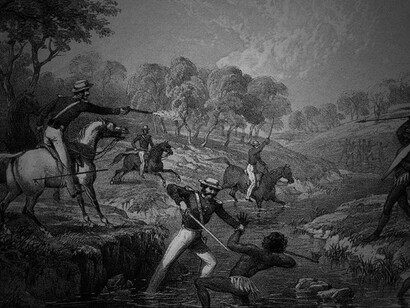
The violence in mining districts was so intense and widespread that it ultimately led to the creation of Queensland's Native Police forces—Aboriginal men recruited to hunt other Aboriginal people—who, from the 1880s, waged campaigns of deliberate extermination. Recent scholarship suggests over 60,000 violent Aboriginal deaths on the Queensland frontier alone in the late 19th century: coincidentally, the same number as Australian casualties in World War I.
Sex, reciprocity, and the spiral of revenge
But geography and economics don't fully explain the escalating brutality. Cultural collision, particularly around sex and concepts of justice, created its own accelerating dynamic.
The convict factor
Early Australian settlement had a perverse demographic problem. The colony was built on convict labor; urban criminals were shipped to the other side of the world, overwhelmingly male and young. In Van Diemen's Land in 1822, the ratio of convict men to women was 16:1. Overall, there were six times more men than women in the colony.
These men, already brutalized by the British penal system, worked as shepherds and laborers far from settled areas. They were often unarmed, isolated, and sexually frustrated.
The rape and abduction of Aboriginal women became endemic. The mistreatment of their women often drew violent responses from Aboriginal men—warriors whose culture emphasized male protection of women and who felt profoundly emasculated by their inability to stop the sexual violence.
The Hobart Town Gazette reported in 1819 that "a native woman, supposed to be the wife of a chief, had been maltreated by two of the stock-keepers; that she escaped after much ill-usage; and that the tribes returned and attacked," seriously injuring the two white men.
This pattern of sexual violence followed by revenge attack followed by overwhelming settler retaliation repeated across the continent. And crucially, it resulted in an increasingly disparate and lopsided outcome for the diminishing Aboriginal populations.
The kinship trap
But the sexual dynamic was even more complex. Many Aboriginal tribes used sex as diplomacy, offering women to create kinship networks between tribes and with whites. Settlers were often offered sexual access without understanding they were being enmeshed in "an intricate web of kinship."
By accepting what they perceived as casual sex, settlers unknowingly entered reciprocal relationships where food, tools, and ongoing obligations were expected. When these weren't provided, Aboriginal men felt betrayed by broken kinship bonds.
M. Moorehouse, official Protector of Aboriginals in South Australia from 1839 to 1856, noted how "Natives seem to claim a liberal and constant supply of food, and in case it is not given, they do not hesitate to use violence in obtaining it." Aboriginals on the New South Wales Riverina protested "the Europeans promising the Aborigines food, clothing, and tomahawks for the use of their females, but the Europeans did not fulfill their promises."
Cultural misunderstanding around sex created endless cycles of perceived betrayal and violent retribution on both sides.
When reciprocity breaks down
The most devastating cultural collision, however, involved the concept of justice itself.
Aboriginal warfare operated on principles of reciprocity and proportionality. If harm was done to an individual or group, the injured party had the right, and indeed, the obligation, to exact equivalent revenge. As anthropologist William Lloyd-Warner observed with the Murngin of Arnhem Land, "If harm had been done to an individual or a group, it is felt by the injured people that they must repay the ones who have harmed them by an injury that at least equals the one they have suffered."
This created an action-reaction dynamic where European settlers who killed Aboriginal people or violated their customs were marked for death. One Western Australian settler wrote in 1833 that "the doctrine of taking life for life seems perfectly established, and they avow their determination to act upon it."
Reciprocal killings could take months, even years, to eventuate. Settlers lived knowing they were being watched and tracked. One "old Waterloo man" who shot an Aboriginal shepherd was stalked for a year before being fatally speared when he absent-mindedly put down his musket to tie his shoes.
However, here's the catastrophic problem: European settlers didn't reciprocate in proportion. They retaliated with overwhelming, indiscriminate force against entire tribal groups.
The 1835 Battle of Pinjarra, where settlers slaughtered the Bindjareb Noongar people, resulted in what the Western Australian Advocate-General called the "complete annihilation" of Aboriginal concepts of proportional violence. Settlers demonstrated they would massacre entire communities in response to individual attacks.
This shattered Aboriginal assumptions about how conflict worked. As historian Henry Reynolds argues, "For the groups in question, the constraints of custom had been circumvented; they had moved from feud to warfare." Skin color became the primary enemy identification. The limited, reciprocal violence of traditional Aboriginal conflict transformed into total war.
The radicalization of Aboriginal resistance
There has, at times, been a pernicious myth regarding the colonization of Australia that Aboriginal peoples didn’t—or simply were incapable of—putting up armed resistance. That, following the natural rules of nature and a particularly warped interpretation of Darwinism, they were doomed to fade out from existence as a non-competitive race of people.
But Aboriginal people didn't passively accept dispossession. Resistance was fierce, organized, and sophisticated—but it also radicalized dramatically as traditional approaches failed against an enemy who refused to play by recognizable rules.
Initially, Aboriginal groups tried to use their own customs of limited warfare—ambushes, raids on livestock, and targeted killings—to drive specific settlers away. These tactics had successfully regulated inter-tribal conflict for millennia.
But from the 1840s onward, something changed. The violence intensified, became less discriminate, and increasingly desperate.
The 1857 Hornet Bank and 1861 Cullinlaringoe attacks in Queensland demonstrated this shift. At Cullinlaringoe, the rape and murder of the Fraser family women—highly unusual in Aboriginal warfare—was a deliberate "political act" responding to the systematic rape and abduction of Aboriginal women by Fraser family employees.
At Hornet Bank, Aboriginal war bands sent their women and children to safety and coordinated between multiple tribes, with other tribes over a hundred miles away aware of the operation and "rejoicing immediately" when news of success reached them. In January 1858, several hundred warriors ambushed a Queensland Crown Commissioner and his party at night. This was organized military action on an unprecedented scale.
On the Mooney River in 1843, besieged shepherds were told by their attackers they would "kill or drive all the white fellows off the Mooney, McIntyre, and Barwon Rivers."
This was no longer a limited conflict over specific grievances. Aboriginal resistance had radicalized into a war of extermination to drive out all Europeans by any means necessary.
The last weapon: magic as resistance
As physical resistance increasingly failed, Aboriginal people turned to their final and most powerful weapon: sorcery.
In Aboriginal culture, magic was "as significant as physical confrontation" in warfare. It inhabited a place of utmost importance as the ultimate deterrent. It was, in essence, the apocalyptic option.
Following clashes around Port Phillip in 1840, Aboriginal elders channelled their anger into magic to unleash "the horrifying power of Mindye, the rainbow serpent, on the whites." Aboriginals fled the region, abandoning work on local farms. Mindye would rise "to sweep off the Port Phillip blacks and all the whites" in retribution, visiting the same pestilence upon settlers as smallpox had visited upon Aboriginal people.
In Adelaide in 1849, Aboriginals fled en masse after a comet appeared: "the harbinger of all kinds of calamities, and more especially for white people. It was to overthrow Adelaide and destroy all Europeans and their houses."
Corroborees ran entire weeks, featuring intricate role-playing of armed Europeans and cattle, culminating in rituals where a figurative water spirit would "devour all the 'European' dancers while the destructive magic was directed out in all directions to kill the settlers." "Rain stones" were cast into fires to create drought that would kill European herds so "the white fellows would go away again, and then, as long ago, the Blackfellows' country would have plenty of emu and kangaroo."
These apocalyptic rituals mobilized "the most potent magic available" to dying tribes. When strength of arms failed, when the land was mostly taken, the last resort was to turn to the deepest cultural power they possessed.
The magic failed. The Europeans didn't disappear. The old world was gone, and the new was being born from the violent logics of colonization.
Best we forget?
The Australian frontier wars killed at least as many people as Australia's celebrated overseas military campaigns. Yet while every ANZAC death at Gallipoli is meticulously recorded and memorialized, there's no official monument to frontier violence. Many Australians remain uncomfortable even acknowledging it happened.
This discomfort has generated what's called the "History Wars"—an ongoing debate since the early 2000s between historians who view colonization as fundamentally progressive (the "White Armband" view) versus those who see it as "the war that made the nation" (the "Black Armband" view).
Conservative historian Keith Windschuttle argued that British "Christian faith and civilization's fidelity to the rule of law" excluded the possibility of systematic massacre. Prime Minister John Howard wanted Australians to feel "comfortable and relaxed" about their history.
But the evidence suggests something far more troubling: that legal frameworks, economic incentives, cultural misunderstandings, and demographic realities combined to create escalating violence that neither side initially intended but which became increasingly difficult to stop.
Terra Nullius created the legal permission structure. Pastoral economics created the ecological pressure. The convict gender imbalance created sexual violence. Cultural concepts of reciprocity clashed catastrophically. And Aboriginal resistance, initially limited and targeted, radicalized into total war as traditional approaches failed.
Each factor fed the others in a self-reinforcing cycle. The violence didn't begin at maximum intensity but rather escalated to it, driven by forces that transcended simple racism into something more systemic and more terrifying: rational actors following their incentives within structures that made catastrophe nearly inevitable.
Perhaps this is why Australia remains so uncomfortable with this history. It's easier to blame individual racist settlers than to acknowledge how entire systems of governance, be they property law, market economics, or cultural frameworks of justice, can interact to produce mass violence even among people who might not have individually chosen it.
The Aboriginal poet Oodgeroo Noonuccal wrote, "The scrubs are gone, the hunting and the laughter. The eagle is gone; the emu and the kangaroo are gone from this place. The bora ring is gone. The corroboree is gone. And we are going."
But Aboriginal people didn't go. They survived, barely, this century of escalating violence and the reserves, stolen generations, and systematic discrimination that followed. Today, they're demanding Australia finally reckon with how the nation was actually made: not in the trenches of Gallipoli, but in the isolated gullies and grasslands where a legal fiction, an economic system, and cultural incomprehension combined into catastrophe.
Sources
Bain Attwood and Tom Griffiths, Frontier, Race, Nation: Henry Reynolds and Australian History (North Melbourne, Vic.: Australian Scholarly Pub., 2009).
Henry Reynolds, Forgotten War (Kensington, NSW: New South Books, 2013).
Henry Reynolds, The Other Side of the Frontier: Aboriginal Resistance to the European Invasion of Australia (Sydney, NSW, Australia: University of New South Wales Press, 2006).