English
 Español
 Français
 Deutsch
 Italiano
 Português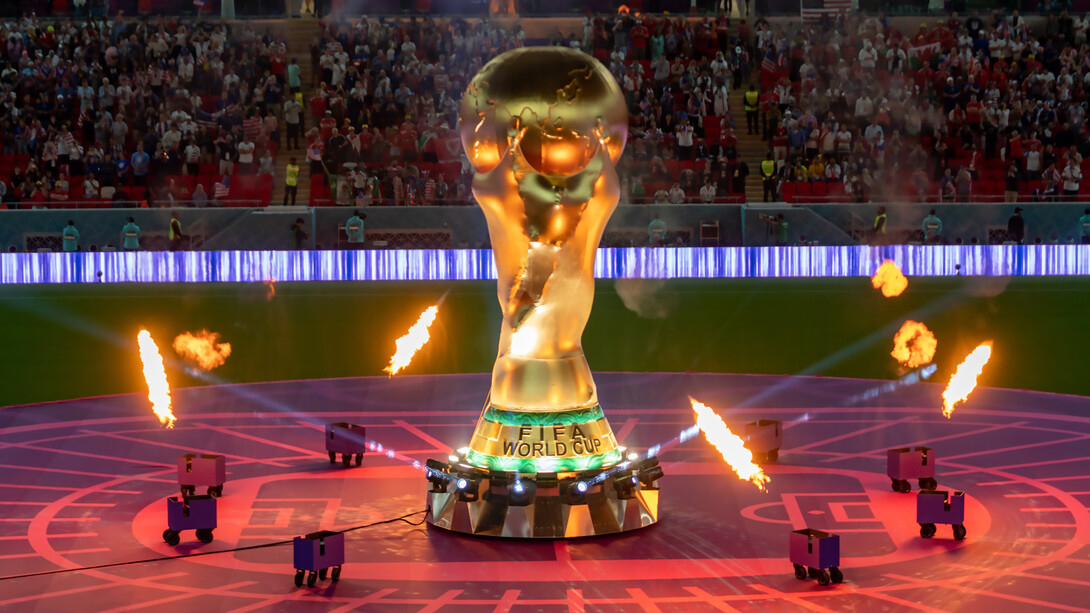
I think my oldest memory of watching sports on TV was in the late 1980s. I was at my uncle's house, I think; his family lived in Krugersdorp. The old government was still very much in control of the airwaves. The only sports you were allowed to watch on TV were rugby and cricket; that meant watching South African teams competing against South African teams. At that time, South Africa was very much a pariah state, and this meant that expressing the virtues of apartheid through the medium of sport was simply not an option.
However, on this specific occasion, we weren't watching rugby or cricket. Rather, we were watching a match of football match. Liverpool, if I remember correctly. More than the match, I remember the experience. The after-braai blur of family get-togethers, my uncle and my father with empty Castle bottles littered through the house. And a large CRT TV, its blurry, pixelated image broadcasting through an aerial catching a signal from Bophuthatswana, one of the homelands that was created by the old government. It was the only way for South Africans to watch English football. Again, the old government was still in control of the airwaves. Mostly. By this time, cracks had begun to form, and control was being eroded.
Ultimately, no matter how authoritarian a government, no matter how much control it may exert over the population, sometimes, things just slip through. And while something as simple and as innocent as a football match may seem, especially to today's viewpoint, it meant the system was not in fact as in control as it would like its populace to believe. And for a totalitarian system such as apartheid, the slipping through of pixelated forms of white men kicking a ball can realistically cause the whole house of cards to collapse. Because at that time, it wasn't only white men. Some people were not white. Playing the sport at the highest level. This ran counter to the central myth of the nation. And that is why sport was so carefully cultivated and controlled. It was but another tool in the toolset of power.
Born in blood
Sport, from its inception, has always been part of the language of power. In fact, sport has long been an effective means of projecting power before the blood and guts reality of war needs to take place. A highly useful way of being able to predict the victors of war without the bloody pay cheque of war itself. If we look at most early civilizations, each had its own projection of power, utilizing sport as its means of spreading the message of the strength of said civilization. And this was particularly true with the advent of the Olympics. What better way to get young men of military age ready for conflict than to get them playing sport?
And this became even more true by the time that Europe rebirthed the Olympics. It was not by accident that the Olympics, football associations, and WWI happened to all align. The Industrial Revolution had a very negative effect on those most likely to fight wars: poor, working-class, and urban young men. The lack of physical exercise meant that these young men were not at all suitable to be put into the meat grinder. England learnt this firsthand with its experience in the Anglo-South African wars and was able to put this experience to good use by the time WWI started.
This can be most easily seen with the young men signing up for war through various local football clubs. It can even be seen in the names associated with clubs. Take Arsenal as an example; that cannon isn't there just because it looks cool. It's evidence of the formation of the club itself, formed by workers at the armaments factory in Woolwich, manufacturing weapons to be used by the empire, a metaphorical projection of power, birthed in the literal projection of power. Or perhaps, take Liverpool's famous Kop End, named after the Battle of Spion Kop, which took place during the Second Anglo-Boer War.
Raised on violence
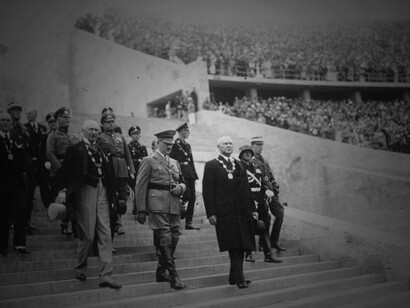
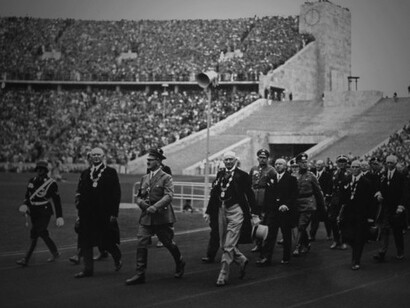
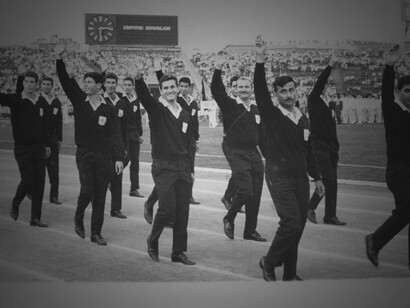
The relationship between war and sport grew as the 20th century progressed. The Nazis took full advantage of this and, in 1936, used the Olympics as a platform to advertise their ideology of superiority. This can clearly be seen as a success, as German athletic superiority was put on display in the medals table, winning 101 medals, with the USA a distant second with 57. Ultimately, this didn't turn out great for Germany, and the scoreboard of WWII would ultimately be the reverse of the Olympics medal table.
This trend of using sport as a platform to broadcast an ideology or to display perceived superiority continued into the 20th century, as WWII ended and the Cold War began. While the USA and USSR quite happily used smaller nations around the world to flex their muscles and attempt to gain dominance, they also used the Olympics and ice hockey as other battlefields. Of course, these two nations were not the only ones to take advantage of sport as a means to broadcast ideology.
The apartheid government wanted to do much the same, using athletics, cricket, and rugby as their sports of choice for showing off just how successful their approach to organizing and structuring a society was. However, the international community quite rightly refused to allow sport to be a platform to advertise a system such as apartheid. By the 1970s and 1980s, South Africa had been banned from participating in most sports on an international level. Luckily, the story has something of a happy ending. This is due to the fact that sport, in the form of rugby, once a tool of oppression and division, came to be a unifying force and quite possibly helped prevent a civil war in South Africa.
The opportunity to compete again at an international level after the end of apartheid was a huge source of pride for the nation. Winning the Rugby World Cup in 1995 and witnessing Mandela raise the trophy with Francois Pienaar gave a divided nation a shared myth of success. It was something the whole nation was able to share for the first time in almost a century.
Bought with wealth
In the 21st century, we are living through a new age of sports as a means of expressing power. Organizations such as the IOC and FIFA are very powerful tools for regimes around the world to legitimize their systems or to reframe how they are perceived internationally.
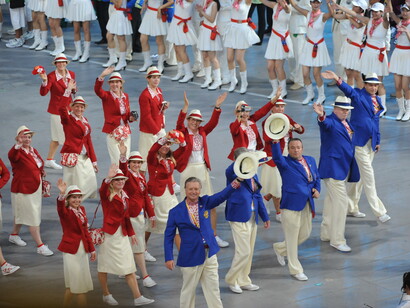
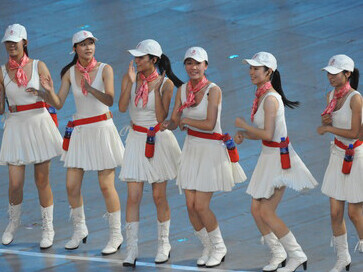
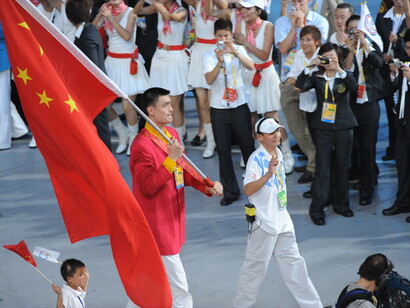
In 2008, China skilfully used the Olympics to show off its new position on the world stage. No longer merely a participant, China was beginning to view itself as a competitor and soon would seek to take the number one spot held for so long by the USA. Going by the medals table, the USA came out first with 112 medals, with China not far behind with 100. China had caught up to the USA at such a rate that it would not be long before having to ask who was in first place, and not just in a sporting sense.
Taking the relationship between power and sport a step further, it is no surprise then that the three most successful nations in the Olympics also happen to be the three biggest spenders in terms of their military.
Then there is FIFA
In the 21st century, FIFA became a mouthpiece for nation-states to advertise their nation on the world stage. A mouthpiece that was clearly for sale to the highest bidder. From very early on, FIFA became compromised and has, for decades, been a tool for making money through not entirely legal or ethical practices. This came to a head with the jailing of FIFA officials. Sadly, money buys justice, and it is unlikely they will ever face real justice.
In the 21st century, FIFA really got down to business, working for authoritarian regimes looking to clean up their international image in the best way possible, with well-paid footballers kicking a ball around for fans around the world to play in the paddling pool of patriotism, a nice gateway drug for out-of-control nationalism.
Where are we going from here?
That brings us to today and tomorrow. In the current climate, it does feel as though the world is taking in a deep breath in preparation for something incredibly ugly. The USA is imploding into an authoritarian regime run by extreme nationalists, opportunists, and proven criminals. Corruption is rotting the core of almost every level of global society. Billionaires are buying our futures and, in return, are making us all digital serfs, tied to digital land, trading our lives for things we will never own. Europe is tearing itself apart over complex issues such as immigration and identity.
The war in Ukraine is still ongoing without any real end in sight. The war in Palestine is ongoing, regardless of any ceasefire. Africa has had a regional conflict in the DRC that no one outside of the continent seems to care about. The USA has been illegally blowing up boats from Venezuela with no consequence. And China is standing on the sidelines, building roads and railways around the world, buying up mines and resources, all while watching Taiwan and waiting.
But don't worry about any of that; next year is the Football World Cup in the USA, Mexico, and Canada. It's time to put on the shirt of the team you support and be ready to draw blood for them. Why worry about AI and climate change? Why worry about geopolitical trends that seem to indicate the potential death of democracy as an experiment in equality? You can play the latest EA game and escape all the messy complexity of a world falling apart. You can be the hero in your own tiny little virtual bubble.
Because if sport, blood and guts physical metaphors for patriotism and nationalism, and war minus the killing can be used as a means of projecting power and projecting status on the global stage, well then, video games are just as much a very useful tool. Perhaps even more so.
Hitler and Goebbels looked at Hollywood with envy for its function as a means of propaganda. Hollywood is dying, if it is not dead already. The new medium is games. And the one that controls the message in the games can control the mind of the consumer of that message.
Conclusion
We know there is a way to get bad actors out of sports. We know there is a way to prevent the messages of these bad actors from getting the loudspeaker of attention. The world knew that apartheid was wrong. The world collectively stood up and said, You cannot play with us. You cannot use sports to project your sinister message to infect the hearts and minds of people.
When Russia invaded Ukraine, the same action was taken.
We know how to diffuse the ability of sport to provide a platform for bad actors. We just need to act on it. However, wealth can quite easily get in the way of doing what is right. And wealth corrupts. And corruption is cancer. If an organ is infected, it needs to be cleansed. If it is not, the body will die from the spread.
By allowing bad actors to buy the loudspeakers of sports or video games, we allow them to place their message directly into the minds of others.
In the 1980s, John McEnroe was offered a huge amount of money to play in South Africa; here is what he said:
“It felt wrong. This was an unbelievable amount of money at the time, but there's a reason they're offering it. Because they wanted to use that propaganda, and I wasn't going to be a pawn."