English
 Español
 Français
 Deutsch
 Italiano
 Português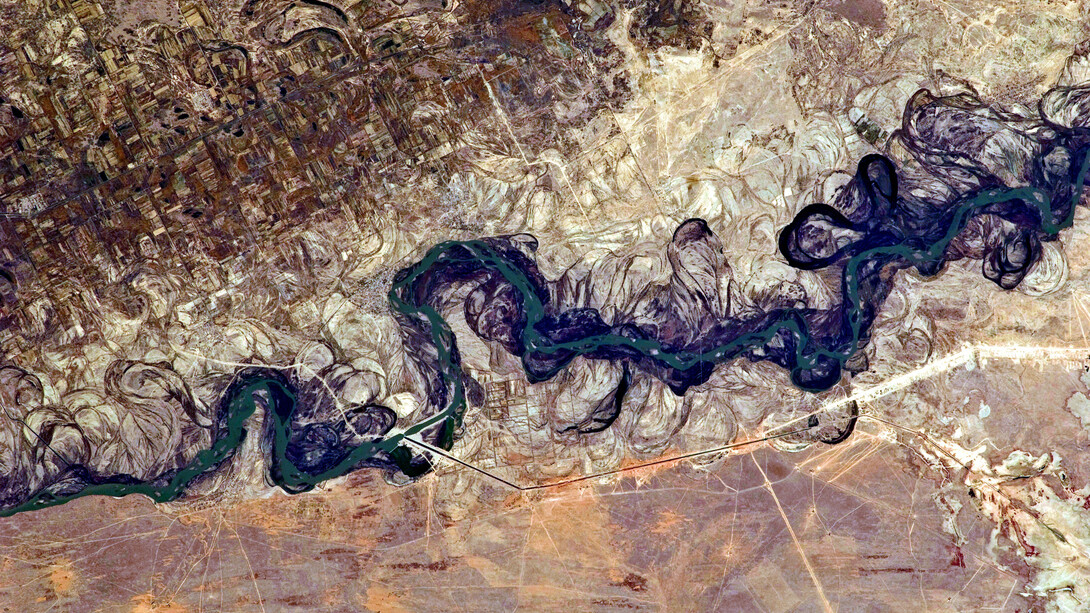
In Central Asia, power flows through rivers as much as through pipelines. Sovereignty here is not measured only in borders or constitutions, but in the ability to command water. From the glaciers of the Pamir to the sands of the Karakum, rivers provide electricity, support agriculture, and serve as a foundation for political power. Fuel scarcity disputes, dams turning into bargaining chips, and every canal, even the smallest one, are strong reminders that the flow of rivers for Central Asian republics is never purely natural but always political.
The Soviets were well aware of this. Moscow united the republics into a unified economic entity by rerouting the Syr Darya and Amu Darya into a complex network of canals, dams, and reservoirs. Water served as a planned economy's circulatory system in Uzbekistan for cotton, Kyrgyzstan and Tajikistan for hydropower, and Kazakhstan for grain. This network broke up into separate, independent parts when the USSR fell apart in 1991. For the first time, managing water resources became a political issue as well as an economic one.
After thirty years, Central Asian hydropolitics has developed into a geopolitical battlefield. Megaprojects like Kyrgyzstan's Kambarata hydropower facility or Tajikistan's Rogun Dam are displayed by upstream republics as symbols of their independence. States downstream worry about their social stability and food security. External forces vie for control of this most valuable resource, including the European Union with its hydrogen projects, China with its Belt and Road, and Gulf nations with farmland leases. Once the judge of regional harmony, Russia now finds it difficult to maintain its power.
Although oil and gas garner international interest, the region's sovereignty is defined by its water. Rivers are becoming the unspoken currency of global politics in Central Asia.
USSR legacies and post-Soviet fragmentation
The Soviet experiment is at the heart of Central Asian hydropolitics. Rivers were not just natural resources to Moscow; they were also tools for integration and administration. An intricate network of irrigation systems, reservoirs, and canals united the republics into a unified economic entity by the middle of the 20th century. With their rivers and glaciers, Kyrgyzstan and Tajikistan were entrusted with storing and releasing water; Uzbekistan and Turkmenistan were entrusted with producing cotton, while Kazakhstan provided grain. Coordinated from the center, the system was more of an asymmetrical hierarchy than an arrangement among equals.
Although this approach produced results in the short term, it came at a great political and ecological cost. One of the most spectacular environmental disasters of the 20th century resulted from the diversion of the Syr Darya and Amu Darya, which drained the Aral Sea. The wider meaning, however, was geopolitical: Moscow showed that it could enforce interdependence by controlling the most vital component for survival. Water became a tool of imperial order and an essential instrument for the achievement of the five-year plan.
With the collapse of the Soviet Union in 1991, that order unraveled. All of a sudden, five independent states had to renegotiate the coordination that had previously been handled from Moscow. A technical system turned into a political boundary. The headwaters provided Kyrgyzstan and Tajikistan with additional leverage. Upstream control was seen as a direct threat to Turkmenistan and Uzbekistan, whose economies depended on steady flows. Kazakhstan, more diversified, positioned itself as a mediator but remained vulnerable to regional instability.
The concept of hydro-sovereignty, the belief that controlling water resources was essential to claiming independence, arose in this setting. In addition to infrastructure, dams and reservoirs came to symbolize statehood. Seasonal flow negotiations revealed a well-known security conundrum: upstream releases optimized for energy security downstream undermined food security, and vice versa. Regional governance's shortcomings were exposed by institutionalization initiatives, such as the 1993 establishment of the International Fund for Saving the Aral Sea. Bilateral bargains—water traded for gas or electricity—were ad hoc fixes, not durable regimes.
The early international relations of the region were influenced by this fragmentation. In addition to serving as technical mediators, the World Bank and UNDP's entry demonstrated that the politics of water were a global problem. Although it was no longer hegemonic, Russia remained involved; its influence had to contend with the newly independent republics' aspirations to sovereignty. Almost immediately, what had been an internal Soviet resource regime was the focus of exterior diplomacy and regional order.
The paradox became evident by the end of the decade. The rivers that formerly functioned as a planned empire's circulatory system were now disputed territorial boundaries. Water was not depoliticized by the Soviet legacy; rather, it engendered structural rivalries that still influence foreign relations in Central Asia.
The new great game of water
If the 1990s were characterized by disarray and negotiating between the five republics, the following decades have shown a more profound truth: water in Central Asia is no longer only a regional problem. It has evolved into a platform for global competition, a new "Great Game," where outside nations vie for influence through dams, canals, and hydroelectric plants rather than troops and treaties.
For upstream states, megaprojects remain at the center of this contest. Tajikistan’s Rogun Dam, which is expected to be the tallest in the world, is portrayed domestically as a symbol of triumph and sovereignty, but externally it is a magnet of regional anxiety, being a source for foreign finance and competition. At the same time, Kyrgyzstan’s Kambarata complex, stalled for decades, has been revived with a mixture of Russian, Chinese, and international backing. These projects are not only technical solutions; they are bargaining chips in regional diplomacy and invitations for external patrons to extend influence.
The bargaining power of water and its increasing capacity to shape politics in the region are clear-cut when considering the case of Uzbekistan. Long the most vocal critic of upstream dams, the country has recently recalibrated its approach. Under President Shavkat Mirziyoyev, Tashkent has shifted from confrontation to cautious engagement, seeking cooperative arrangements while simultaneously modernizing irrigation networks. The realization that the politics of water can no longer be settled by isolation is reflected in this turn. It necessitates negotiating with both international partners and neighbors.
Among these international actors, China looms largest. The elephant in the room, the Belt and Road Initiative, brought massive investments extending well beyond transport corridors: Beijing has financed hydropower plants in Kyrgyzstan, irrigation modernization in Uzbekistan, and the nearly completed China-Kyrgyzstan-Uzbekistan railway that will double as a corridor for agricultural (and not only) exports. In Kazakhstan, Chinese firms have partnered with local authorities on projects to produce green hydrogen, an initiative that relies as much on a secure water supply as on wind and solar potential.
The European Union, especially as a consequence of the war in Ukraine, eager to diversify away from Russian hydrocarbons, has turned to Central Asia not only as an energy partner but also as a site for renewable innovation. Though more cautious than other external superpowers, In 2023 Brussels signed important memoranda with Kazakhstan and Uzbekistan to explore joint hydrogen and clean-energy ventures. These projects, while framed in terms of climate goals, are equally about geopolitics: ensuring European stakes in the region’s resource networks before others consolidate control. At the same time, new actors like the Gulf states, once at the border of the political regional chessboard, driven by anxieties about their own food security, have leased farmland in Kazakhstan and Uzbekistan, linking Central Asian rivers directly to Middle Eastern food chains.
What emerges is a landscape often described as a “new Great Game.” Yet unlike the nineteenth-century rivalry fought over barren steppe and mountain passes, today’s contest unfolds around dams, reservoirs, and irrigation networks. Pipelines and canals serve the same function that railroads and garrisons once did. For Beijing, Brussels, Moscow, and the Gulf alike, securing influence in Central Asia increasingly means securing access to its “blue gold.”
Water, nation, and narrative
If external actors have transformed water into a geopolitical prize, domestic leaders have used it as a political language. In Central Asia, rivers, lakes, and canals serve as more than just practical features; they are also emblems that governments use to express their legitimacy, sovereignty, and sense of national destiny. The stories about megaprojects make this the most evident. The Rogun Dam in Tajikistan is hailed as a symbol of freedom as well as a technical marvel. It is used in official speeches as evidence that Tajikistan can control its resources and determine its own destiny in spite of poverty and conflict. Similarly, Kyrgyz rhetoric around the Kambarata hydropower complex presents the dam as a bulwark of sovereignty, a project that will anchor national development. These discourses reveal how infrastructure becomes nation-building: concrete and steel are recast as symbols of resilience.
Water has played an equally important role in identity downstream. Uzbekistan's reputation as an agrarian powerhouse, which was a holdover from Soviet planning, has long been linked to its reliance on cotton. Reforms in the sector under President Shavkat Mirziyoyev are portrayed as a moral break with the past: updating irrigation, diversifying crops, and lowering the use of forced labor are not simply economic measures but also assertions of a more autonomous and just country. The Northern Aral Sea's partial recovery has been welcomed as a national victory in Kazakhstan. The Kokaral Dam, which was constructed with foreign assistance, is presented as proof that the nation can stop its slide by successfully combining diplomacy with sovereignty.
Additionally, water acts as a conduit for social legitimacy. Access to irrigation or drinking water is frequently the focal point of local protests, which portray shortages as a violation of the state's obligation to safeguard its citizens. Disagreements over water distribution can swiftly turn into political disagreements in rural regions where irrigation is a major source of income. Governments are well aware that their authority is compromised if they are unable to meet this fundamental need.
The symbolic weight of water extends into regional politics. References to shared rivers are used to signal cooperation or solidarity, while disputes over dams and flows reinforce narratives of national victimhood. In addition to discussing policy, leaders use rivers in their speeches to place their nations in the larger regional order, whether as defenders of downstream survival, upstream sovereignty, or mediators looking for equilibrium.
For international observers, these narratives matter. They explain why water projects often receive disproportionate political attention compared to their economic output. A dam is not just megawatts; it is a statement of independence. An irrigation reform is not just crop diversification; it is a claim to justice and renewal. In Central Asia, water politics is inseparable from the politics of identity.
In this sense, the geopolitics of water is not only about scarcity and strategy. It is also about meaning. Rivers and reservoirs function as symbols through which governments build legitimacy at home and project authority abroad. They are, in short, instruments of narrative power—where sovereignty is not just exercised but performed.
Where power flows
To speak of Central Asia without speaking of water is to miss the essence of its political condition. Although they make the news, oil and gas are extracted and exported, but water stays in the area and unites it despite its division. Underneath every harvest, every megawatt of electricity, and every border dispute, it is the quiet architecture. It is also the metaphor that influences how countries view themselves: as custodians of resilience, as engineers of rebirth, or as victims of exploitation.
What began as Soviet engineering has become post-Soviet geopolitics. Sovereignty in Dushanbe and Bishkek is now anchored by reservoirs that were formerly controlled from Moscow. The stability of Tashkent and Ashgabat depends on irrigation systems that were originally created for cotton monocultures. Today, external actors compete for influence not through ideology but through infrastructure: China with its dams, the EU with its hydrogen projects, Russia with its waning leverage, and the Gulf with its farmland leases. The so-called “new Great Game” is not fought across empty steppes but across the currents of the Syr Darya and Amu Darya.
Yet water is more than a resource to be bargained for. It is the liquid destiny of the region. To secure sovereignty is to master it; to mismanage it is to invite decline. In Central Asia, the future will not be measured in barrels of oil or cubic meters of gas, but in the flows of its rivers. Those who command them will command the century.