English
 Español
 Français
 Deutsch
 Italiano
 Português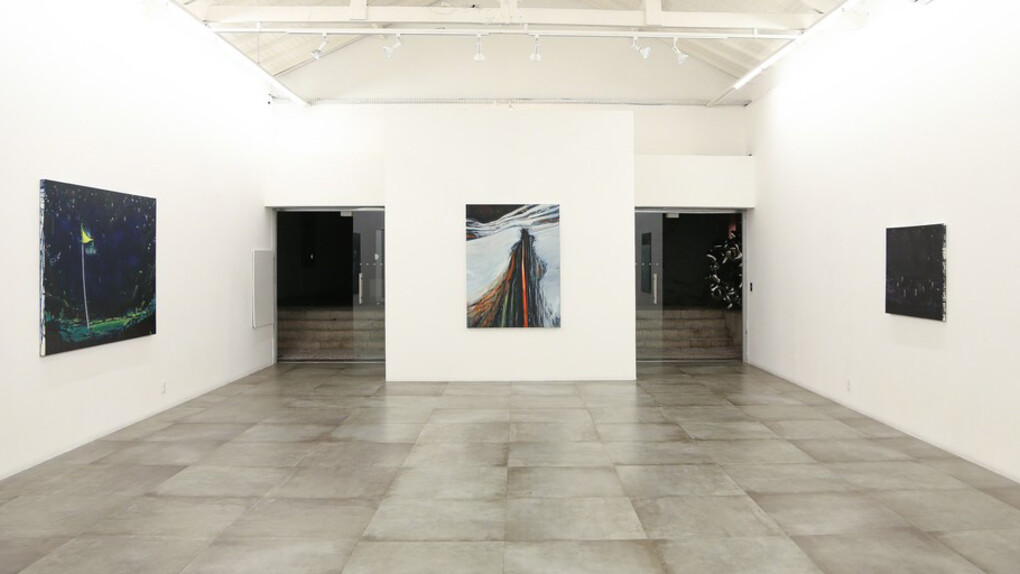
It´s night. I feel it is night not because the shadow came down (I quite care about de black face) but because inside of me, in the depth of me, the scream is now quiet, and dismay sets in. I feel we are the night, that we tick in the dark at night we dissolve. I feel it is night in the wind, night in the waters, on the rock.”
(excerpt of the poem “Passage of the Night”, by Drummond)
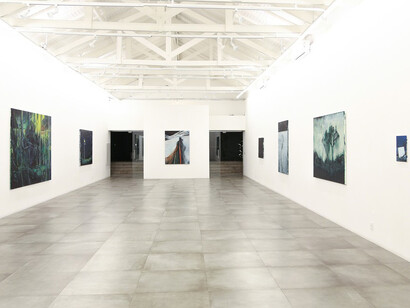
In the work of Alexandre Wagner there is a sound that nearly resembles a rumor. His paintings are pervaded by this subtle wind that slightly raises the fabrics of the flags that bows the stakes and the flagpoles, that make the water and the tree tops slowly tremble.
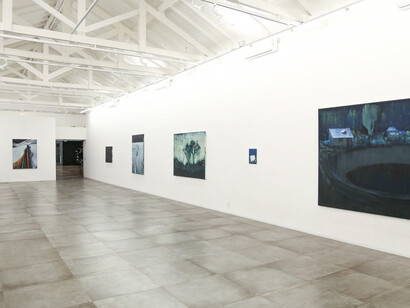
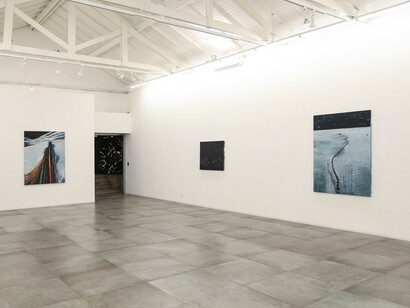
His landscapes have a low light that leads us to another epoch – past or future, we cannot tell – or perhaps they are another dimension of these very spaces, as though the paintings were remembrances of these places or still uninhabited futures. Some resemble a moon surface or some other planet.
In this series of artworks, Alexandre reveals the solitary night in landscapes that take us to deserts and abandoned places, where there is no human presence, but his scarce clues already deteriorated: a tent, a pole, a flag, an old house, a tire. These artifacts, the only dwellers of these spaces, seem to survive conserved in an extended time – as in a slow and fuzzy dream, where a pair of trees may also be a ghost.
In a stance where landscapes could be in daytime, the brightness seems to be the one in which the day has not yet been born, when dawn is underway, but yet no sun rays have risen. It is like the paintings sought the boundary of the night, as if they stretched out to see how far they are still night: yellows, whites, greenish. In the paintings by Alexandre there is no high sun, evident. And when it takes it to the sky, it mismatches with the moon. If in the poem by Drummond the objects become night, in the paintings by Alexandre Wagner the night unfolds into layers, depths and, eventually, become day.
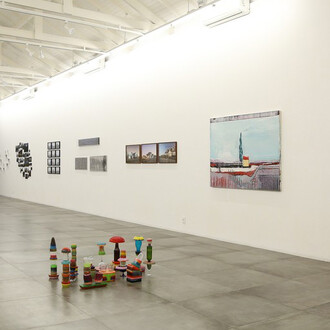
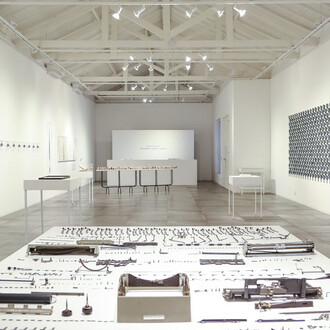
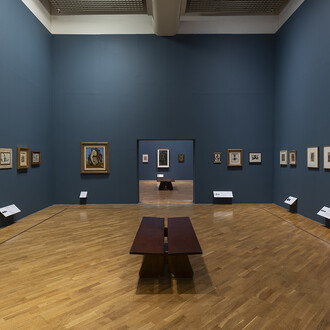
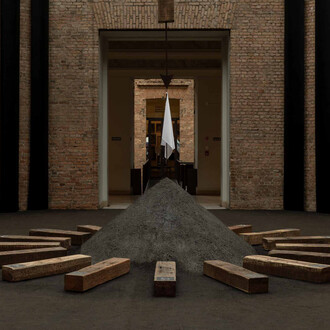
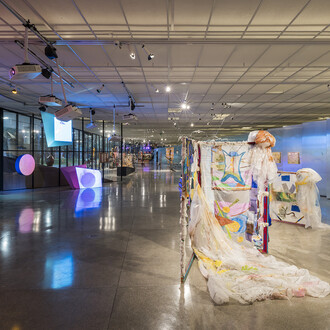
![Various artists, Histórias latino-americanas [Latin american histories], exhibition view. Courtesy of MASP](/attachments/2ec1b7615df2d9b9c3f211de14c70faefd850aea/store/fill/330/330/8481e63599516249cba60f15e188644bb76fc1eec25547e2c4b88b8f1c92/Various-artists-Historias-latino-americanas-Latin-american-histories-exhibition-view-Courtesy-of.jpg)