English
 Español
 Français
 Deutsch
 Italiano
 Português
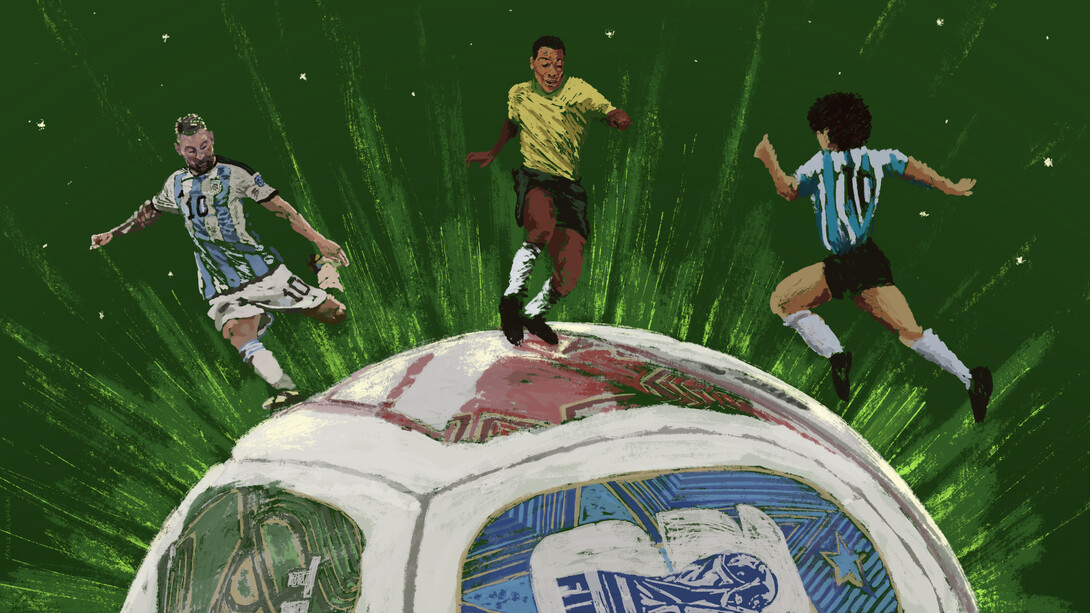
Analyzing the most notorious football players of all time, three names come readily to mind. Although this is inevitably a personal selection, it reflects what many experts think is the reality. The Brazilian Edson Arantes do Nascimento (Pelé) and the Argentinians Diego Armando Maradona and Lionel Messi constitute ‘The Holy Trinity’ of the most popular game in the world.
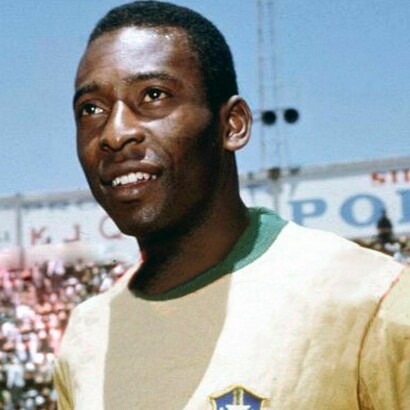
During his career, Pelé— born October 21, 1940— scored 1281 goals in 1363 games, including unofficial friendly and tour games. He is listed in the Guinness Book of World Records as the football player who scored the most goals during his career. A man with a strong social conscience, Pelé was very vocal in his support of policies to improve the social conditions of the poor in Brazil. Because of his achievements as a player, in 1961 he was declared a national treasure by Brazil’s president, Jânio Quadros.
Perhaps he is the only player who ever held up a war. During the Biafra War, when he arrived in Nigeria with the Brazilian team Santos, a two-day ceasefire was declared so that the people could enjoy the performance of ‘The King’ of the beautiful game.
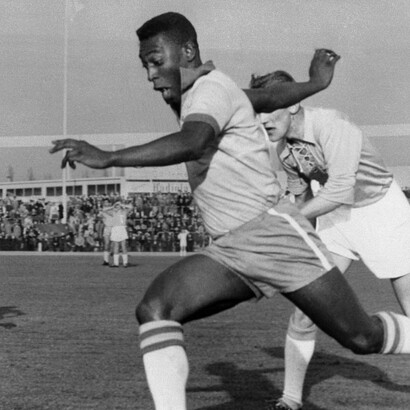
Nobody explains Pelé’s football style better than the Uruguayan writer Eduardo Galeano. In his book Soccer in Sun and Shadow, Galeano writes, “When Pelé ran hard, he cut right through his opponents like a hot knife through butter. When he stopped, his opponents got lost in the labyrinths his legs embroidered. When he jumped, he climbed into the air as if it were a staircase.” He then adds, “But those of us who were lucky enough to see him play received alms of an extraordinary beauty: moments so worthy of immortality that they make us believe that immortality exists.”
In 1958, Pelé made his first World Cup appearance. At age 17, alongside Garrincha, he gave the world what is remembered as ‘the greatest three minutes of football ever played.’ At the final game, when Brazil defeated Sweden 5– 2, Pelé scored twice– an iconic flick over Swedish player Gustavsson and a volley, plus a late header– becoming the youngest scorer in a World Cup Final.
In the 1970 World Cup Final, when Brazil defeated Italy 4– 1, Pelé scored the opening goal and assisted the goal of another legendary player, Carlos Alberto. His performance gave him his third World Cup, a remarkable achievement.
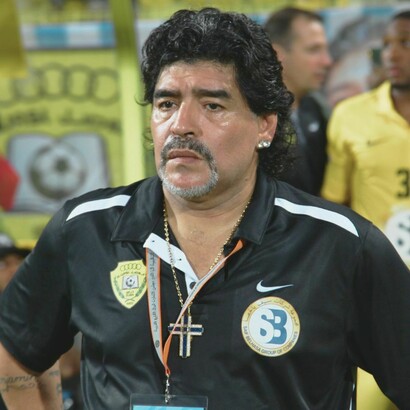
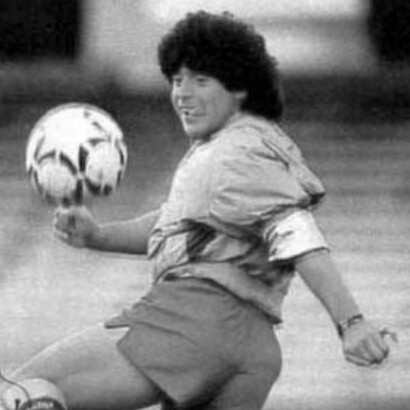
While Pelé’s behavior was that of a gentleman, Maradona— born October 30, 1960— behaved like the street urchin that he was as a child. Nobody, however, can deny how great— and controversial) Maradona was as a player. He was joint FIFA (Fédération Internationale de Football Association) Player of the Century with Pelé. Maradona reached the peak of his professional career playing for the Italian club Napoli, elevating the team to the most successful era in its history.
Led by Maradona, Napoli won twice the Serie A Italian Championships in 1986-87 and 1989-90, the Coppa Italia in 1987, the UEFA (Union of European Football Associations) Cup in 1989 and the Italian Supercup in 1990. His achievements for Napoli made him revered like a religious figure in that city, where many streets in the center of town have a shrine or mural dedicated to Maradona.
But it was his extraordinary performance during the 1986 World Cup in Mexico that earned him lasting fame. The second goal he scored against England was voted by FIFA as the greatest goal in the history of the World Cup. During that game, just four minutes after his infamous ‘Hand of God’ goal, Maradona received the ball in his own half of the field, turned around skillfully, and, with 11 touches, ran more than half the length of the pitch. He dribbled past five English outfield players, Peter Beardsley, Steve Hodge, Peter Reid, Terry Butcher, and Terry Fenwick, and finally sent the ball past goalkeeper Peter Shilton into the net.
Talking on BBC Radio, Bryon Butler best described Maradona’s moves: “Maradona turns like a little eel; he comes away from trouble. Little squat man, comes inside Butcher and leaves him for dead, outside Fenwick and leaves him for dead— and puts the ball away. And that is why Maradona is the greatest player in the world.” Michel Platini, UEFA President, stated succinctly, “What Zidane could do with a ball, Maradona could do with an orange.”
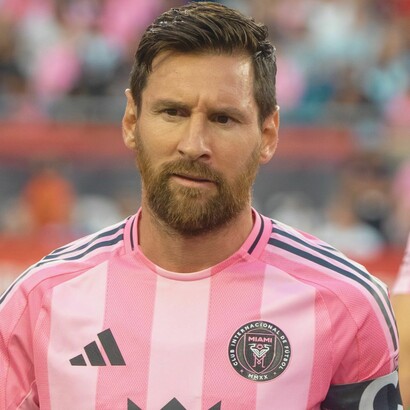
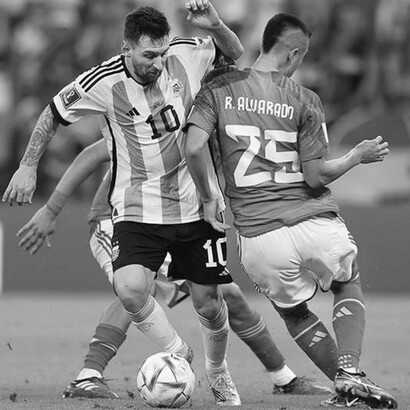
Unlike the bombastic Maradona, the other member of the Holy Trinity— Lionel Messi— is a quiet, almost taciturn person. A short man born in Rosario, Santa Fe Province in Argentina on June 24, 1987, he has arguably been the world’s best player for several years. He is the first player in history to win six Ballons d’Or— and has since extended his record to eight— as well as the first to win six European Golden Shoe awards. In addition, he is the first player to score the most goals in four consecutive Champions League campaigns. He can be called ‘the record breaker’ because he has broken so many. He also captained the Argentinian National Team to glory in the 2022 World Cup and reached another World Cup final in 2026.
Messi takes advantage of his short stature— standing at 5 feet 7 inches— to dexterously move among his rivals and send the ball into the opposing net, which turns into a magnet for his shots. With his eyes fixed on the net, nothing distracts him from his main objective. Hernán Casciari, an Argentine writer and one of Messi’s greatest fans, explains, “He looks as if in a trance, as if hypnotized; he only wants the ball to go into the rival’s net. He doesn’t care about the sport, the final result, nor the regulations of the game. One has to see his eyes to understand this— he looks cross-eyed, as if he has difficulty reading a subtitle; he focuses on the ball and doesn’t lose sight of it even if they knife him.”
When comparing them, one is tempted to choose the best among them. Alas, it is a futile exercise. They are different but equal in their superior quality. They have remained iconic figures through time, and they represent, and probably will for the foreseeable future, the greatest among the best.