English
 Español
 Français
 Deutsch
 Italiano
 Português
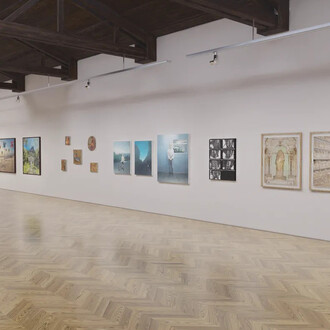
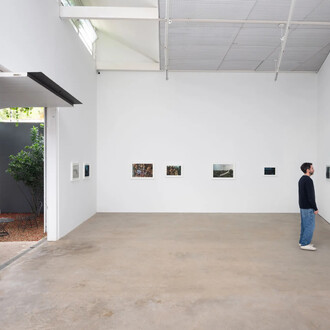
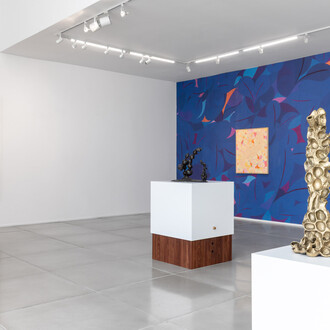
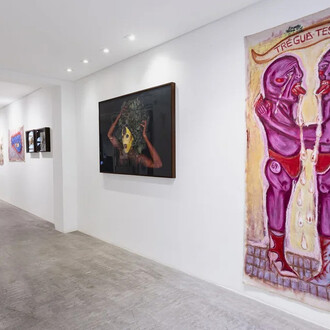
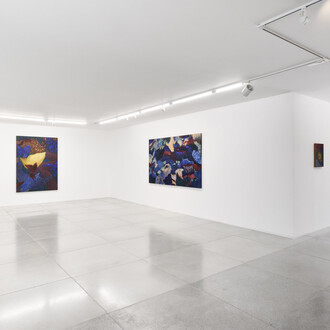
Zipper Galeria presents O vaso de Ojuara [Ojuara's vase], a solo exhibition by Claudia Marchetti at Zip'Up, opening on October 8. The show brings together around twelve small- and medium-scale acrylic paintings on canvas, made over the past two years. It is the first body of work the artist has shown to the public in twenty years. Dedicated to independent and experimental projects, Zip'Up occupies the gallery's upstairs space.
The title names the object that sets the story in motion. Ojuara, an anagram of the surname Araujo, is the character the artist created for the children's books she has written and illustrated since 2024. A twelve-year-old caiçara girl, she finds a clay vase with three eggs inside. The eggs break open and magical snakes emerge, leading the character to become aware of the living conditions of her community on the northern coast of São Paulo. For the artist, the vase refers to the womb, a container for the elements that reappear throughout the canvases.
Painting returned by way of fiction. In the exhibition's critical essay, Paula Alzugaray notes that "before becoming word, Ojuara appeared to Claudia as an image," and identifies an unusual chronology in this trajectory, in which "it is the work that anticipates life." The character came to function as more than a heteronym, feeding back into the artist's own biography. The exhibition is credited to Claudia Marchetti, while the works are signed Ojuara, the persona Claudia has adopted in her painting since returning to the medium. "It is through this girl's perspective that I work," she says.
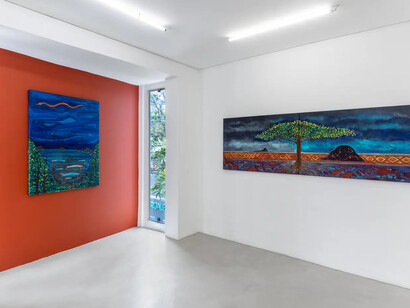
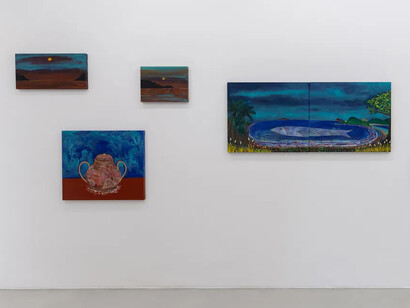
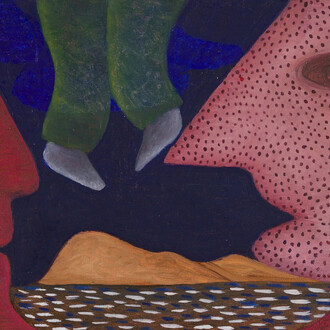
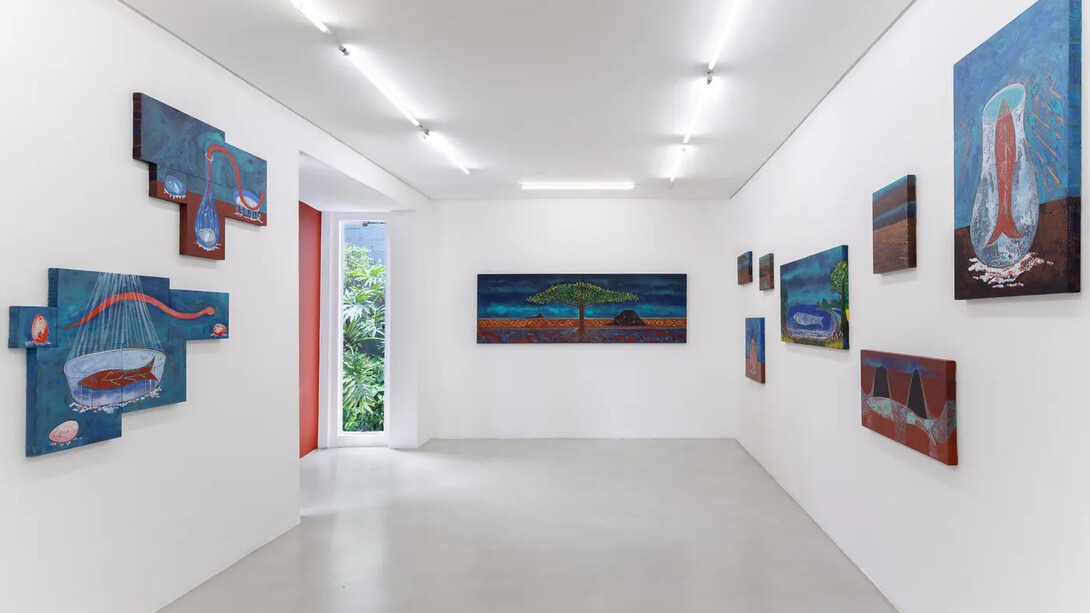
The artist has spent time on the northern coast of São Paulo since childhood. The Ojuara books address the effects of the environmental crisis and real estate speculation on the region's caiçara and riverside populations, and it was the writing that sparked her new body of painting. The canvases start from this landscape, struck in February 2023 by the heaviest rainfall ever recorded in the country in a 24-hour period. In Mar de lama [Sea of mud] (2026), the mountains flow down. The canvas addresses the landslides of that summer, an episode that also gave rise to the second book in the series. Rede de peixe [Fishing net] (2026) depicts fishing, the main livelihood of Ojuara's community, and draws the net as a zigzag line linking islands and fish.
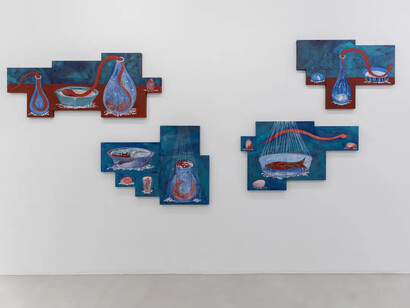
In the series Chorar sobre o leite derramado [Crying over spilled milk] (2026), canvases of various sizes are joined together on the wall to compose a modular narrative, which Alzugaray describes as "an aesthetic of montage." The restricted use of turquoise blue and red, together with white, gives these paintings their unity.
A naïve and schematic figuration links the new phase to the painting Claudia was making twenty years ago. In Serpente vermelha [Red serpent] (2026), a family tree of fish appears framed by shrubs against a seascape, with a snake winding across the sky. In Memórias aqueológicas [Archaeological memories] (2025), the jars return as Indigenous ceramics and Chinese porcelain. Alzugaray likens the course of the exhibition to an Ouroboros that returns to its starting point, to the containers that are "the bellies and wombs from which more and more seeds of forests and of fictions will keep pouring forth."
Her artistic practice is connected to Casa de Ojuara, a social project she runs on the northern coast, through which she distributes free copies of the books to public schools and non-governmental organizations. Part of the proceeds from the sale of the works will go to the social programs of Instituto Verdescola, an organization based in Barra do Sahy, São Sebastião, where Claudia teaches painting. In the exhibition space, a video presents the institute's work, and the books are available for reading.