English
 Español
 Français
 Deutsch
 Italiano
 Português
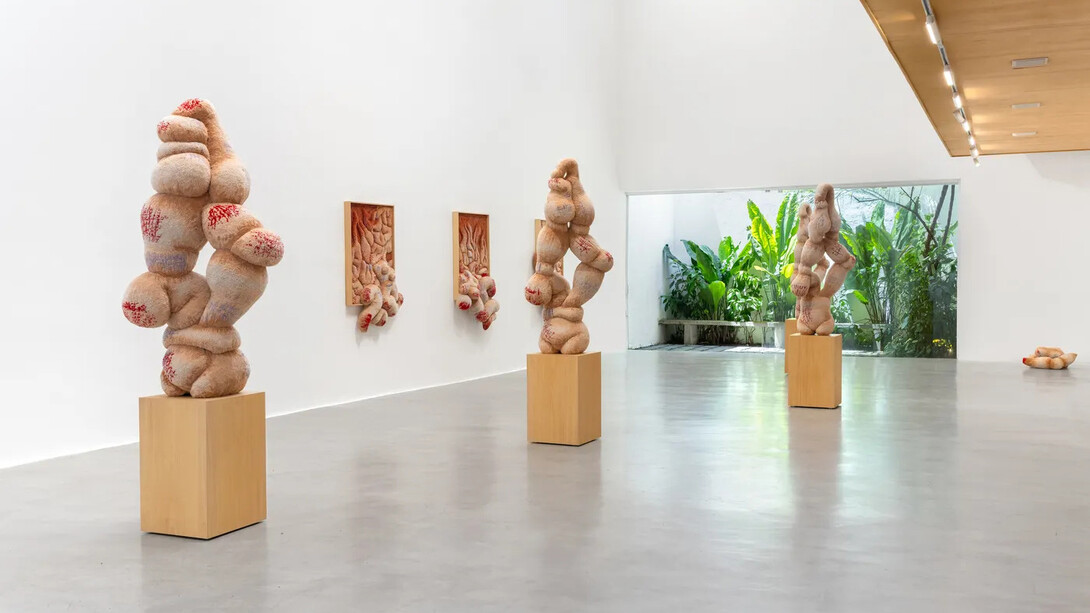
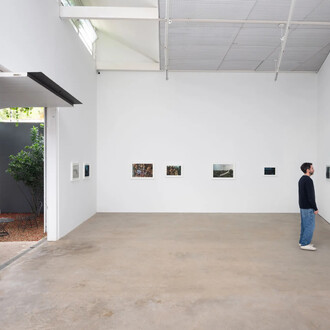
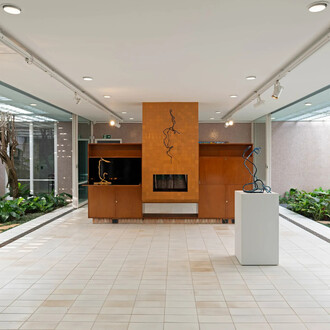
Zipper Galeria presents Aquilo que não cabe (What doesn't fit), Jessica Costa's first exhibition in the gallery's main hall, curated by Carollina Lauriano. The exhibition starts from a question about form, namely how much volume a form can have before it ceases to be tolerated.
Jessica Costa's trajectory begins in fashion, first at a yarn factory and later in the handmade production of clothing. Teaching these techniques led her to deepen her theoretical research on textiles and, from there, to adopt tapestry as her language. The body remains a measure inherited from this background, so that the human figure continues to organize her imagery even after her move into the visual arts.
The exhibition grew out of the curator's visit to the artist's studio, where her first sculpture stood. The conversation around the volume and rounded form of that piece gave rise to the proposal that guides the show, an inquiry into reduction.
Curator and artist also share a past in fashion, a field that Lauriano sees as a space for expressing individuality that at the same time carries oppressive values, evident to anyone who falls outside normative standards. Fashion thus serves as an entry point into a poetic inquiry that reaches the surveillance of the body on a broader social scale.
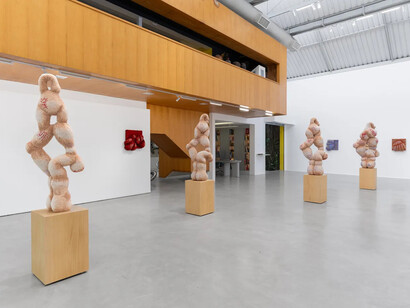
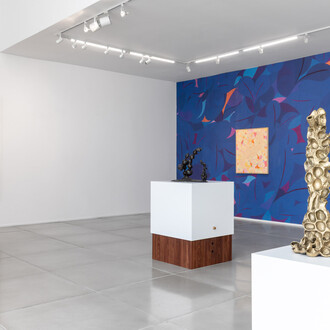
Among the series in the exhibition, a set of four tapestry sculptures on pedestals stands out. With abstract forms rooted in the observation of the body, the pieces progressively decrease in size, and the reduction takes place part by part, with each segment of the structure treated as a limb that loses circumference. The procedure comes from garment patternmaking, where grading sizes is routine. On their pedestals, the sculptures exceed human scale and evoke Greco-Roman statuary, a reference of monumentality removed from everyday life. Wool brings close what marble keeps at a distance.
The logic of the series emerged from the making itself, since each piece takes the previous one as its reference, a sequence the artist associated with the weight-loss photographs that circulate on social media.
"While making each sculpture, my reference is always the previous form. This reminded me of the before-and-after images that accompany weight-loss processes, in which one photograph is placed next to the other," says Jessica Costa.
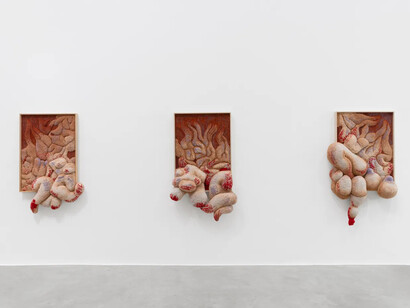
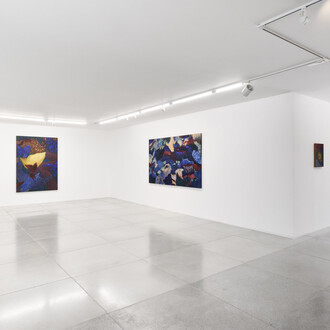
In the three framed tapestries, the frame returns as a figure of containment. If in the series Sobejos the tapestry already spilled past the sides of the rectangle, here the advance becomes three-dimensional and projects out of the plane. The works share the same chromatic composition, while their contours vary through gains and losses of volume.
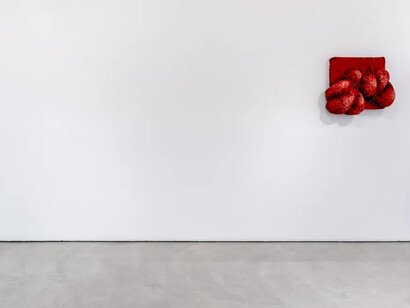
Voluptuosa closes the exhibition with four wall sculptures that start from a square and grow outward from it. The point of departure is lingerie, a garment that gives contour to the body. The artist worked with expanding foam and pressed bra straps into the material while it was still malleable, so that the form escaped through the intervals of the markings.
Taken together, the works address the surveillance of form at a moment when public debate around the female body is increasingly shaped by weight-loss drugs and the ways society makes use of them. The exhibition shifts the subject to the aesthetic field, where form is perceived before it is judged, and tapestry responds to it with volume and slowness.
"This exhibition is about form that occupies space and how it is perceived in the aesthetic field. I shift a profound question, the surveillance of bodies, into my own language and develop this reflection through tapestry," states the artist.
This slowness takes on a concrete measure in the studio. Each work goes through some twelve manual stages, of which tapestry is the last and the only one that reaches the viewer's eye. What one sees is the surface of a long process that gives volume time to take shape. In the curator's reading, this is how the body of work seeks ways out of the "traps of the standard", by granting form the space that the norm denies it.