English
 Español
 Français
 Deutsch
 Italiano
 Português
Since the first portraits of European colonisers in the sixteenth century, the Brazilian landscape has been deliberately presented to the world through a foreign gaze that established an exoticised image of the country, one that persists to this day. From an untouched Eden of infinite exuberance to a wild territory awaiting domestication, the colonial perspective reduced the subjectivities of a nation as complex, diverse and geographically vast as Brazil, whose history long predates the Portuguese invasion.
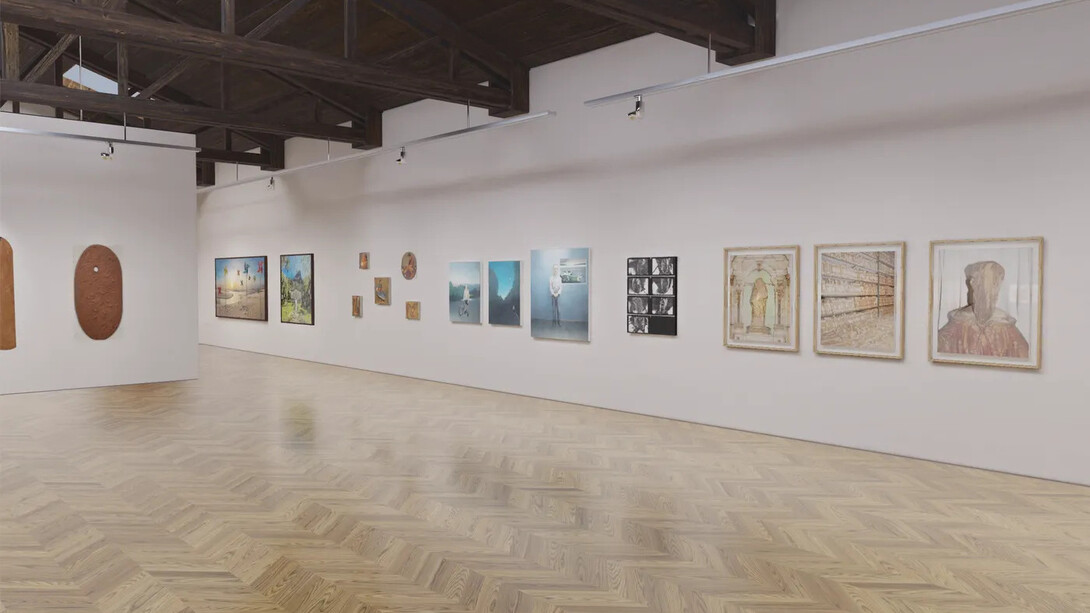
This exhibition, however, proposes breaking with this tradition of detachment, adopting a perspective rooted in the territory itself and rejecting the landscape as spectacle. It presents a Brazil observed by those who inhabit it, with its pain and conflicts, but also its pleasures, affections and imaginations.
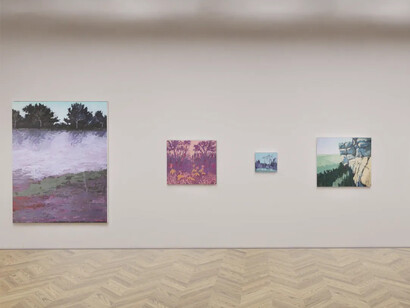
The journey begins with the very genre that contributed most to the formation of this exoticised image: landscape painting. In Miguel Chiquitano's canvases, the subject recalls the tradition that fascinated European travellers during the colonial period. Yet the density of the vegetation, the detailed foliage and the attention to colour reveal that these compositions could only have emerged from close familiarity with the forest, a connection unlikely to arise from an outsider's gaze. His paintings eliminate the horizon line, and without it, there is no distance: the viewer's gaze is drawn into the forest, towards its tangle of roots and shadows.
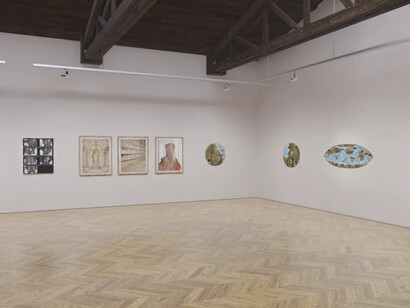
The decolonial reinterpretation continues in Camille Kachani's work Mundus Hodiernus, in which the artist reconstructs a world map inspired by his encounter with a seventeenth-century map depicting what was then called the "modern world". Its vast blue oceans are composed of nautical ropes, beads and fragments of tiles found in antique shops in Lisbon, some dating back to around 1750. Through these materials, Kachani revisits the processes of colonisation, questioning the notion of "official history" and revealing how cartography contributed to the construction of narratives that organised and hierarchised the world.
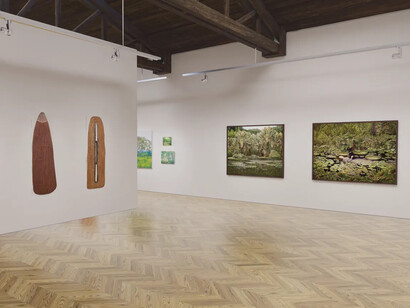
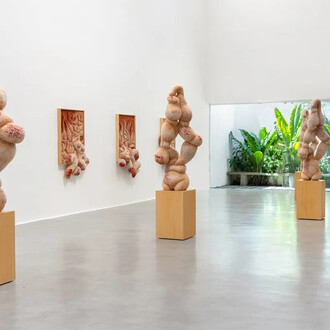
In João Castilho's photographs, the ochre-red colour, reminiscent of rust and iron ore, distances Brazilian flora from the tropical exoticism promoted by the country's image abroad. Meanwhile, Marco Tulio Resende's sculpture, composed of wood and clay from different municipalities in Minas Gerais, highlights the discursive potential of materials, which carry within them traces of labour and memory.
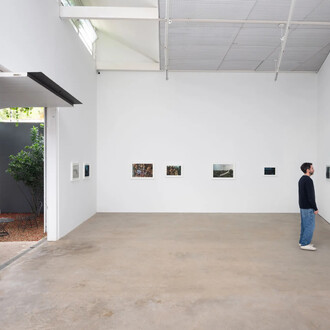
Further along, photographs from André Penteado's series Cabanagem bring to the surface little-known historical conflicts in Brazil. The title refers to the Cabanagem revolt (1835–1840), which took place in the Province of Grão-Pará and was one of the bloodiest rebellions in the country's history. During the revolt, Black, Indigenous and riverside communities rose up against Portuguese economic domination in the Amazon region, which continued even after Brazil's independence. After the rebels killed the provincial governor and seized power for a year, the movement was violently suppressed by the imperial government, resulting in more than 30,000 deaths. Despite its popular character and considerable scale, its history remains virtually unknown in Brazil. While visiting colonial churches in Amazonian areas that had witnessed some of the conflict, the artist encountered one saint wrapped in brown paper and another with a disfigured face. These discoveries gave rise to the photographs.
The theme of conflict reappears in a more recent context in Mario Ramiro's xerographic work Sufoco (1979), created when Brazil was still experiencing the effects of military dictatorship. A pioneer in the use of xerographic printing, Ramiro later became a member of the 3NÓS3 collective. In this work, he depicts a body pressed against the surface of a machine, in a gesture through which the medium's technical limitations become a measure of political repression. Reproduced in a series, the image inscribes within its very act of reproduction the sensation of suffocation evoked by its title.
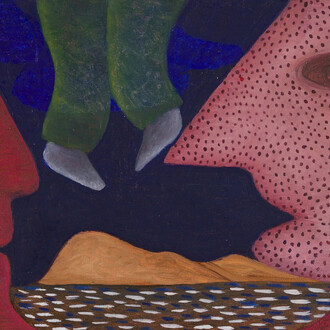
In the present, the construction of territory moves into the urban environment in Ian Salamente's paintings. At a time when Brazil's peripheral neighbourhoods are often fetishised, the artist takes them as the starting point for compositions shaped by affection. Inspired by relatives, friends and neighbours, the figures inhabiting his paintings appear in everyday gestures of care and companionship. The small pile of salt in the background refers to the artist's hometown, Cabo Frio, whose history has been shaped by salt production, an activity that has been central to the local economy for generations.
This attention to an inhabited Brazil continues in Rodrigo Cunha's paintings, which capture the country through the scale of everyday life and domestic interiors. In canvases characterised by subdued tones, solitary figures caught in restrained poses share the frame with landscapes enclosed within the paintings themselves. Thus, when a sweeping view does appear, it has already been reduced to the status of an image hanging on a wall.
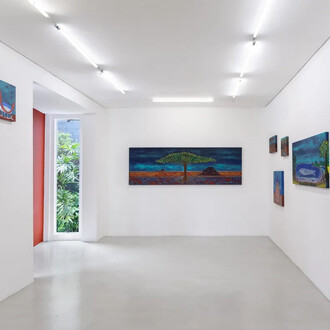
Other works in the exhibition take landscape into the realm of imaginative fiction. In his digital compositions, Marcelo Tinoco uses photography as a starting point to reinvent natural scenery through intensified colours, pronounced outlines and interventions that blend reality and fantasy. In Felipe Góes's paintings, expressive brushstrokes and vibrant palettes create landscapes of "non-places", turning nature into a sensory experience. Flávia Junqueira, meanwhile, develops her installations in locations associated with Brazil's tourist imagery, such as Lençóis Maranhenses National Park and the Rio de Janeiro Botanical Garden, iconic Brazilian "postcard" destinations that she displaces into a playful dimension through her signature balloons and pinwheels.
Finally, Rodrigo Braga's photograph projects the landscape towards a mythical horizon. Born in the Amazon region, the artist has spent more than twenty-five years investigating the relationships between living beings and their surrounding environments. In the image, the egg, an archetypal symbol associated with birth and transformation, appears as a metaphor for a present moment in turmoil, marked by tensions and urgencies, yet still capable of gestating possible futures.
Taken together, the works explore how images of Brazil have been historically constructed and continuously reinvented. If, for centuries, Brazil was served up as a delicacy to satisfy colonial appetites, in this exhibition the artists reclaim the position of those who observe from within. From this perspective emerges the complexity of a territory embraced on its own terms.