English
 Español
 Français
 Deutsch
 Italiano
 Português
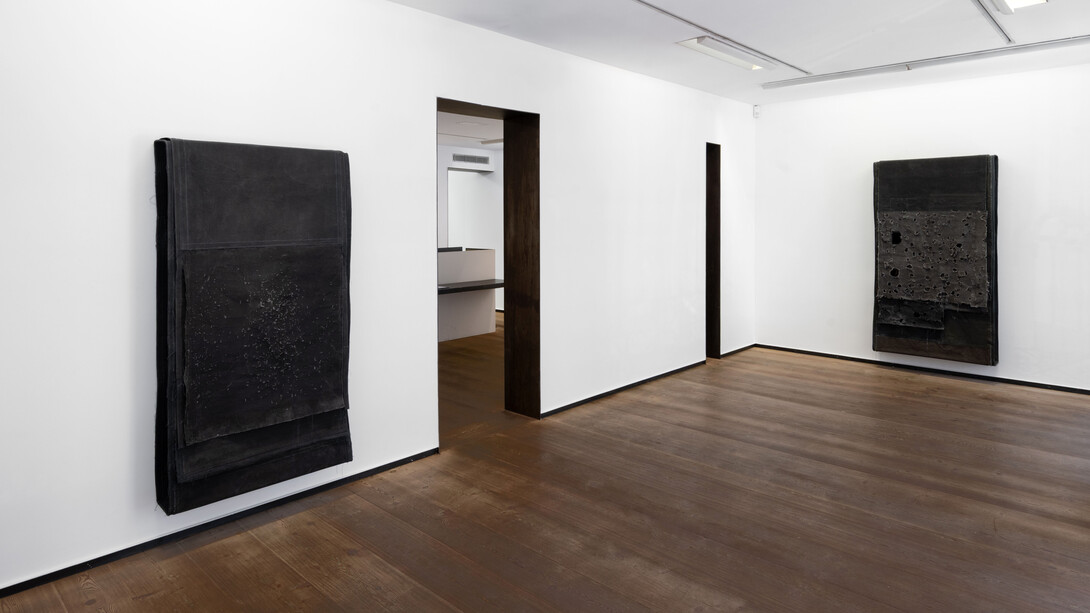
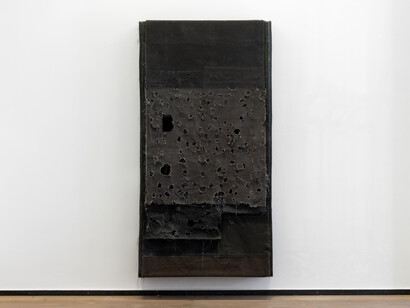
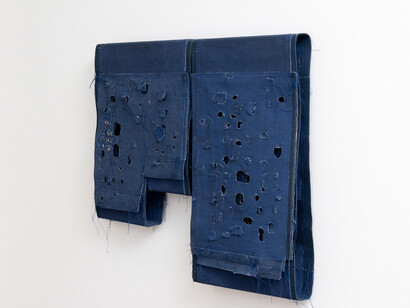
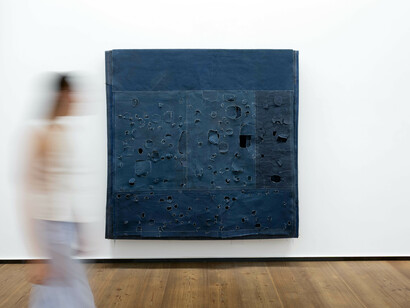
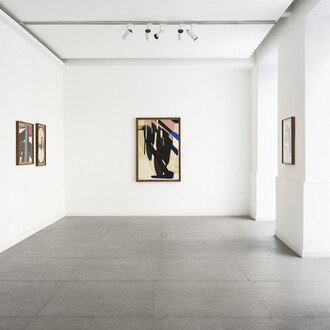
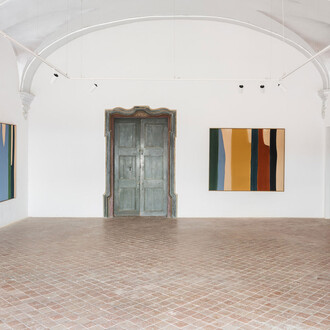
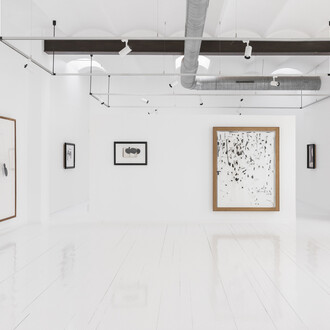
Simon Callery is showing a group of new works called Blue and black puncture paintings. The exhibition includes related large-scale and small-scale works.
Puncture painting is the name the artist has given to paintings with pierced and punctured front faces. These works are constructed from canvas that has been marked on location in the city or in the landscape. Most recently Callery has been working on the low tide riverbeds of the Thames near where he lives in east London, and on the banks of the Thames estuary, close to his studio in south Essex.
Deposited by the water on the river bed, are beaches of rounded flints, broken ceramic shards and masonry debris. The riverbanks are covered with countless plastic objects of all kinds and sizes. Cutting into the sheets of canvas in physical contact with these surfaces produces a fabric with a multitude of small-scale punctures and holes.
Callery’s studio is another kind of depository. All the worked canvasses are taken back there, where they accumulate in piles. Here the canvas is reworked, cut into again or used as templates to generate elements with specific qualities for the paintings. Colour is thought of as a material and is soaked deep into the fabric, which is washed and rewashed, resulting in characteristics not normally associated with painting; they can be soft or they can be hard.
The paintings are very porous. They are full of openings, internal spaces, voids and blockages. They contain ropes and small clusters of steel wire and a multitude of stitched patches and loose hanging threads. These puncture paintings have a general relationship with landscape, but there is no intention to depict it. More than anything they aim to draw the viewer into painting as a language of contact and touch.