English
 Español
 Français
 Deutsch
 Italiano
 Português
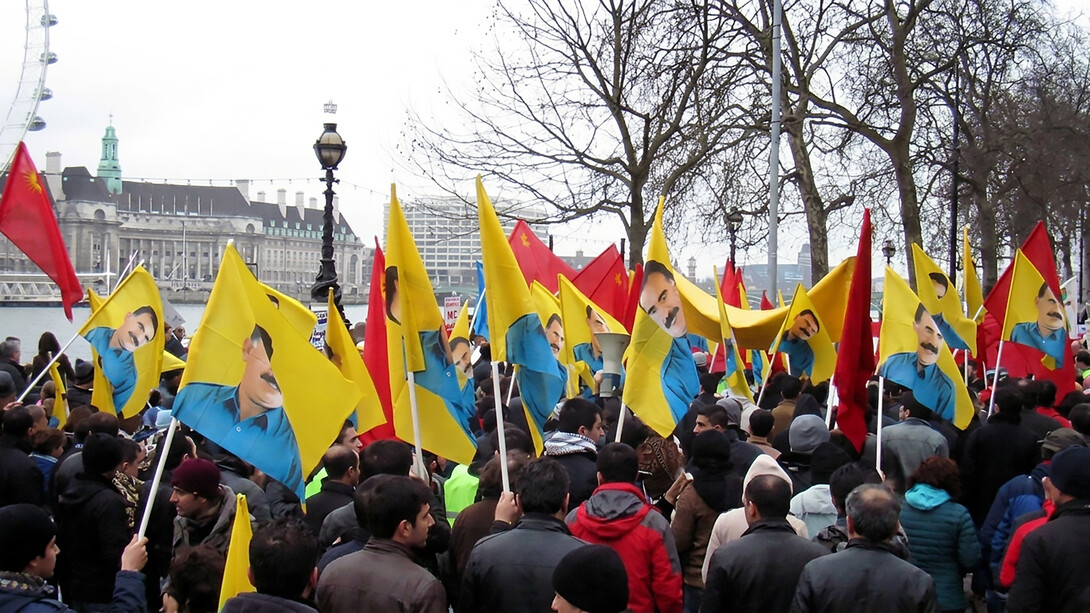
This conversation between Mohandas Karamchand Gandhi (also known as Mahatma Gandhi) and Abdullah Öcalan, activist-ideologue leader of the Kurdish freedom struggle, took place on 31 October in Imrali Prison, on a Turkish island, where Öcalan has been held prisoner for 27 years. This is the third conversation between the two; the first took place in August 20231, and the second in June 20252.
Mohandas: Rojbaş and namaste, Abdullah! Apologies, but here I am again, a third time! Like I said last time we met, all good things come in threes …
Abdullah: Namaste and zindabad, Gandhiji! Pl. don’t apologise, I love your visits, they are such a blessing for me.
Mohandas: I had very much hoped our third meeting would be out in the open, in some beautiful part of Kurdistan. I’m sorry that Turkey still thinks you are a danger – even though you have made the bold move of asking your fellowmen and women to eschew armed struggle, and enter into peaceful dialogue.
Abdullah: I too would have wished to take you to my homeland, but that is not yet to be. At least, though, I can now receive more visitors than before, since we extended the olive branch, and talks began between our people and the Turkish state.
Mohandas: And how are those going?
Abdullah: Well, it’s still too early to conclude anything, but from what I hear, there have been many stumbling blocks, and a satisfactory outcome is not yet in sight. We remain hopeful, though.
Mohandas: I pray that your hopes will materialise, we really need you in the outside world, where things are going from bad to worse – genocide, authoritarianism, fascism, ecological collapse, continued patriarchy, the disappearance of ethics in public life and even the glorification of evil … I could go on, but it’s all too depressing. And anyway, it’s not so much the bad news I came to talk to you about.
Abdullah: I’m glad you said that; else I would have started off on everything that’s wrong. The Kurdish movement describes it as the Third World War! So, what brings you on this third visit, Gandhiji?
Mohandas: Well, I got a sneak preview of your forthcoming book, Manifesto of the Democratic Communal Society3 …
Abdullah (interrupting): What, you saw it? How? It’s not yet published, as far as I know!
Mohandas (eyes twinkling): We have our magical ways in the afterlife, including seeing things … in their beforelife, so to speak! (laughs out loud)
Abdullah (also laughing): I’m tempted to wish for this afterlife soon … I’d certainly like to see some beforelives, such as of Kurdish freedom!
Mohandas: No, no, your afterlife is still many decades away, Inshallah. So, I wanted to talk to you about some of what you’ve written in the book. You have obviously built on what you’ve said and written earlier, but there are new terms and ideas which I found quite interesting.
Abdullah: Yes, I realised that the regional and global contexts are changing rapidly, and we need to keep innovating on our ideas and practices to be able to respond adequately. Also, as we discussed last time, we have the exciting opportunity of forging a new path with the dissolution of our party PKK, an end to armed struggle, and advocating a peaceful solution to the Kurdish question. PKK has achieved its main objective of establishing Kurdish identity and bringing our struggle to global attention, but it is time to build anew.
Mohandas: You know, one of our revolutionary trade union leaders half a century back, said something very prescient. Shankar Guha Niyogi, now a comrade in the afterlife (after being killed by industrialists whose destructive actions he was exposing), called for “sangharsh aur nirman” (struggle and construction). If I might quote from your book: “the new era, grounded in the strategy of democratic politics, will rely primarily on positive forms of action and will constitute the revolution’s constructive phase”. And I read that you see this as a shift away from not only violence and conflict but also from ‘nation-state socialism’ and dependence on political parties as the vanguard of revolution. I notice that in place of these, you stress the role of the ‘commune’ in transforming society. Can you say a bit more about this?
Abdullah: Well, if I’m not mistaken, it’s akin to your own position on swaraj being anchored in communities. I think we have made a mistake in placing our faith in institutions like the state and political parties. They don’t empower us, but rather take away our power. Instead, self-governing collectives of people, which I refer to as communes, have to become the anchor of democracy, or we can even say, of communalism. Of course, they also need internal change, as does the institution of the family, and that is why I also say talk of ‘democratic modernity’ in which women’s freedom is the crucial fulcrum. But to my mind it is communes that will lead us to freedom, not only as solitary units but federated over larger areas in the concept I described last time, democratic confederalism. Or which I now describe as similar to matryoshka dolls – one contained within another, itself contained within an even larger one. Your concept of ‘oceanic circles’ is similar, no? And so, I am now advocating a Kurdish Union of Democratic Communes’, not a Kurdish nation-state, an idea we abandoned long back.
Mohandas: Interesting! I also notice that you have discussed the relationship of the individual vis-à-vis the commune. Now this is something that I think ‘western’ society appears to have got seriously wrong, with its over-emphasis on the individual and on selfish goals. But I guess the other extreme that one sees in some traditional societies, where collectives overpower individual identity and freedom, is also a problem? My own thinking was that individual and social transformations need to work together, including through spiritual means, through the practice of swaraj which I described last time.
Abdullah: Absolutely! In this book I’ve introduced the concept of a ‘democratic communalist personality’. All those who want revolution must transform themselves first, be open to genuine criticism and engage in self-criticism, share work and life with comrades, and learn to live ethically and aesthetically. Individualism and selfishness have no place in such a society.
Mohandas: This was one of my main pre-occupations, the moral or ethical self. I believe humans have both a brutish side and a divine, moral one, and our task is to individually and collectively cultivate the latter. I think you have some similar thoughts. I have here a quote from your book that I liked, where you describe the cadres who will bring about change: “What they are, what they say and what they do are one.” I had also said something to this effect, paraphrased by someone into a pithy “be the change you want to see in the world”.
Abdullah: Pir xweşe! Or, as I think you’d say in India, ‘wah-wah’!
Mohandas (smiling): If I did not know better, I’d say you’ve been watching Bollywood movies! But havel, while I’m struck by how much you and I resonate on so many matters, I do have some differences. You say that democratic communalism or socialism would be possible only in the Middle East due to its historical and current circumstance. Perhaps this is a bit chauvinistic? There are many regions of the world where such a transformation is possible; I’m most familiar with South Asia, and I think the circumstances there are also very ripe for it, as they possibly are in many other regions of the world where people’s movements are building on centuries of democratic practice, co-existence with nature, resistance and reconstruction.
Abdullah: Well, I’ve said this because our region was the cradle of what I call ‘matristic communal society’ in which women had a central role. It is also the cradle of ‘civilisation’ emerging from male hunter clubs and transforming into castic, statist, and patriarchal society, currently dominated by capitalism and dogmatic religion. So, we’ve seen the best and the worst! Our experiments in democratising society have deep roots that we can hopefully reconnect with … and we’ve also seen the ills of what industrial civilisation can do. This contradiction can be a powerful source of transformation towards communal society. But I acknowledge, I need to learn more about other regions, and what kinds of communalist struggles are happening elsewhere. I do stress on the need and possibility of an internationalist communal perspective, in which transformations in different regions can be linked.
Mohandas (smiling): You use the word ‘communal’ in the sense of community; in India this refers to religious hatred and conflict! Just goes to show, we need to be careful of cultural and political diversity when using terms. Also, I notice you use the word ‘castic’ to refer to hard class-like divisions; in our context ‘caste’ has become associated with some of the worst forms of discrimination and exploitation, especially of so-called ‘untouchables’. We all have ancient roots of positive and negative social tendencies!
Abdullah: Indeed, and this is all the more reason for our struggles to link up …
Mohandas (eagerly): Sorry to interrupt, but in this connection, I’m following the youth movements springing up across the world. This Gen-Z that is often vilified by older generations, seems to be coming up with some amazing counters to authoritarianism and fascism. Combined with very creative use of what I’m told is called ‘social media’ … though I have to say I remain rather sceptical of this technology.
Abdullah: In the new book I write about youth being innovative, creative and revolutionary, and when purposeful and methodical in its mobilisation, how it can be society’s driving force. The Kurdish youth have been crucial to the transformations we have attempted in our region. As for social media, I need to get out of this place and experience it first!
Mohandas: Another aspect on which I think we both need to reflect, is the view that humans are distinguished from other species in having ‘mind’, as you say in the book. I also used to think of the human species as standing apart from all others, in having morality, being able to reason, and distinguish between what is right and wrong. But I am now in the company of many Indigenous wisdom-holders, including those killed by colonial land-grabbers, and what are called ‘rights of nature’ advocates. They have convinced me that the distance between humans and other animals is not so great, that other species also have mind and consciousness, perhaps even soul and spirit, maybe also the ability to distinguish right and wrong based on their own ethics. So, we need to revise our thoughts on this! Maybe this is also essential for us to heal our relations with the planet?
Abdullah (looking thoughtful): Again, I’m happy to learn more and revise my beliefs, if necessary. Unfortunately, I have been deprived of so much essential contact with nature for all this time that I’ve been in prison. At least I have the sea to keep me company. But recalling the wonderful valleys and hills and forests and flowers of Kurdistan, I can well imagine them being sentient beyond what I have so far acknowledged. And I do stress that the human is an eco-social being, in which eco refers to first nature, and social to second nature. Humans are the bridge between nature and society, a bridge that has been broken by patriarchy and capitalist modernity, and which can only be mended if we accept being part of nature. So maybe it’s not too far from this position, to one in which we accept the essential oneness of all life forms.
Mohandas: There is so much more to talk about! But, my visiting time is up, and reluctantly I must say ‘aojo’, which means ‘please come’ but also used as ‘bye’ in my native tongue, Gujarati.
Abdullah: May we next meet in the free land of Kurdistan! Till then, stay well, Mohandas, and please give my love and greetings to all my colleagues who are there in the afterlife with you.
Acknowledgments: Comments of Ali Cicek of Academy of Democratic Modernity are gratefully acknowledged.
References
1 Ashish Kothari, 2023, ‘Mohandas Gandhi speaks to Abdullah Öcalan’.
2 Ashish Kothari, 2025, ‘Gandhi visits Öcalan again’.
3 Abdullah Öcalan (forthcoming), Manifesto of the Democratic Communal Society, Pluto Press, London.