English
 Español
 Français
 Deutsch
 Italiano
 Português
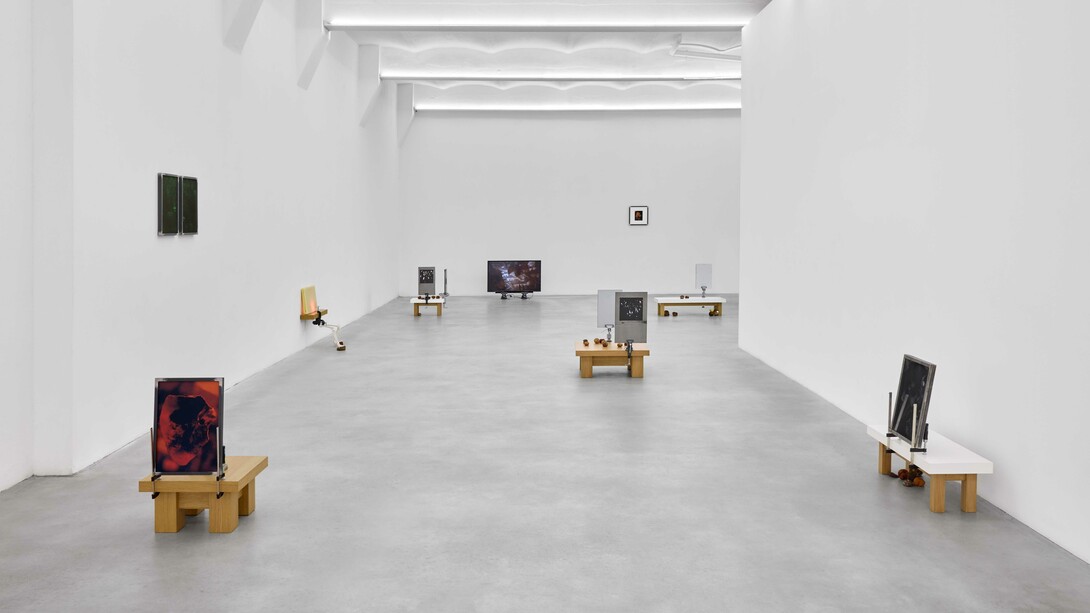
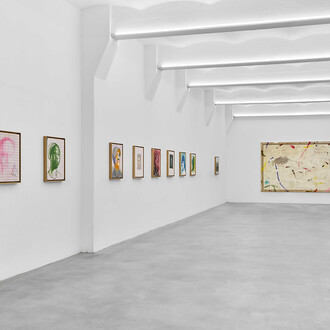
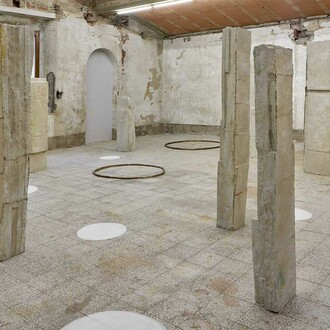
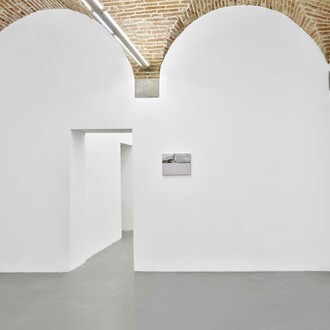
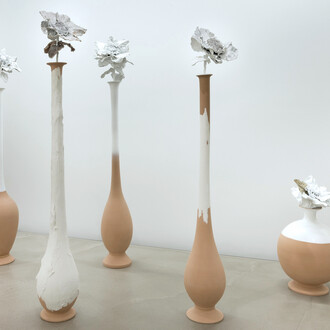
SpazioA is proud to present, Saturday 26 September, Stress test, the first solo show by Andro Eradze in the gallery’s main space.
Will-o’-the-wisp
“Where there is a story, the fire has gone out; where there is mystery, there can be no history,” writes Giorgio Agamben. Stress Test situates itself within this suspended space between storytelling and mystery, where what appears has not yet become narration. Andro Eradze’s works keep open a condition of uncertainty: a time in which the image does not yet coincide with what we know, remaining exposed to the possibility of what it might reveal.
If, until now, Andro Eradze’s practice has engaged with the dream in its nocturnal, spectral dimension, suspended between the spiritual and the material realms, where subjectivities and images seem permeated by the dreams of others, Stress Test proposes a reorientation towards daydreaming. The dream is no longer understood as a cyclical experience, as the ghostly trace of something that has already happened, but as a possibility: the production of a moment that may one day be remembered, a time created so that it may return in the future.
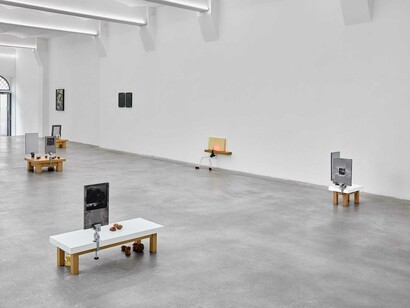
It is precisely this shift that also redefines the position of the viewer. In Stress test, we are no longer merely spectators of a dream moving through the image, but participate in its construction. The images of candles scattered throughout the space are not simple scenographic elements, but devices conceived to activate a form of rêverie in the sense described by Gaston Bachelard: an imagination generated through an encounter with a material, a light, an element capable of opening an interior space. Fire does not illuminate something that has already happened; it makes possible something that has yet to occur. The story is not yet present: the fire is burning.
Bones, skin, fruit
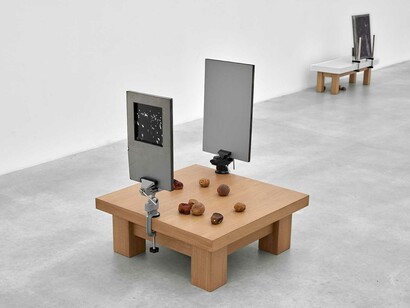
This dimension of possibility is also connected to a reflection on structures, which do not constitute merely the visible form of things, but rather the principles that regulate the way in which they appear to us and the system of relations through which they are understood. Within the exhibition, there is no attempt to produce an effect of realism, but rather a deeply theatrical fiction that reveals its own mechanisms. The construction of the image is not concealed behind the appearance of the natural, but exposed before our eyes. In this sense, a quasi-cartoonish dimension emerges: the attempt to make an artificial world believable is pushed to the point where its very construction becomes evident.
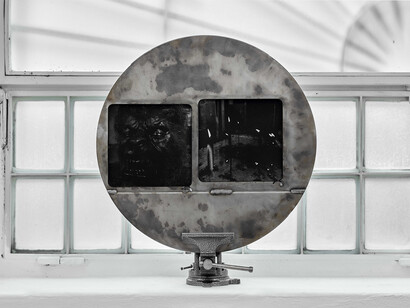
Structures thus become not only what organizes the scene, but what allows the scene to take place. They carry with them a series of images that seem to emerge from different archives: a human head, suspended between a scientific specimen and a possible Lombrosian relic; bones, as fragments of a body reduced to its essential structure, leaning against decaying fruit and creating a short circuit between different states of bodily matter; and candles, once again, introducing a temporal and ritual dimension.
The stage is laid bare: fiction, precisely when it reveals its own artificiality, does not close the space of possibility; on the contrary, it opens it. Fire does not illuminate something that has already happened; it makes possible something that has yet to occur. The story is not yet present: the fire is burning.
(Text by Arnold Braho)