English
 Español
 Français
 Deutsch
 Italiano
 Português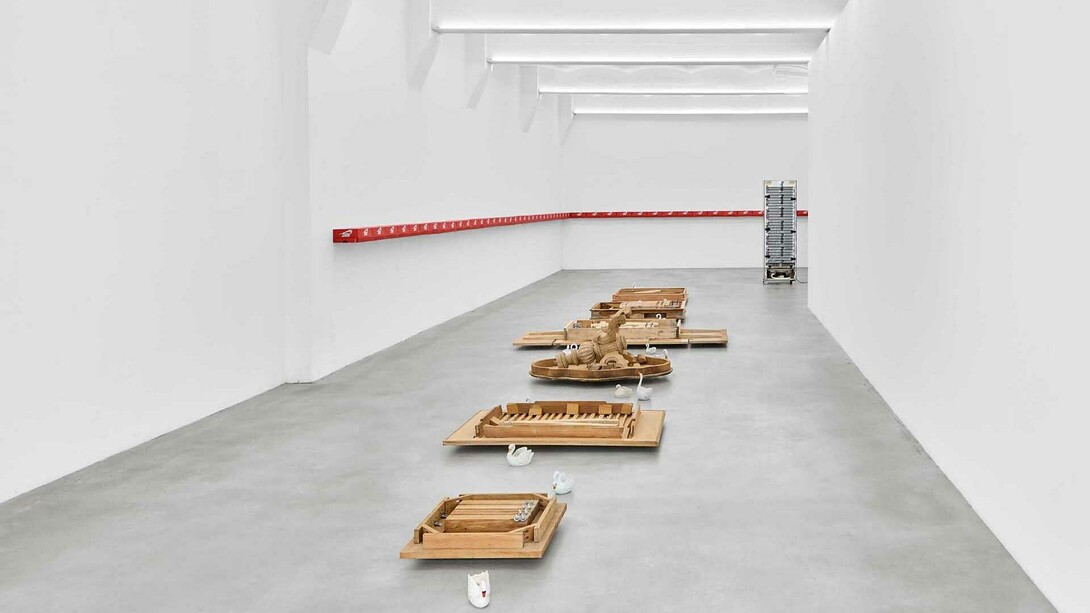
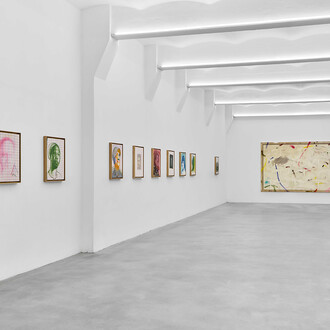
SpazioA is proud to present on Saturday March 28, 2026, Wedge by Finn Theuws. After his debut in 2023 in the project space, the artist will present the first solo show in the gallery’s main space.
Trasaghis, Italy, October 2025. An image of a tennis court in the Italian Alps/ a hardcourt with grey asphalt/ the tennis net, released from its pole, draped over the court/ shoeprints as traces pressed into its skin/ playing for “0”/ a solitary marking/ bound along the court’s chalked margins.
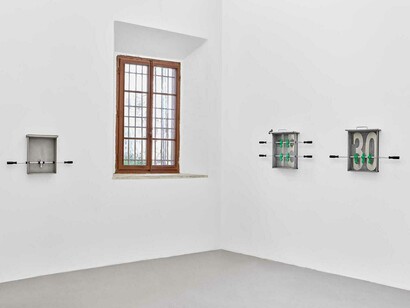
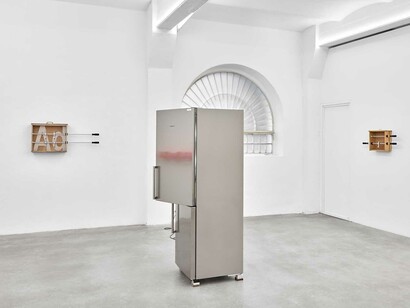
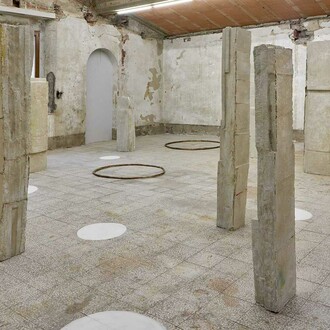
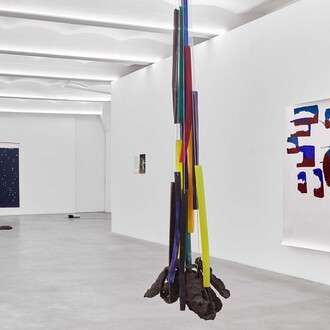
Wedge presents new works by Finn Theuws. Expanding his existing practice of sculpture and installation, the exhibition engages themes of domestic intimacy, The Weird1, and (queer) phenomenology.
Referentiality, orientations and resonances. It is important to note that the works in Wedge should not be read as pure metaphor; it does not serve to illustrate concepts but rather works on the level of the image itself. While referential, Theuws’s work intends to produce images of immediate phenomenological resonance2; images that appear to the individual’s consciousness but have not yet taken root. Approaching the works through the frame of a Queer Phenomenology3, a phenomenology that is understood through disorientation, meaning that the works strive towards producing images that precede orientation. Wedge invites forms of disorientation and intends to decentre the viewer, directing viewers towards the transcendental effect of the first encounter.
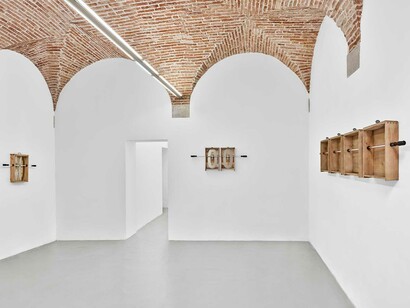
The Weird, citations, and the exterior outside4. ‘The outside is not “empirically” exterior; it is transcendentally exterior’ (Fisher, 2016, p.22). For Wedge, Theuws collected domestic objects (tables, cabinets, desks, drawers) in and around Treppo Grande, Italy. Departing from his earlier work which embraces the ‘lived through’ materiality of the found object, in the work *hotbed (2026) the artist has smoothed away the object’s wear and tear, lending his sculptures a suspended quality. No longer marked by the past, Theuws’s work is deeply anchored in the present, inhabiting the exhibition space while citing the ‘exterior’; the sculptures still referencing that which is ‘outside’ of the exhibition space. Simultaneously familiar and radically out of place, the sculptures are embedded with a sense of The Weird, asking: should this object exist here?5
Intimacy, unsettling normativity, and playing for 00. ‘A wardrobe’s inner space is also intimate space, space that is not open to just anybody.’ (Bachelard, 1958, p.99) What happens when the drawer, an object that implies a need for secrecy, is laid bare and implicated in queer sensibilities through the image of sports? With the works I, II, III, IV, V, VI, VII, VIII, IX, and X (2026) Theuws invites a dialogue between the obscured intimacy of the drawer and the playfulness of figurines; the obscured rendered public by the hypervisibility of athletic performance. Theuws discloses an allegiance between the oppositional, unsettling normativity in sports and reorienting the viewer towards its lingering intimacy6.
This is further explored in the work 6-9-2008 (2026) in which the contrasting concepts of ephemerality and preservation, of achievement, reveal a form of permanence in dwelling.
(Text written by Diede Al)
Notes
1 Mark Fisher, The weird and the eerie, 2016.
2 Gaston Bachelard describes the phenomenological concept of ‘resonances’ in The poetics of space as ‘dispersed on the different planes of our life in the world’ (Bachelard, 1958, p. 7), these are images that appear to us across space and time and, in multiplicity, disclose reverberations that ‘bring about a change of being.’
3 In her influential book Queer Phenomenology Sara Ahmed approaches the queer lived experience phenomenologically. In this work Ahmed argues that queerness emerges from misalignment and disorientation from objects of power.
4 Theuws has been visiting his family in Treppo Grande in Northern Italy from childhood.
5 ‘[The weird] involves a sensation of wrongness: a weird entity or object is so strange that it makes us feel like it should not exist, or at least should not exist here’ (Fisher, 2016, p.15).
6 Although it will always fail us, as desire lingers in its secrecy. Bachelard writes that
‘there will always be more things in a closed, than in an open, box. To verify images kills them,
and it is always more enriching to imagine than to experience.’ (Bachelard, 1958, p. 108).