English
 Español
 Français
 Deutsch
 Italiano
 Português
In late February 2026, the United States and Israel launched a preemptive war against Iran. The stated pretext: Iran was weeks away from a nuclear weapon. The real calculation, however, was simpler. Washington and Tel Aviv believed that a devastating opening strike, including the martyrdom of Supreme Leader Ayatollah Ali Khamenei and his entire top command, would trigger a rapid regime collapse.
President Donald Trump, riding high from a perceived success in Cuba, reportedly declared war without consulting the CIA or senior security agencies. He promised victory in two days. "We will conjure Iran," he said, expecting the Iranian people to rise up and finish the job.
Instead, the United States lost the war.
How did that happen? The answer lies in a profound miscalculation: the US and Israel mistook Iran's leadership structure for a fragile, centralised pyramid like their own. They were wrong. Iran's regime is not like the US. And that difference proved fatal.
The decapitation strike: a devastating blow on paper
On the first day of the war, a coordinated airstrike levelled a command bunker in Tehran. Confirmed martyred:
Ayatollah Ali Khamenei – Supreme Leader.
Ali Shamkhani – Senior military adviser to Khamenei, former head of the National Defense Council.
Mohammad Pakpour – High-ranking IRGC commander.
Aziz Nasirzadeh – Defence Minister.
Sayyid Mousavi – Chief of Staff of the Armed Forces.
Several of Khamenei's family members, including his daughter, son-in-law, and grandchildren.
By any conventional military logic, this was a catastrophic, war-ending blow. The entire political and military hierarchy of a nation was erased in minutes. Critics inside and outside Iran declared the regime finished.
But the war continued. And Iran struck back.
The American model: a pyramid of authority
To understand why the US/Israel lost, one must first understand how they thought Iran worked.
The United States operates on a centralised, legal-bureaucratic pyramid. Authority flows from the president down through a clear chain: Cabinet secretaries, agency directors, and regional commanders. If a drone strike kills the president, the vice president assumes command. If the entire line of succession is eliminated? Chaos. The military's unity of command collapses. The system is designed for orderly transition, but it is fragile at its apex.
This is the mental model US strategists applied to Iran. They assumed that killing Khamenei and his top lieutenants would sever the head of the snake. They expected local commanders to freeze, rival factions to turn on each other, and a power vacuum to ignite the long-hoped-for popular uprising.
None of that happened.
The Iranian model: a distributed "nerve net"
The Iranian regime is not a pyramid. It is better described as a decentralised, ideological nerve net resilient, redundant, and deeply embedded in society.
Three structural differences explain its survival:
Velayat-e Faqih is an idea, not just a man
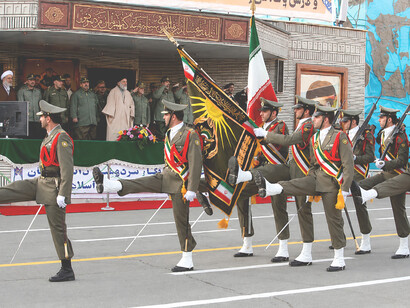
The doctrine of "Guardianship of the Jurist" means that the Supreme Leader is the custodian of a divine political project, not merely a CEO. When Khamenei was martyred, the office remained sacred. The assembly of experts which survived the strike had a predetermined, secret succession protocol. Within 72 hours, a new Supreme Leader was quietly installed from Qom. To the outside world, the regime appeared leaderless. Inside Iran, the switch had already happened.
The IRGC is a state within a state
Unlike the US military, which is subordinate to civilian control, Iran's Islamic Revolutionary Guard Corps (IRGC) is woven into every level of governance, economy, and ideology. Killing Pakpour and Mousavi did not paralyse the IRGC because its mid-level commanders, the hundreds of veteran colonels and brigadiers, operate with tremendous autonomy. They are ideologically self-motivated. They do not wait for orders from the top; they execute prepared contingency plans. Within hours of the strike, IRGC units launched drone and missile barrages from pre-positioned hidden sites.
The "Deep State" is horizontal, not vertical
Iran has parallel power structures: the clerical establishment, the military, the bazaar, the intelligence ministries, and the local Basij militias. These networks overlap and constantly communicate. When the formal leaders died, informal leaders emerged—often quietly, often from the second or third tier. This horizontal resilience is alien to US planners, who expected vertical command to collapse.
Trump's fatal overestimation
The president's unilateral decision to attack—bypassing intelligence agencies—compounded these errors. He assumed that "shock and awe" against the top would produce a popular uprising. Why? Because prior to the war, there were genuine protests in Iran over economic grievances.
But nationalism is a powerful anaesthetic. When foreign bombs started falling on Tehran, killing the Supreme Leader and his family, the streets did not rise against the regime. They rallied behind it. The regime, bloodied but not broken, channelled that rage into a unified war effort.
The US and Israel had overestimated their own power and underestimated Iran's distributed resilience. They thought Iran would break in two days. Instead, Iran dragged them into a quagmire that lasted months—and ultimately ended in American withdrawal, humiliation, and defeat.
Conclusion: the lesson for future wars
The failed decapitation of Iran offers a stark warning: regimes are not all alike. A structure that works for the USA's transparent, hierarchical, succession-driven system is not universal. Iran's hybrid clerical-military network, built for survival after decades of sanctions, assassinations, and pressure, proved remarkably resistant to decapitation.
Donald Trump promised two days. The war was lost because the US never understood the enemy it was fighting.