English
 Español
 Français
 Deutsch
 Italiano
 Português
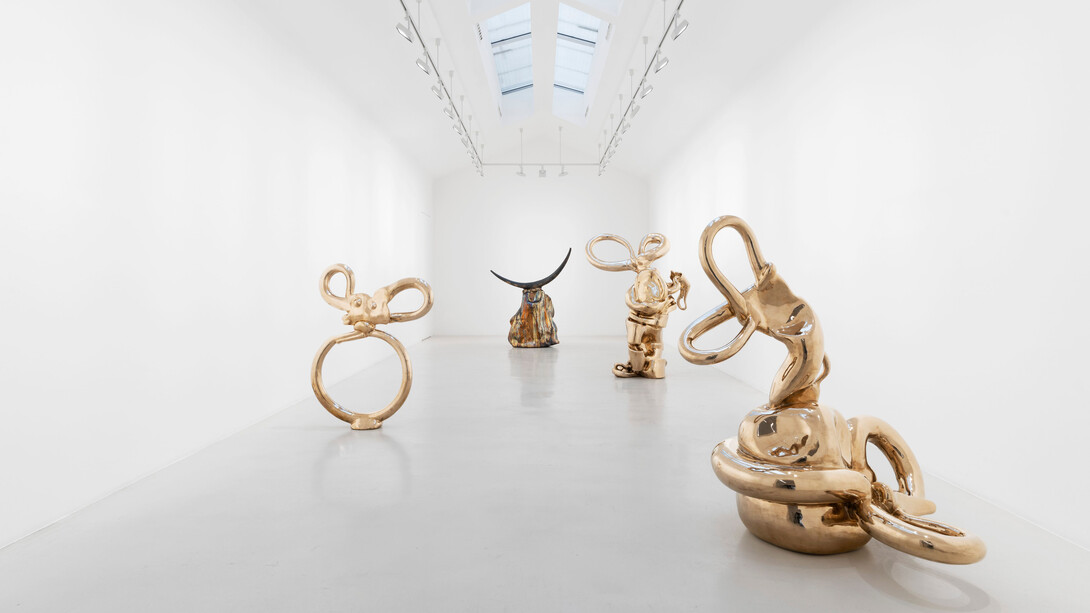
Perrotin presents Alma Allen's first solo exhibition with the gallery, debuting in Paris.
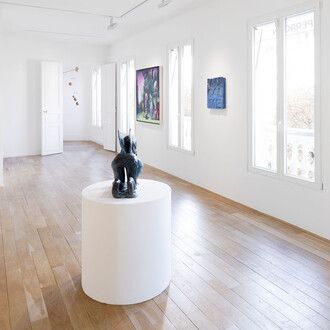
Allen is a self-taught sculptor who works in wood, stone and bronze, often with material sourced from his immediate surroundings. His works appear psychically charged and talismanic, simultaneously inviting and resisting classification.
Resembling roots, seed pods, molluscs and fossils, the sculptures appear to relate to the vast expanses of territory and monolithic natural formations that have punctuated his life: Utah where Allen spent his childhood; Joshua Tree, California and Tepoztlán, Mexico, where he currently lives.
When a collector once asked Jean-Michel Basquiat for his C.V., the artist offered to draw around the outline of his hand. I imagine Alma Allen’s hands, too, as a record of his experience: whorled and rubbed, smoothed and shattered — ‘plump with struggle’, as one critic described Allen’s life story. Though his sculptures take their final form in the hard stuff of stone, wood and, more recently, metal, each one still begins, as they have since he began carving with a pocketknife as a teenager in Utah, in the immediacy of the hand: the artist working pieces of string, clay or wax through his fingers, pushing their limits, finding the point where they have poise and weight. It’s a meditative practice, the aim is not mastery over these materials, nor to realise some predetermined intention through them, but to release a potential form that is somehow already there. ‘To have my hands teach me something’, is how Allen puts it.
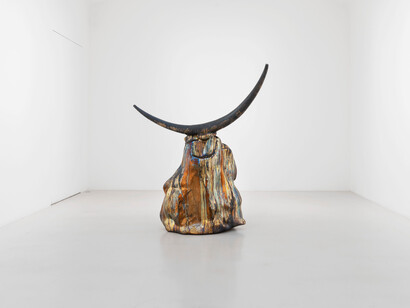
Scanned from these hand-sized works, scaled up and finally cast in bronze at Allen’s home foundry, the sculptures in this exhibition still bear Allen’s intimate relationship to the tactile. You don’t need to be a seafarer – or to know that the artist loves to sail and is planning a voyage by boat from Mexico to Europe soon – to recognise the haptic grammar of nautical knots in these sculptures’ twists and coils, or to feel in their snaking, spilling masses echoes of lengths of rope hitched up, looped around and extruded out from a tie. Allen worked on many of these pieces after spending time in Venice this year, he tells me, carrying with him the experience ‘of being surrounded by water’; several of them he worked on aboard his boat, carrying his hand-sized models in a small suitcase. Looking at these tensile, fluid forms, you can almost imagine forces pulling on them across a voyage: rough winds, deep tides, towing and straining. Yet for all they stretch and wind, these braids and tangles do not give. If they evoke strain or stress, they also impart an ultimate sense of holding fast – holding on. Standing for a kind of endurance, they also remind us of what art is and always has been for Allen: the means of survival.
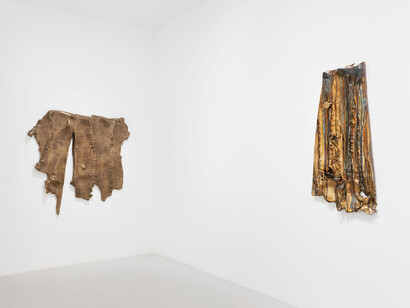
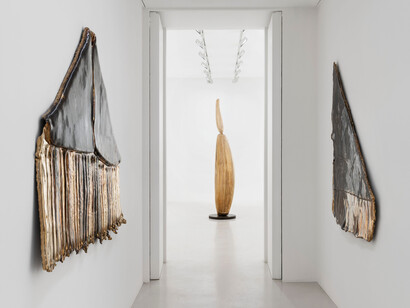
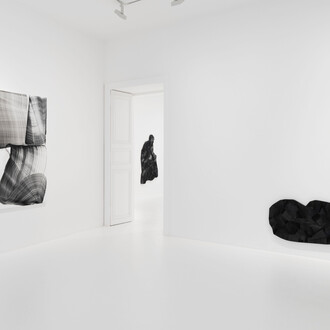
A group of bronze wall-reliefs presented in the exhibition also show the trace of the artist’s hand, their rippling and ridged surfaces showing a process of shaping, like dough that has been kneaded and stretched. Recalling shields or animal hides, they stir ideas of protection or shelter, but also could be fragments of a cave wall, or a cliff face. It makes sense when Allen tells me that the first and possibly most impactful artworks he ever knew were Native American petroglyphs. (Note that Allen intends for the highly polished patinas of these bronzes to develop and deepen over time, as a stone in a landscape becomes weathered.)
As shown in his 2023 exhibition at Mexico City’s Museo Anahuacalli, where his works rubbed shoulders with Diego Rivera’s collection of pre-Columbian art, Allen has a deep affinity with art of the ancient past. He describes the wonder of encountering, in the petroglyphs he saw in Utah, the work ‘someone I never knew, or saw’. It this way, art for Allen has always involved a certain distance – something that necessarily cannot be articulated or explained. Two wall-reliefs in the exhibition seem to have doubled over themselves: Allen likens them to pages of a diary or a letter, folded up so no-one can read them: so that they keep their secrets.
The lines or seams in these new works also, to me, recall the ribs or ‘flutes’ which run down the length of a saguaro, that sacred cactus whose lined, columnar form is recalled by two upright works in this exhibition. The other thing they remind me of are the folds in a piece of Renaissance drapery, like the ones in, say, the Madonna del parto (c.1457) that Piero della Francesca was said to have painted by hand in seven days, just after his mother’s death. Evoking both the divine and the botanical, these works shed further light on the towering piece that Allen placed at the centre of his Venice exhibition: a great gleaming figure that evoked both the saguaro and the shape of the Virgin of Guadalupe, the patroness of Mexico, who spoke Nahuatl and left her miraculous mark in the folds of a tilma, an indigenous cloak.
‘I do in a sense make apparitions’; Allen concedes when we speak. We are talking about mysteries: unexplained experiences, the doctrine of Analytical Idealism and life in a town where the appearance of a spirit is an everyday occurrence, like the weather: but also, how a life streaked with isolation and destitution has led, through twists and turns, to the living miracle of a loving family and a busy studio. In their constant encounter with the unexpected, Allen’s sculptures are tributes to these mysteries and witness to the essential and unpretentious curiosity with which the artist meets them: his simple desire to ‘look around the corner of what reality is and use my own life as an experiment to understand it.’
As ever, every work in the exhibition goes by Not yet titled. With this statement of insistent inconclusiveness, Allen reminds us to hold back space for information and understandings to be revealed. Hindsight, I read somewhere, is only ever 50/50, after all: the other half of the story has to be out there, still to come.
(Text by Matthew McLean)