English
 Español
 Français
 Deutsch
 Italiano
 Português
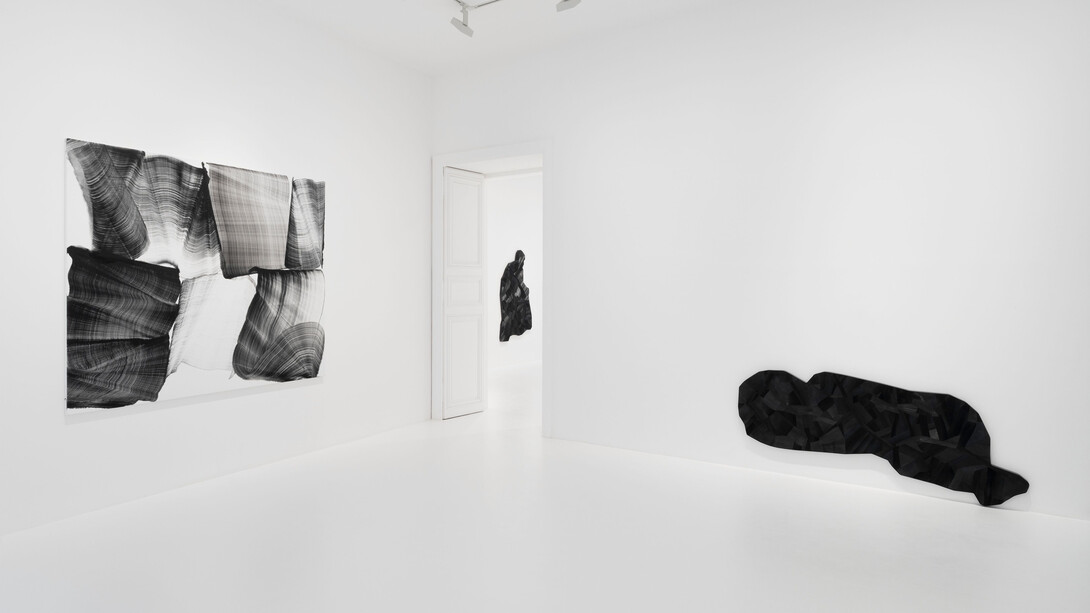
Following major solo institutional exhibitions this year at Museum SAN in Wonju, South Korea, the He Art Museum in Shunde, China, and the Abbaye de Beaulieu-en-Rouergue, France, Lee Bae returns to Perrotin Paris for his ninth solo exhibition with the gallery.
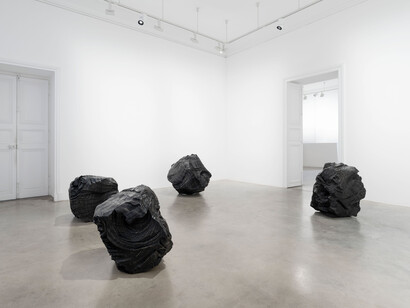
With Attending, the artist presents a new body of work including large-scale sculptures and an in-situ installation, recent works from his Brushstrokes series, and a performance video.
The cycle of life beats at the heart of Lee Bae’s art. Widely recognized for his mastery of charcoal, the philosophical artist uses it to explore universal themes of destruction and renewal. Charcoal, made from wood burned by fire, symbolizes both nature’s destructive force and its potential for regeneration and reignition. For Lee Bae, charcoal embodies the life cycle, purification, the passage of time, and energy. It is nature transformed by fire.
Born in South Korea in 1956, Lee Bae came of age amid his country’s collective trauma from the Japanese occupation during the Second World War, the hardships of the post-Korean War era, and the economic struggles of the 1960s and ‘70s. He attended Seoul’s Hongik University, where he studied art under Park Seo-Bo, considered the godfather of Dansaekhwa—a monochrome movement that rejected both Western and Japanese art traditions in favor of introspective, labor-intensive, highly repetitive methods involving close physical interaction with raw materials.
Exhibiting in solo and group shows in Korea soon after earning his MFA in 1986, Lee Bae moved to Paris in 1990, encouraged by Lee Ufan, another Dansaekhwa master and co-founder of Japan’s Mono- ha movement. Instead of producing traditional sculptures or paintings, Mono-ha artists arranged basic natural and industrial materials—like stone, soil, wood, iron plates, glass, and rope—in straightforward, unembellished compositions. When Lee Bae arrived in Paris, he worked as an assistant in Lee Ufan’s studio for the next several years.
Lee Bae learned self-improvement through art—the unity of body and mind—from Park Seo-bo, while Lee Ufan taught him about the relationship between space and material, encouraging him to empty himself and discover a new connection between the material and his identity as an artist. Seeking a meaningful artistic identity outside his home country, Lee Bae began using charcoal as a raw medium, partly because of the same financial constraints that led the Dansaekhwa artists to use simple materials, and partly for its spiritual connection to his birthplace.
Never considering himself a Dansaekhwa artist, he has conceptually bridged the Dansaekhwa and Mono-ha movements by dedicating his practice to a rigorous study of the color black and the purity of form— developing a style of art that is distinctly his own. Lee Bae’s approach is an introspective, labor-intensive process in which the artist’s body engages closely with raw materials. His practice reflects a spiritual, ritualistic movement, repeating precise physical tasks using carbonized trees. This repetition—like his physical movements while creating lively calligraphic works—becomes a meditative conversation among the body, time, and matter.
Developing a deep spiritual and artistic philosophy centered on charcoal, Lee Bae has skillfully used the material as the primary artistic medium across drawings, paintings, sculptures, and immersive installations for over 30 years. Charcoal is more than a basic material for him. It matters more because he makes it himself by burning pine, oak, and poplar trees, pouring his time and energy into creating something new. He thinks about the work as he makes the charcoal. Before he creates, he always takes time to gather his thoughts. For him, waiting isn’t a waste of time; he needs it to think when starting his creations.
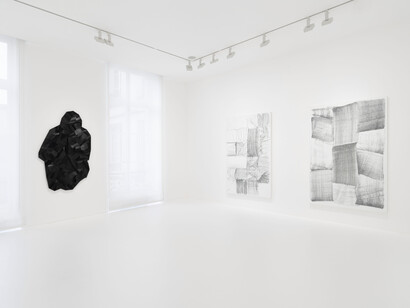
Lee Bae’s mosaic-like Issu du feu (From fire) assemblages are created by slicing charred wood chunks and charcoal fragments into shards, meticulously arranging and embedding them on canvases, then sanding the surfaces and coating them with resin to create monochromatic blacks that both absorb and reflect. His sublime Brushstroke paintings use a mixture of charcoal ink with oil to create thick, spontaneous gestures on paper or canvas—thoughtfully conveying bodily movement, physical gravity, and the passage of time through abstract, meditative strokes. In sculpture, he transforms raw, carbonized tree trunks into striking physical totems, while handily translating his charcoal ink brushstrokes into large-scale, three-dimensional bronzes.
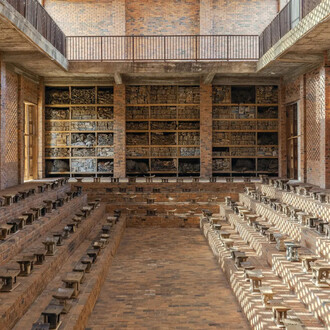
For his 2024 Venice Biennale collateral exhibition, Lee Bae created an immersive installation that integrated many of his working methods to metaphorically recreate a Korean Moonhouse Burning, a ceremony traditionally held on the first full moon as a community celebration of cyclical cosmology. More recently, he presented En attendant (Waiting), a three-venue exhibition offering a different methodological overview— exploring charcoal as a medium of transformation, the cycles of nature, time, disaster, and active waiting—at the historic Abbaye de Beaulieu- en-Rouergue in France, in his hometown of Cheongdo in South Korea, and at the country’s spectacular Museum SAN, a modernist temple for art designed by Tadao Ando, in Wonju.
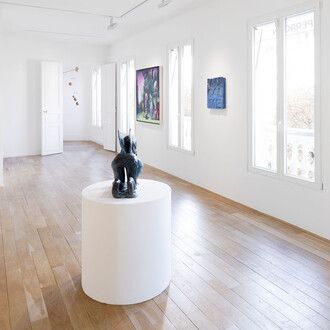
Following these marvelous mixtures of old and new ways of working, the artist’s exhibition at Perrotin Paris—his ninth solo show with the gallery since joining in 2018—presents an immersive installation of works spanning two floors of the gallery and the garden. Featuring his signature Issu du feu assemblages on canvas and Brushstroke-Bronzes, the sprawling exhibition will also include a new video, Lee Bae’s innovative Brushstroke-Staples pieces, and the introduction of his Issu du feu-Performance assemblages, shaped by elements of the artist’s video ritualistic performance in a Korean rice field.
Titled Attending, the exhibition advances the concept of waiting, or gidarim in Korean, which can be understood as an action—an entire emotional experience of anticipating something or someone you deeply care about. Lee Bae chose Attending as the exhibition’s title to offer a fresh perspective on the attitude of waiting—a theme that has long defined his work. Attending means being fully present in the moment while awaiting something that has yet to arrive. It involves paying attention, listening closely, and focusing on time, space, and one’s own existence.
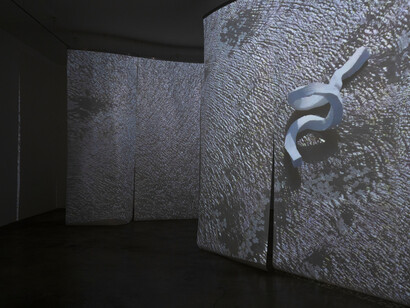
The new video, Becoming, performatively captures Lee Bae becoming one with nature and his homeland, rooted in a rice paddy, as he brushes the land and large sheets of white fabric with a broom made of tied tree branches. He moves through the watery realm, meditatively pauses to plan his next move, then takes action with his broom, brushing with calligraphic gestures. He’s working the soil, reflecting the closeness to labor in all of his work—from the gathering of trees and making of the charcoal to the repetitive, almost meditative quality of his approach to his art.
His new shaped Issu du feu-Performance works, created with shards of charcoal assembled on cutout pieces of wooden planks, reproduce the artist’s silhouetted form as it moves in the video. Abstractly frozen in time, the figurative form takes on a three-dimensional power as light reflects off the shifting planes of the mosaic slices of charcoal. Relatedly, his light-reflective Brushstroke-Staples pieces are calligraphic works that simulate large brushstrokes and expressive gestures using clusters of metallic staples. Revisiting an earlier use of this medium in an inventive way, Lee Bae uses this commonplace office supply to recreate meditative mark-making, applying thousands of individual staples to create a highly textured surface that catches light and reveals a visible movement of energy.
In the garden, Lee Bae presents a sculpture from his celebrated Brushstroke-Bronze series. The sculpture employs bronze, yet it is treated to achieve an almost charcoal-like blackness. It does not merely imitate charcoal; rather, it preserves charcoal’s language in another medium through its rough surface, light-absorbing blackness, fire-scorched texture, and the way a line suddenly freezes mid-movement. Bronze gives the work weight and permanence, while charcoal carries its memory and spirituality into this new form. Lee Bae’s bronze work goes beyond enlarging visual scale and space; it also entails deeper material shifts. The initial shift crosses dimensional boundaries: a quick gesture, once confined to paper, becomes a three-dimensional form to walk around, view from below, and examine closely. The brushstroke evolves from a mark into a physical form between earth and sky.
While Lee Bae’s sublime garden sculpture features stacked elements of individual gestures that coalesce into a unified piece, the equally dynamic works on view in the exhibition’s eight interior rooms are linked by a cable, like the expressively tied wire binding his bundled burnt wood sculptures, forming a fascinating poetic thread that traces the continuous connection throughout the Paris-and Seoul-based artist’s ever-evolving, imaginative body of work.
(In the moment. Text by Paul Laster, Art curator)