English
 Español
 Français
 Deutsch
 Italiano
 Português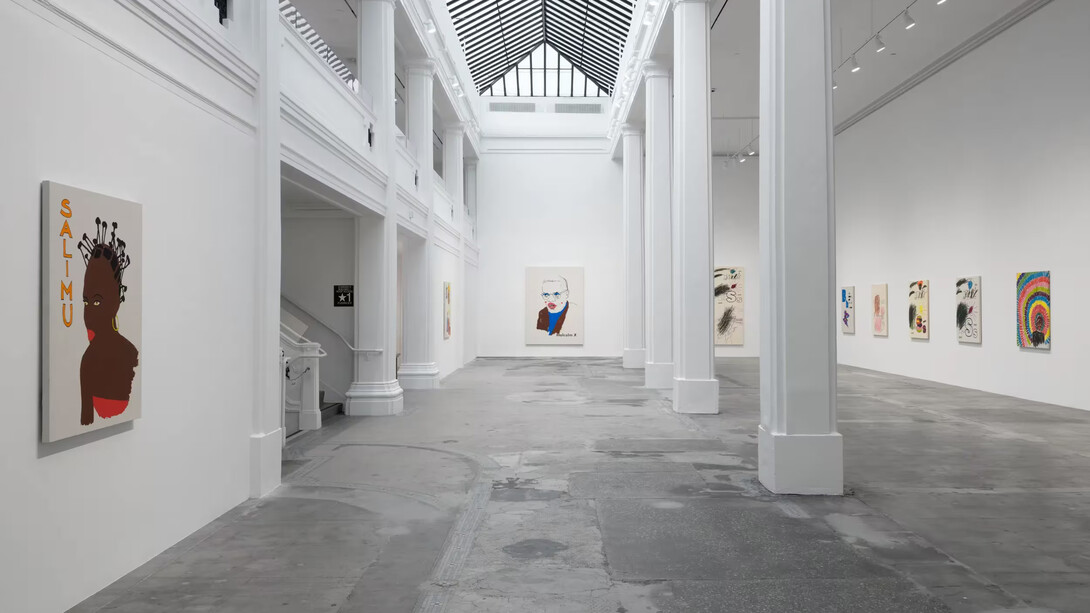
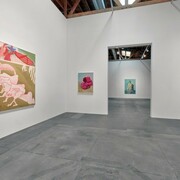
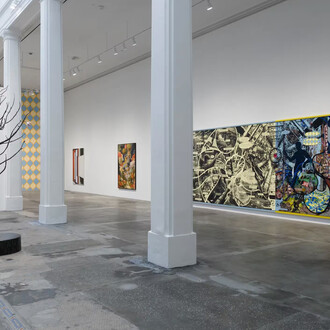
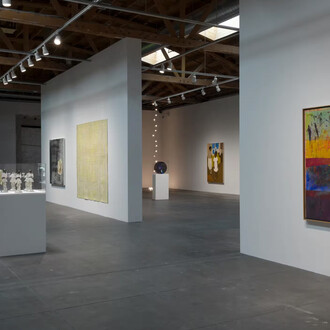
On view together for the first time in 25 years, Sit so your back isn’t against the door reunites the largest group of Glenn Ligon’s Coloring book paintings since their debut at the Walker Art Center in Minneapolis.
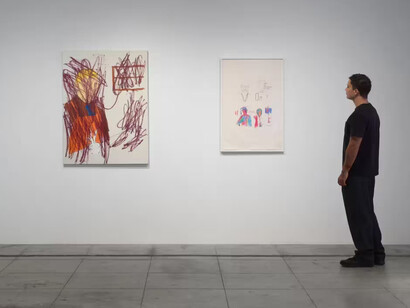
Conceived during the artist’s 1999 – 2000 residency at the museum, the celebrated series draws on Afrocentric coloring books of the late 1960s and early 1970s. While at the Walker, Ligon invited local schoolchildren to color pages from these vintage publications, then reinterpreted their creations in his own hand on large-scale canvases. The resulting paintings—colorful, uninhibited, deceptively loose—offer a striking departure from the monochromatic, text-based work for which Ligon is best known.
Sourced from the Schomburg Center for Research in Black Culture, the post–Civil Rights-era images that filled these coloring books were created as tools for teaching children the visual vocabulary of Black pride and self-representation. Ligon, however, removed the historical context, reproducing them as simple coloring sheets to share with the children in his workshops as an invitation to draw unencumbered. Initially attempting to replicate their spontaneous marks precisely at scale, Ligon soon discovered that the children’s wonderfully unguarded gestures could not be replicated. He reinterpreted their drawings, preserving each child’s palette and composition while allowing his own hand to improvise, translating young, unfettered gestures into deliberate marks.
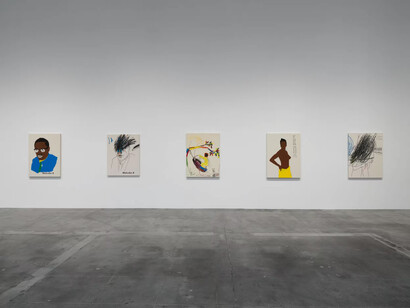
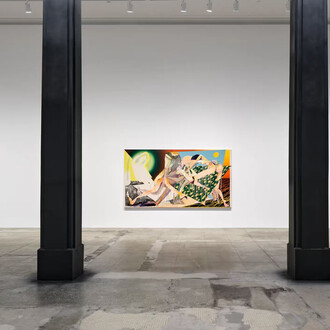
Across his Coloring book canvases, Ligon isolates and recombines imagery—suns, alphabet letters, street scenes—with portraits of such historical Black figures as Frederick Douglass, Harriet Tubman and Malcolm X. Multiple versions of paintings come from the same template: marks pile up in dense thickets of pigment in some works while just a few strategically placed blooms of color are enough to animate a face in others. While Ligon’s tactic of repeated templates recalls the mass production of the original educational coloring books, each painting takes on its own meaning. The children’s instinctive, unselfconscious marks combined with Ligon’s considered, conceptually informed interventions render layers of meaning and association and invite multiple interpretations. In Malcolm X, Sun, Frederick Douglass, Boy with bubbles (Version 3) #2 (2001), both of the titular historical figures appear with rouged cheeks, a detail taken directly from one child’s drawing. Ligon’s color application recalls the stylized make-up of Andy Warhol’s Mao paintings. But where Warhol drew parallels between propaganda and consumer culture, Ligon foregrounds education’s role in constructing identity and reinforcing stereotypes. Both playful and unsettling, the Coloring Book paintings expose how elusive representation can be, hinging on the tension between children’s untutored imagination and the historically informed perspective only an adult can bear. This friction squares with Ligon’s broader interest in abstraction and legibility, typifying his approach to stripping legibility not to obscure meaning but to enable its multiplicities to surface.
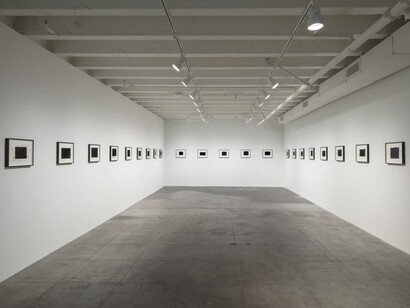
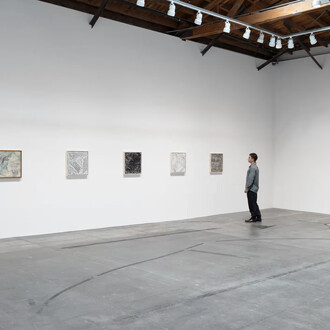
Alongside the Coloring Book paintings, the exhibition at Hauser & Wirth will debut Ligon’s Black panther coloring book #1, a new 22-part work based on a political primer for adults illustrated in 1969 by artist Akinsanya Kambon and later circulated by the FBI to discredit the Panthers. Working in black oil stick, Ligon masks each image behind a taped-off rectangle, leaving only captions, faint traces of the drawing, and his own fingerprints and smudges visible. Degrees of concealment shift from page to page in a studied obscurity that turns withholding itself into a form of meaning.
Throughout Sit so your back isn’t against the door, Ligon returns to existing historical images as material that can be revisited, reinterpreted and transformed, accruing new significance as the context changes.
Alongside the exhibition, our Learning team will collaborate with local partners on a public program inspired by Glenn Ligon’s practice, culminating in a collaborative poster project shared at a public event in December.