English
 Español
 Français
 Deutsch
 Italiano
 Português
The industrial chimney rises not simply as a structure, but as a body under pressure — its bell-bottomed form an architectural concession to force, to the need to both contain and expel. It is a vessel of tension, bulging where it must endure, narrowing where it siphons to release. From its topmost mouth, white steam erupts in colossal funnels, not as elegant script but as blunt declaration: a wall rather than a line; a thickened mass, no lightness of gesture. It resists the delicacy of drawing. There is no calligraphic flourish, no expressive hand. Fat steam does not belong to the taxonomy of elegant vapors — the curlicue of cigarette smoke, written from the mouth like silent and personalized script; it is not the romantic chimaera of an extinguished candle flame. Instead, there is an insistence on volume, on the suffocating potential of accumulation as a singular wall.
This pummeling white mass threatens not by dispersing into invisibility, but by its capacity to remain, to hang or submerge, to flatten the field of vision into a misty and unarticulated presence. What is uncanny is the conjoined sense of paralysis and inanimation: an industrial building shrouded in smoke or fog is engulfed and made explicitly heavy, numbed as a subject despite its use as apparatus. Like an enormous glass tower block that in sunlight transforms into a throbbing mirror, this is infrastructure making kinetic procedure visible: the actions of blanketing, excoriating, washing, saturating, devouring, outlining, engorging, scorching.
The graphic flames on a fire extinguisher are illustrated as curved, stylized blades like jagged red grass. There is no sense of fire as sublime decimator, as hot tongue or poetically livid transformative engine; rather, this graphic signage breaks meaning to present a glyphic idea of gesture. Representation abstracts danger into something mathematical and decorative, a reduction of energetic disarray held in by a neat, vectorized border. The clash provokes an unbalanced sense of mutual ruin and regeneration, signage for a manic and hypothetical energy circuit reduced to a simple organic badge. Perhaps this distillation of connotation and depiction creates a new verbal arch with multiple options: entry to a larger continuum of abstract chaos and secret animism, or exit to methodological containment. ABC powder is a common category of fire extinguisher that coats burning material with a thin layer of dust, effectively separating any fuel source from oxygen in the air and halting the chemical reaction that initiates flames.
The ABC refers to classes of combustibles — solids, liquids and gases; DEF is another common category, extending the technical description to suit flammable metals, electricals and cooking media such as deep fat fryers. Any alphabetic ordering automatically positions language as an instrument with iterative and collective options. This childish, sequential terming implies a series of classifications that might feasibly be hijacked to extend outwards to more existential or metaphorical frames, to desire, fear, inertia, rage: GHI deployed to extinguish greed, hate, and irony; JKL to jealousy, kindness and love; MNOP to madness, nymphomania, obstinacy and pleasure. Perhaps ABC powder provides an invitation to all generalities of creative production: a simple reclassification of substances, expelled and expanded, to the point of requiring a new landscape of definition. ABC powder as obsession towards active disjointedness.
Any expulsion also necessarily implies containment. A border speaks to a body of one kind or another: matter shifted for its capital, political, social or aesthetic relevance from one territory to another. On a granular scale, to blow air into a balloon is not merely to transfer atomic matter but to give away something less tangible: the trace circulatory intelligence of chemical individuality and its distributable points of ignition.
Breath carries with it memory, sensation, shame — the flavor of a synthetic drink on the tongue, the hushed persistence of an undiagnosed pain, the intimate cleanliness of brushed teeth that nevertheless anticipate contact, portions of speech modulated by exertion. The balloon, then, is not empty: it is filled with a condensation of personal and social subjectivities, stretched thin across a surface that defines both its limit and its symbolic meaning. The frame, in this sense, does not simply contain; it produces.
A field of circles, for example, remains abstract until it is interrupted by automatic (and accidental) association — until eyes, noses or mouths are imagined, and suddenly, faces emerge. Recognition is not inherent but psychologically constructed, layered atop geometry. Likewise, a schematic arrangement of shape or pattern may at any moment tip into figuration: a mouth appearing on a chest, an anus displaced to a foot. These transformations are not aberrations but expansions. They suggest that any sense of a conventional physical body is not fixed but distributable and that this logic can be reconfigured. A hole is an orifice and an oracle, a darkness of sucking, swallowing, digesting, conjuring and disappearing; it is also a cosmos expanding and repositioning, shifting matter or recoding it altogether. The hole is a stockpile of waste or the productive space in which to empty anything: thus, a repository of invention. The pictorial hole is ball and boulder, tunnel or abyss. A hole in a painting or a screen is a different critical conclusion: mechanical punctuation like a quotation of language; a damp patch of shade that paradoxically becomes a mirror; a Rorschach blob that, like wavy ribbons of smoke, diagrams affinities with soul and text.
There is too, the strange physiognomic vestige of an object whose function has been repurposed: a kind of mimicry, explicitly not memory, but a haptic lodging of previous iterative function. Perhaps this might be imagined like a ghostly parallel action, the trace residue of one explicit functionality that sits displaced, but still present, beneath a new kind of scripting: a broom that no longer sweeps, but props up a picture; a diagram so wholly extricated from its original diagnostic or illustrative function that it becomes simply musical or obdurate; curtains on a draped window that abandon their diurnal usefulness, becoming violently anthropomorphized like a libidinal peeling of hair or skin; a grid that is no longer building or plan, but infinitely expansive mythology. Perhaps loosening diagrammatic or linguistic clarity creates a deliberate catastrophe, initially appearing as a mere accident of layout or intent, but in doing so erasing all previous clichés.
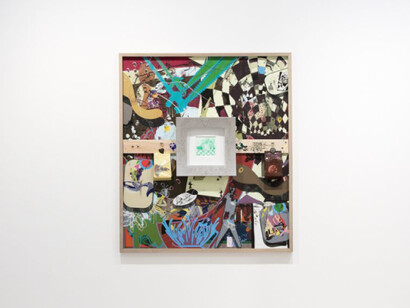
A chessboard with its miniature landscape is another tray of offerings. Model forms are chosen in portions of theoretical risk and spatial calculation. Alongside naked geometry, there is the mannerism of movement, knots of thinking and intent kept constantly in motion even if a game is dormant. This ingrained vibration of parts — like wood, leaves, dust, letters, handwriting, birds — means that there is always a surplus of philological and iconographic motion: a pawn is not a numb subject; a castle not simply a model house. Rather, something is always exponentially turning into something else. Perhaps there is a sly nod to Surrealism's taboo elongations and rapid psychological meta-morphosis. Perhaps the game board is explicit in that it is always an analogical surface. Like cartoons and their approximations of virtual architecture, it is full of the spirit of animation: the simulation of inorganic matter into a terrain that is explicitly vivified. Space is opened not only for formal invention but for metaphor — one tethered to language precisely because it hovers so close to the body, even when that body is only implied, for in the assertion of architecture there is always a reflexive assertion of bones.
The enduring relationship between field and frame is a negotiation rather than a hierarchy. Forms behave like a squabbling machine — any shape reiterating itself, plastic only insofar as it repeats and mutates its own conditions. There is no stable ground, only a series of expansions that argue with one another, jostling for coherence. This instability becomes materially explicit in the act of making. To scratch into a foundry sand mould is to draw blindly, to produce marks that cannot be immediately verified. Sand gathers and obscures, behaving like a fast adhesive dust that conceals the very gestures it receives. Visibility must be forcibly restored: compressed air tools are used to clear away the surface, revealing what has rapidly been made and even more rapidly hidden. Even then, the act of seeing is compromised, because dust accumulates — talcum lubricant, smoke particles, resin powder — building on safety lenses, on protective ventilators, on the apparatus of perception itself. The effect is not of increased saturation as with the addition of water or oil, but rather a new kind of interfering static electricity. Vision becomes contingent, disordered by infrastructural interference. Even hair is altered by this environment: previously sculpted by grease or paste, its many follicles are newly softened by the oil-blotting friction of airborne particles, brushed ironically clean and smooth, not by intention but by accumulation.
Although a sand mould is only one niche analogy, cleaning a surface often produces a split, like a kind of Freudian twinning. A cleared patch of legibility sits beside blurred or contaminated residue, and the eye must negotiate both simultaneously. One is forced to choose: to work intuitively within known gestures that can later be refined, or to persist with the convention of following a visually continuous line, marking and erasing in tandem, trusting in a classically deployed mode of drawing. In either case, the act is conditioned by partial knowledge, by an acceptance that clarity is always deferred: on the one hand a literal obfuscation, and on the other hand, marks made in mirror image because the mould is only one half of a negative container. Like so much handwrought process, what occurs is an endless metabolism of picture and activity that allows, within terms of paradoxically destructive effort, multiple productive reveals. This displaced visibility finds an echo in the experience of migraines accompanied by visual aura. Here, the disturbance is not pain per se, but certainty itself. Vision tears, vibrates, reorganises into a sharp and insistent pattern that overrides all else. It is a presence that is totalizing, beautiful in its intensity yet deeply disorienting. The world does not disappear; it is replaced and opens like a zipper towards a new space of temporary fracture that is not metaphorical but chemical. The mechanism of seeing is subsumed by a personal kind of internal weather that renders external objects secondary.
In such moments, representation collapses into its most elementary forms, into the bigness of megastructures. Grain, texture, grammar — all become momentarily irrelevant except as underlying notations, a kind of abstraction-in-suspension that points directly at meaning without fully inhabiting it. What remains is a pre-symbolic state, an attitude rather than a language. It is as if language itself has been ground again into another kind of powder, gleefully suspended in air, and it must wait to settle into sequences of more acceptable pronounceability. The particulate becomes both medium and message, both the maker of signs and their obstruction. Air is the armature.
Within this awkward framework, a forensic prudishness takes hold: a commitment to fidelity that paradoxically once again relies on abstraction. It is a meticulous attention to detail that strips away excess while simultaneously intensifying meaning. The result is a state that is both desperately real and desperately unreal — a tension between the desire to capture the world as it is and the recognition that such capture is always mediated, always incomplete: puritanical connotation. In the end, the chimney’s steam, the balloon’s breath, the air’s dust, and any fractured field of vision all point toward the same condition: that perception is never neutral and endlessly moving. It is always shaped by pressure, by containment, by the bodies that produce and receive it. What emerges is a stratified understanding of visibility itself. Like layers of the Earth — core, mantle, crust, atmosphere — vision itself can be graded, located, and analyzed as a series of slivered iterations. Each description carries its own density, its own logic, its own chemical attitude, its own distortions. What is seen is not simply what is there, but what can be held, expelled, obscured, and reassembled. Perception is always mediated, always contingent on context. The cultural condition that follows is reactive, shaped by these disjunctions rather than by stable correspondences.
(Text by Helen Marten)