English
 Español
 Français
 Deutsch
 Italiano
 Português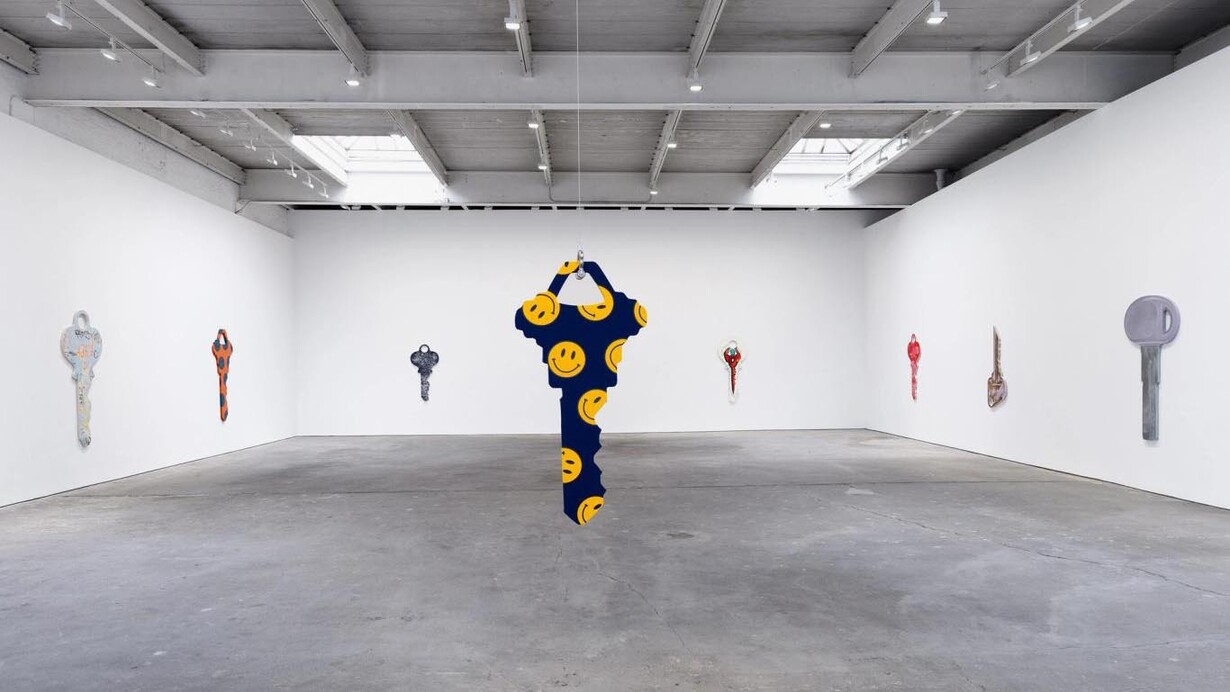
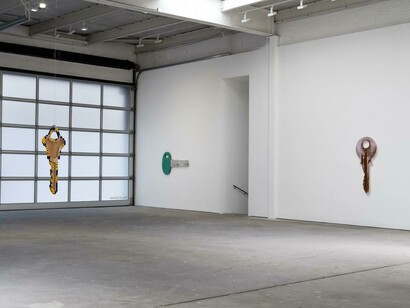
David Zwirner is pleased to present new work by Nate Lowman (b. 1979), opening at the gallery’s 519 West 19th Street location in New York. The exhibition debuts a body of shaped canvases that take the form of keys–objects freighted with associations of access, security, and exclusion–a new motif for the artist.
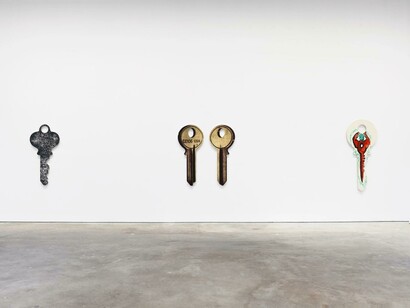
Lowman has frequently employed universally recognizable shaped canvases including hearts, tree-shaped air fresheners, poppies, and maps, among others, each produced in iterations with distinct painted surfaces. His key paintings extend this vocabulary, ranging from tightly rendered replicas to more schematic, nearly abstract forms. Some reproduce dissonant photographic imagery taken by the artist; others appropriate the bright, patterned novelty finishes available at hardware stores to distinguish one key from another; whereas another work, a silkscreen diptych, represents two keys yet to be cut into their final shape. The paintings recall distinct art-historical registers—from hard-edged geometric abstraction to loose, gestural markmaking, to the flattened logic of the readymade—each employing a different painterly language on the same recurring form.
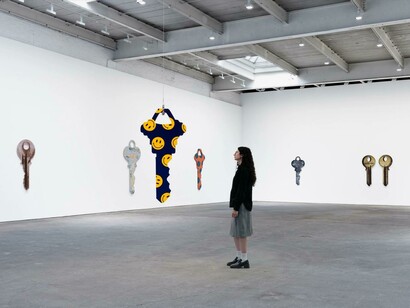
Hung serially, the keys enact their own logic of reproducibility and variation, each one a singular modification of a template, like keys themselves. This capacity for endless reproduction gives the key a particular resonance within Lowman’s practice, which has long engaged with the appropriation and recirculation of found imagery. The key is not only a subject for the artist, but also a metaphor for duplication, transfer, and dilution—the same slippage his images undergo as they are copied, recirculated, and subtly altered. These works continue Lowman’s ongoing complication of figuration and abstraction, painting and object, image and meaning.
Keys are indications of access—who is let in, who is kept out, who holds the right to a given space—ideas that carry a particular charge in a moment when security can feel more like a construct than a guarantee, and when the key itself is being nudged toward obsolescence by newer technologies. Even as it recedes from daily use, it persists as something valuable to hold onto: a small object with outsized meaning, handed from one owner to the next, exchanged at a closing, slipped under a door, passed from landlord to tenant, entrusted to a new employee. In New York, where Lowman has lived and worked for three decades, that logic of ownership maps onto real estate as much as anything else: A key becomes its own currency in a city where space is precarious and increasingly out of reach, sustaining a small local economy of twenty-four-hour locksmiths and duplication shops built on the fact that a key exists to be copied.
The key also marks a threshold between public and private. Several works in the series draw directly from Lowman’s own life. In his early years in New York, friends once gave him a copy of their house key—patterned with a rave-culture yellow-and-blue smiley-face motif, in a nod to the smiley-face paintings Lowman was making at the time—so he would have somewhere to stay. Another work reproduces the key to the artist’s current front door, while a third—painted from a photograph he took of names scratched into a bench in a botanical garden in Rio de Janeiro—takes the shape of a close friend’s spare, kept for emergencies. The motif also represents a quieter homage, in that the form was originally prompted by the memory of Lowman’s late friend, the designer Benjamin Cho, who designed an evocative dress in 2008 that was constructed with holes and keyrings. Together, Lowman’s key paintings bring together distinct registers of meaning—formal and symbolic, public and private—opening them up to new associations.