English
 Español
 Français
 Deutsch
 Italiano
 Português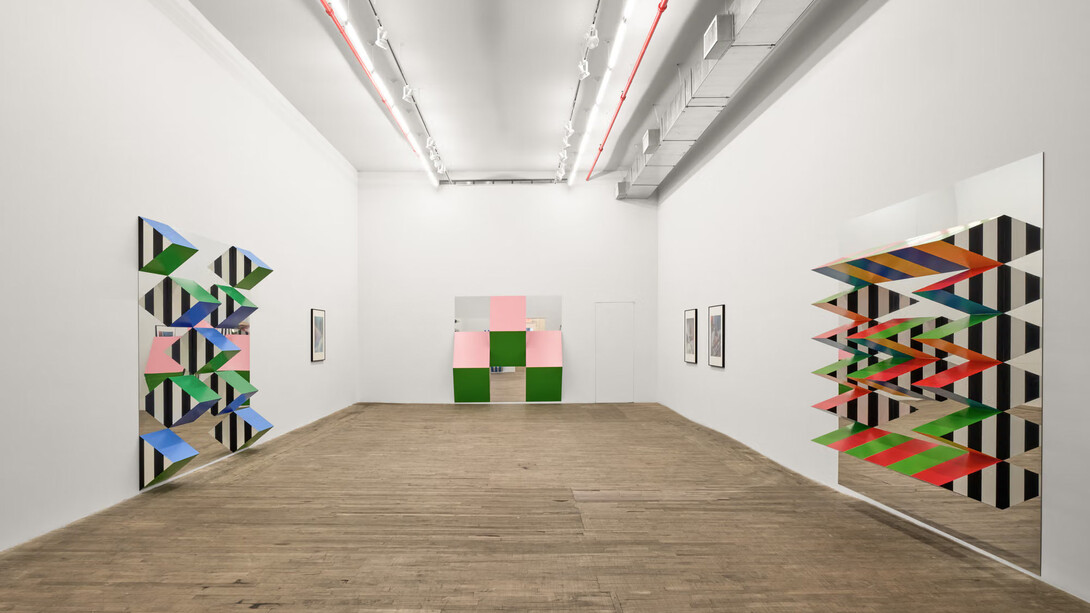
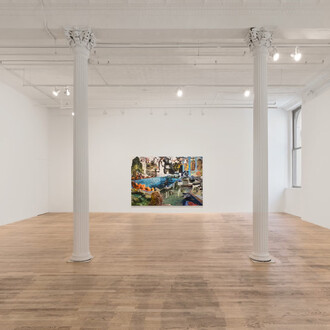
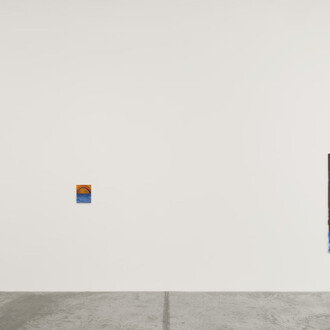
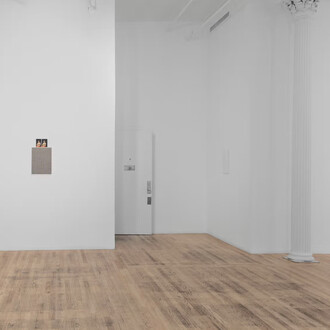
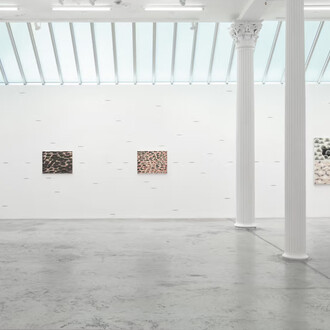
Bortolami is pleased to present an exhibition of works by Daniel Buren and Barbara Kasten at 55 Walker, on view from September 9 through October 24, 2026.
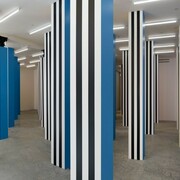
For the last six decades, Buren has worked in direct relation to the architectural placing of his works, with an interest in the physical conditions that shape how space is experienced. Kasten’s longstanding process includes assembling mirrors, screens, plexiglass, and geometric solids into temporary studio constructions, before using the camera to resolve these arrangements into an image. In this exhibition, the two artists share a similar formal vocabulary, using light, reflection, and geometry to different ends.
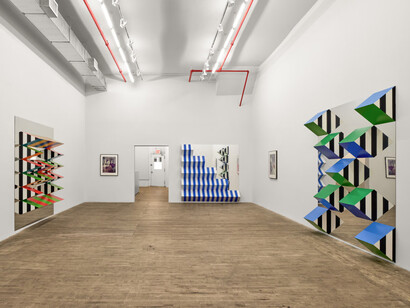
For Buren, the wall serves as a point of departure: his Haut-relief works rise nearly eight feet high, extending from the wall into the gallery, while their mirrored surfaces draw in what lies outside the sightline. Constructed from aluminum prisms and mirrored panels, these recent works employ bold colors, reflections, and shadows that move across geometric surfaces, creating prismatic projections that both expand and distort the viewer’s field of vision. Alike in scale, each installation produces distinct effects through variations of shape and pattern. Seen in conjunction, these works reflect Buren’s longstanding interest in complicating the relationship between art, its structuring frameworks, and the spaces in which they are encountered.
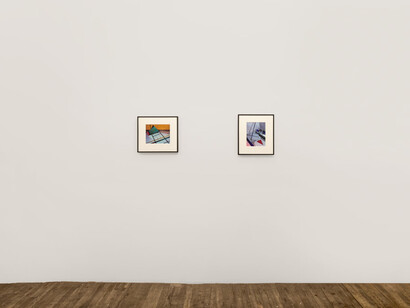
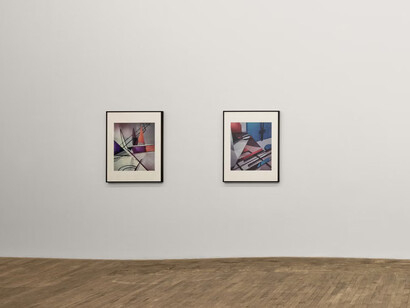
Kasten’s Construct Polaroids, made between 1981 and 1983, capture careful arrangements of geometric objects and mirroring surfaces. Built in the studio and dismantled afterward, the materials are presented as both subject and process. The series evolved from earlier experimentations with camera-less photography, such as cyanotypes and photograms, and her eventual turn to the Polaroid in 1979. Within each frame, Kasten’s constructed spaces resist a stable reading of depth and scale. The nonrepresentational, dimensional forms that make up her temporary studio tableaux are flattened through the camera into a single plane, collapsing distinctions between object and image. The resulting compositions exemplify Kasten’s commitment to making the photograph itself the site where space is both constructed and recorded, an approach that has remained central to her work.
Collectively, the works shift our attention between the space we physically occupy and the space produced through acts of looking, revealing perception not as a passive response to an environment, but as a process through which that environment is continually made and remade.