English
 Español
 Français
 Deutsch
 Italiano
 Português
The grid warning that changed the AI infrastructure conversation
On May 4, 2026, the North American Electric Reliability Corporation (NERC) issued a rare Level 3 “Essential Actions” alert — the highest category in its reliability framework — warning that rapidly fluctuating computational loads posed immediate risks to the stability of the North American bulk power system.
The warning marked a major shift in how electricity regulators are beginning to interpret AI infrastructure.
Public debate around artificial intelligence has largely focused on electricity consumption: how much power future AI systems will require and whether grids can support rising demand over time. NERC’s alert identified a different problem — not simply how much electricity computational infrastructure consumes, but how rapidly those loads can change once connected to large-scale power systems.
Grid operators reported customer-initiated load reductions and significant oscillations occurring within seconds, leaving “little or no room for real-time responses” to stabilise system conditions.
The organisation identified several forms of “computational load” as emerging reliability concerns:
AI training clusters
Hyperscale data centres
Cryptocurrency mining operations
Other large-scale digital processing facilities.
Electric grids remain stable only when electricity generation and consumption stay continuously balanced. Conventional industrial demand typically changes through slower physical processes tied to manufacturing throughput and localised operations. Large compute systems behave differently.
AI workloads can be redistributed, paused, accelerated, or disconnected through software orchestration systems operating across thousands of GPUs and multiple facilities simultaneously. At sufficient scale, these rapid demand shifts begin interacting directly with grid-balancing mechanisms that were historically designed around slower-moving industrial behavior.
Analysis from Carbon Direct, citing NERC reliability findings, described multiple events since 2022 in which more than 1,000 megawatts of computational load disconnected within seconds, creating severe frequency-management challenges for grid operators.
When very large computational loads disconnect suddenly, electricity generation briefly exceeds demand, causing grid frequency to rise before balancing systems can respond. If synchronised load losses occur at sufficient scale, instability can spread across interconnected systems faster than many operational frameworks were originally designed to manage.
NERC’s findings suggest that many reliability institutions were not built around this category of load behavior. In responses to earlier guidance, the organisation found that many entities lacked “sufficient processes, procedures, or methods” to manage risks associated with computational loads.
The May 2026 alert effectively reframed AI infrastructure as an active participant in grid stability rather than simply a large electricity customer.
Once computational systems begin altering demand on timescales that challenge conventional grid-response mechanisms, AI infrastructure stops being only a scaling issue and becomes part of the operational behaviour of the power system itself.
How AI infrastructure concentrates systemic risk
Another transformation is unfolding alongside these operational concerns: compute capacity is becoming concentrated inside a relatively small number of high-capacity electricity and network corridors.
Hyperscale compute clusters tend to emerge where several infrastructure advantages already align:
High-voltage transmission access
Dense fibre connectivity
Existing data centre ecosystems
Available land and cooling capacity
Favourable permitting and tax conditions.
Northern Virginia illustrates this pattern clearly. Often referred to as Data Center Alley, the region has evolved into one of the world’s largest data centre hubs, hosting an exceptionally dense concentration of cloud and hyperscale infrastructure. Similar clustering is visible across Texas, Phoenix, and Dublin as AI-related compute demand accelerates globally (see Figure 1).
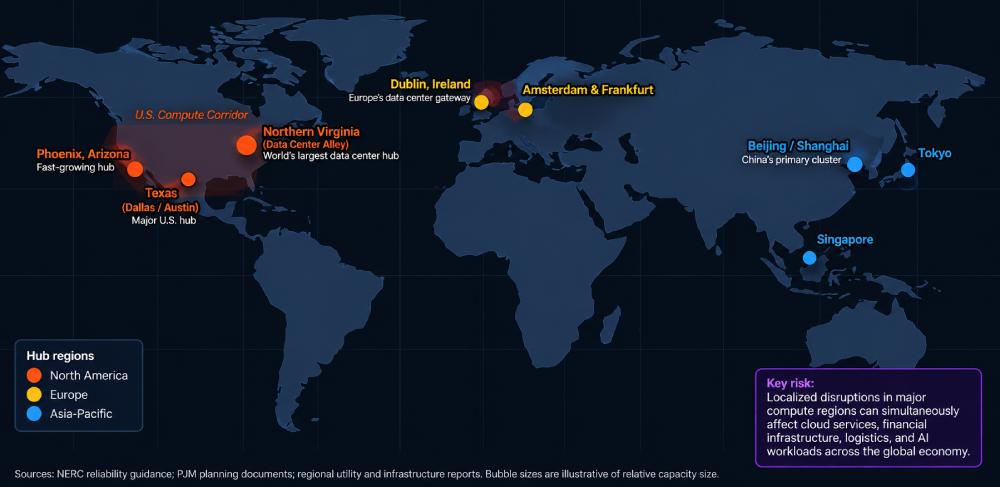
Figure 1. Geographic distribution of AI data centre infrastructure.
Industrial electrification historically distributed demand across broad manufacturing geographies. Hyperscale compute follows a different logic. Economies of scale increasingly favour concentration near substations, transmission corridors, and mature data centre ecosystems.
That concentration changes the structure of infrastructure exposure.
Growing shares of compute capacity are now dependent on a relatively small number of regional electricity systems. Localised disruptions inside major compute regions can therefore affect disproportionately large shares of cloud services, enterprise platforms, logistics systems, financial infrastructure, and AI workloads simultaneously.
The issue is not simply electricity demand in aggregate. The deeper challenge is whether transmission systems, substations, reserve margins, and regional grid architectures can absorb concentrated compute growth without introducing fragility elsewhere in the system.
Hyperscale compute corridors increasingly function less like isolated industrial facilities and more like interconnected infrastructure zones where electrical reliability, network connectivity, and computational capacity are tightly linked.
That shift carries broader implications for the digital economy itself.
Cloud services, industrial coordination systems, public-sector platforms, and AI applications now depend on continuous compute availability across a relatively concentrated set of infrastructure hubs. Regional grid conditions therefore begin influencing the resilience of much larger economic and digital systems.
How grid constraints are reshaping AI expansion
The central infrastructure problem facing AI expansion is becoming increasingly temporal: compute infrastructure scales far faster than power systems can expand around it.
Electricity planning frameworks evolved around industrial growth patterns that typically unfolded over decades. Hyperscale AI infrastructure operates on a very different timeline.
Large data centre campuses can often move from financing to deployment within only a few years, particularly in regions where land, fibre connectivity, and electrical infrastructure already exist, as illustrated in Figure 2.
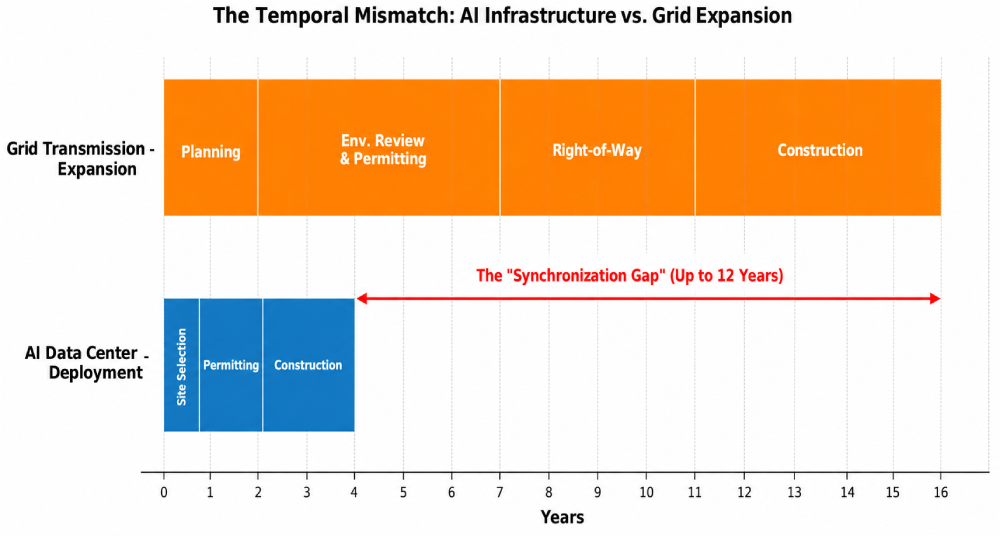
Figure 2. Temporal mismatch between AI infrastructure deployment and grid expansion timelines.
Transmission expansion moves much more slowly.
Utilities and transmission operators must navigate:
Environmental review
Land acquisition
Interconnection studies
Regulatory approvals
Multi-year construction timelines
Coordination across multiple jurisdictions.
The mismatch between compute deployment and infrastructure readiness is becoming visible across major grid systems.
PJM Interconnection planning documents increasingly identify data centres and other large-load additions as major drivers of long-term electricity-demand growth across multiple regions.
Utilities and transmission planners are also evaluating how sustained data centre expansion could affect reserve margins, interconnection queues, and long-term infrastructure investment requirements.
Similar pressures are appearing internationally.
In 2026, Energinet, Denmark’s transmission operator, temporarily paused new large-scale grid connection agreements after proposed electricity-demand requests rose far beyond historical planning assumptions. Reporting indicated that data centre-related projects represented a significant share of the proposed connection queue.
The significance of the Denmark case is not that every proposed project will ultimately be built. Interconnection queues often contain speculative proposals. The deeper signal is that transmission access itself is beginning to shape where hyperscale compute infrastructure can realistically scale.
The issue is no longer simply a shortage of generation capacity. Grid expansion requires coordination across permitting systems, transmission planning, interconnection approvals, environmental review, and long-cycle infrastructure investment processes that often operate under different institutional timelines.
Under conditions of gradual industrial growth, this fragmentation remained manageable. Rapid hyperscale compute expansion places those systems under far greater pressure.
The result is that AI deployment cycles and infrastructure governance cycles are no longer synchronised.
Competitive advantage may increasingly depend not only on access to semiconductors or investment capital but also on the ability to secure transmission access, interconnection approvals, and stable long-term power availability.
AI infrastructure as strategic infrastructure
Governments are beginning to evaluate AI compute infrastructure through a framework traditionally associated with strategic infrastructure systems rather than purely commercial technology sectors.
The shift reflects a broader change in how infrastructure dependency is being understood.
Electricity networks, telecommunications backbones, transportation corridors, financial settlement systems, and satellite infrastructure have historically been treated as strategically important because disruptions within those systems can propagate across multiple dependent sectors simultaneously.
Their governance therefore emphasises continuity, resilience, redundancy, and long-term planning rather than purely market-driven optimisation.
AI infrastructure is increasingly entering that category.
North American reliability governance already reflects elements of this transition. Following the May 2026 Level 3 alert, NERC increasingly distinguished “computational loads” from conventional industrial demand within reliability guidance and emerging planning frameworks.
Industrial policy discussions are evolving in parallel.
In Europe, EuroHPC Joint Undertaking has expanded support for large-scale AI compute development as part of broader initiatives around technological sovereignty and digital capacity.
European policy discussions around “strategic autonomy” increasingly include questions of compute infrastructure, semiconductor supply chains, and dependence on externally controlled digital systems.
The United States is seeing a different version of the same dynamic. Sustained data centre growth is becoming increasingly intertwined with transmission planning, grid reliability discussions, and long-term electricity infrastructure development.
China has also integrated AI infrastructure expansion into industrial policy frameworks centred on technological self-reliance and domestic compute capability.
These approaches differ substantially across political systems and regulatory models. What unifies them is a growing recognition that compute infrastructure now influences broader questions of economic resilience, industrial competitiveness, and national capability.
The distinction between “technology infrastructure” and “strategic infrastructure” is therefore becoming less clear in practice.
Compute systems are no longer operating solely as commercial digital platforms. They are becoming part of the underlying infrastructure environment that supports economic coordination, industrial activity, cloud services, and public-sector operations.
The AI economy is forcing several structural shifts
The AI economy is widely projected to add between $10 trillion and $15+ trillion to global GDP by 2030, depending on adoption scenarios, with estimates from firms such as PwC placing the upper range at approximately $15.7 trillion, equivalent to roughly 14% of global GDP. At the same time, the International Energy Agency projects that electricity demand from data centres could more than double by 2030, reaching approximately 945 TWh annually, driven primarily by AI workloads and hyperscale compute expansion, as shown in Figure 3.
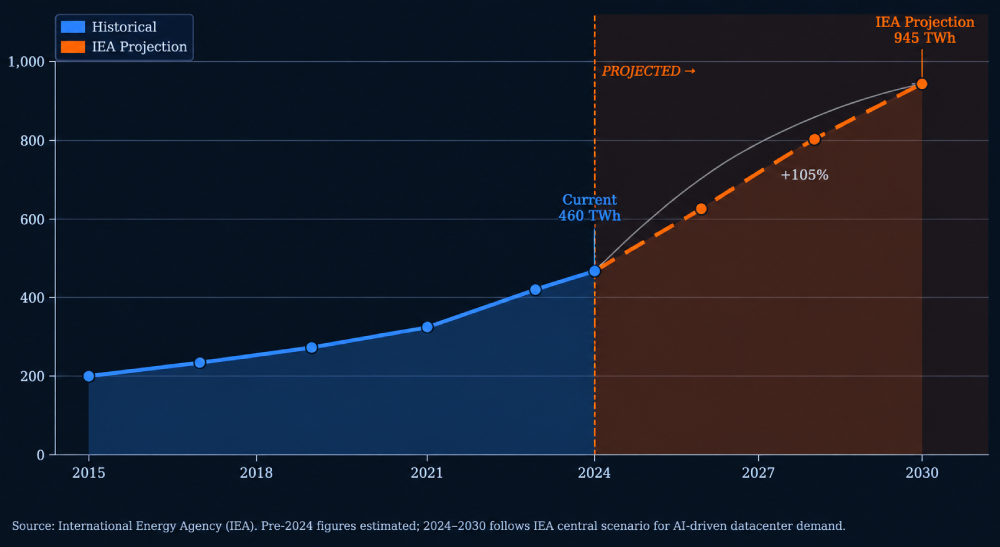
Figure 3. International Energy Agency projection of data centre electricity consumption growth.
The scale of projected AI expansion is beginning to force several structural shifts in how economies build, govern, and sustain the infrastructure required to support large-scale computational growth.
Regulatory speed becomes an economic strategy
The ability to adapt regulatory systems to infrastructure-scale AI expansion may increasingly influence long-term economic competitiveness.
Many electricity governance frameworks were designed around slower industrial growth cycles. Hyperscale AI infrastructure, however, operates on compressed deployment timelines, placing growing pressure on:
Permitting systems
Transmission approvals
Interconnection governance
Environmental review processes
Long-cycle infrastructure planning institutions.
As a result, the challenge is becoming increasingly institutional rather than purely technological.
Under these conditions, regulatory responsiveness increasingly becomes part of the broader economic environment determining where hyperscale compute infrastructure can scale efficiently.
Countries capable of accelerating infrastructure approvals while maintaining grid reliability and policy stability may gain long-term structural advantages in attracting AI infrastructure investment.
Infrastructure coordination becomes a competitive advantage
The next phase of AI expansion increasingly depends not only on software capability or semiconductor access but also on the ability to coordinate large-scale physical infrastructure systems around sustained compute growth.
This shifts competitive advantage toward broader coordination capacity across:
Electricity systems
Transmission planning
Industrial construction
Infrastructure financing
Long-term energy development.
The scale of projected growth reinforces this shift. As noted earlier, the International Energy Agency (IEA) projects that electricity generation used to supply data centres could rise from approximately 460 TWh in 2024 to more than 1,000 TWh by 2030.
As a result, infrastructure deployment speed is becoming increasingly tied to coordination capacity rather than purely technological innovation.
Economies capable of aligning infrastructure deployment, energy planning, financing systems, and industrial policy efficiently may gain lasting advantages in sustaining hyperscale AI growth over time.
Geography regains strategic importance
The AI economy is also reintroducing geography as a major determinant of digital competitiveness.
For much of the cloud-computing era, digital infrastructure was often treated as relatively location-flexible. Hyperscale AI infrastructure behaves differently because compute expansion depends heavily on physical conditions that vary significantly across regions.
Competitive positioning increasingly depends on access to:
Reliable electricity supply
Transmission capacity
Cooling efficiency
Land availability
Infrastructure financing capacity
Regulatory and political stability
Grid resilience.
Emerging research on the infrastructural geography of AI suggests that compute infrastructure is becoming increasingly concentrated in regions capable of supporting both large-scale electricity demand and long-term grid reliability simultaneously.
This marks a broader shift in the digital economy: energy geography, infrastructure resilience, and institutional capacity are increasingly shaping where advanced AI systems can realistically scale.
In this environment, physical infrastructure constraints are becoming central to digital economic competitiveness.
Public–private infrastructure coordination deepens
As AI systems become more deeply integrated into national infrastructure environments, the relationship between governments, utilities, regulators, and hyperscale technology firms is becoming increasingly interconnected.
Large-scale compute infrastructure depends heavily on systems operating through public governance frameworks, including:
Electricity grids
Transmission networks
Permitting institutions
Reliability coordination systems
Long-term energy planning frameworks.
This creates stronger incentives for coordination around:
Infrastructure investment
Transmission expansion
Power procurement
Grid modernisation
Industrial planning
Long-term energy resilience.
As compute infrastructure becomes more economically significant, coordination between public institutions and private infrastructure operators increasingly shifts from optional cooperation toward long-term strategic necessity.
The boundary between public infrastructure systems and private digital infrastructure is becoming increasingly blurred.
Infrastructure stability becomes economic leverage
As AI infrastructure becomes more deeply embedded across economic systems, infrastructure stability itself is increasingly becoming a source of long-term competitive advantage.
Large-scale compute investment depends heavily on predictable access to:
Electricity supply
Transmission reliability
Resilient grid systems
Stable regulatory environments
Long-term infrastructure planning continuity.
Under these conditions, infrastructure resilience evolves from a technical requirement into a broader economic variable influencing where hyperscale compute investment concentrates over time.
This shift is already becoming visible across major economies, where rising AI-related electricity demand is beginning to influence transmission planning, utility investment cycles, industrial policy discussions, and grid modernisation strategies.
Under these conditions, infrastructure reliability, coordination capacity, and long-term planning efficiency may increasingly shape which economies emerge as major centres of advanced compute development.
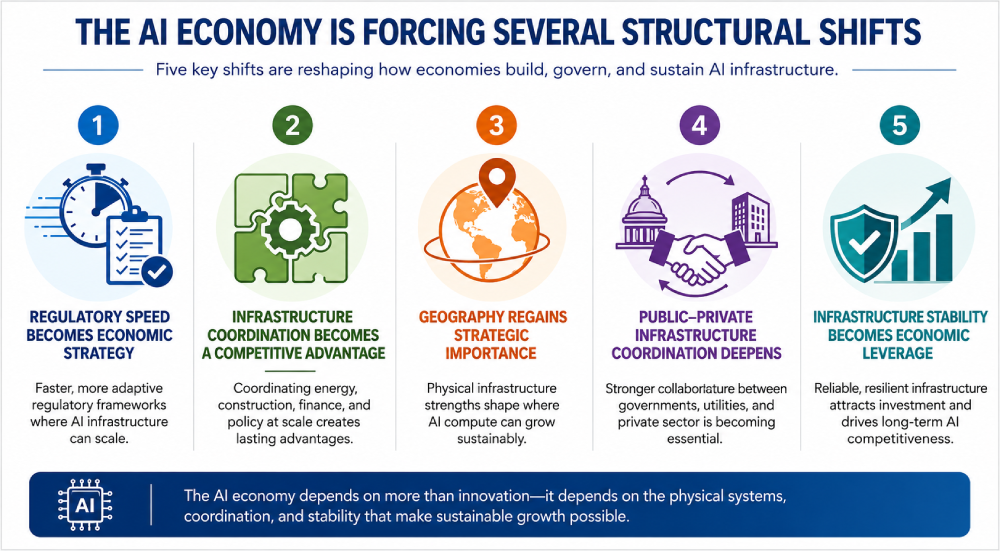
Figure 4. Summary of structural shifts in the AI economy.
AI infrastructure is no longer just a scaling problem
For much of the modern AI expansion cycle, infrastructure discussions focused primarily on scale: larger models, larger data centres, larger GPU clusters, and rising electricity demand.
That framing is becoming increasingly insufficient.
The emerging challenge is no longer defined solely by how much compute can be built, but by whether surrounding infrastructure systems can absorb hyperscale computational growth without generating operational instability, transmission bottlenecks, or broader systemic stress.
Across electricity markets, infrastructure planning institutions, and industrial policy frameworks, AI infrastructure is increasingly behaving less like a conventional digital sector and more like a foundational economic system dependent on power networks, transmission capacity, cooling infrastructure, fibre connectivity, and long-cycle governance structures.
The implications extend beyond the technology sector itself.
As compute infrastructure becomes more geographically concentrated and economically significant, infrastructure resilience increasingly influences broader questions of industrial competitiveness, economic coordination, and long-term investment capacity.
The emerging AI economy is therefore becoming tightly linked to the physical systems required to sustain it.
In this environment, electricity availability, transmission access, infrastructure coordination, and regulatory efficiency are no longer peripheral constraints on computational growth. They are increasingly becoming the conditions that determine where advanced AI infrastructure can scale sustainably at all.
The next phase of AI expansion may ultimately depend less on theoretical model capability alone and more on the ability of economies to build stable, resilient, and expandable infrastructure environments capable of supporting sustained computational growth over time.
Notes
American Public Power Association. (2025, April 11). Electricity demand from data centers worldwide set to more than double by 2030. IEA.
American Public Power Association. (2026, May 4). NERC issues action alert tied to risks posed by computational loads interfacing with bulk power system.
Carbon Direct. (2026, May 7). Inside NERC’s Level 3 alert on data center loads.
Chen, D., Zhou, Z., Cai, Y., Qin, J., Katchova, A., & Chen, L. (2026). Concentrated siting of AI data centers drives regional power-system stress under rising global compute demand. arXiv [Preprint].
International Energy Agency. (2025). Energy and AI. IDEA.
International Energy Agency. (2025). Energy demand from AI. In Energy and AI.
International Energy Agency. (2025). Energy supply for AI. In Energy and AI.
International Energy Agency. (2025). Executive summary – Energy and AI.
North American Electric Reliability Corporation. (2026, May 4). Essential action to industry: Computational load modeling, studies, instrumentation, commissioning, operations, protection, and control (Level 3 Alert).
PricewaterhouseCoopers. (n.d.). PwC’s global artificial intelligence study: Exploiting the AI revolution.
Reuters. (2025, April 10). Global trade war may produce headwinds for nascent AI sector, IEA says.
Reuters. (2024, June 25). Data centers, EVs to significantly boost US power load by 2030, consultancy says.