English
 Español
 Français
 Deutsch
 Italiano
 Português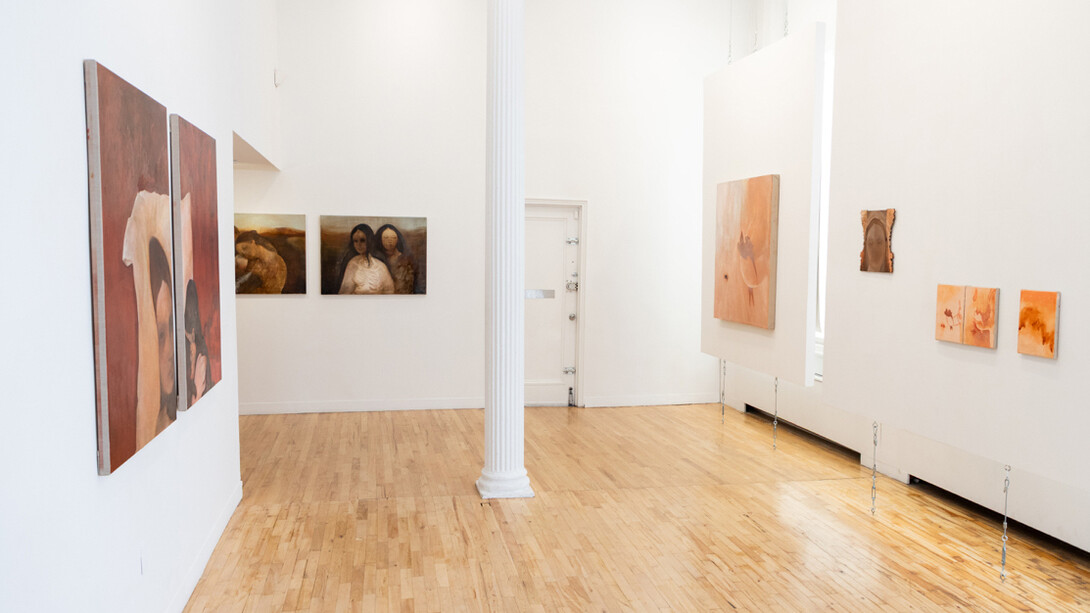
Y cuando le preguntaron qué sabía hacer, ella solo dijo la verdad: ‘Sueño.’
And when they asked her what she knew how to do, she simply told the truth: ‘I dream.’
(Gabriel García Márquez, I sell my dreams)
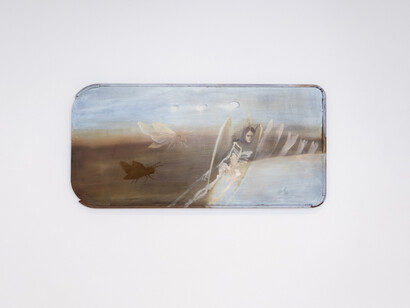
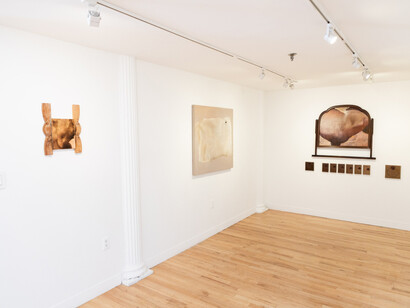
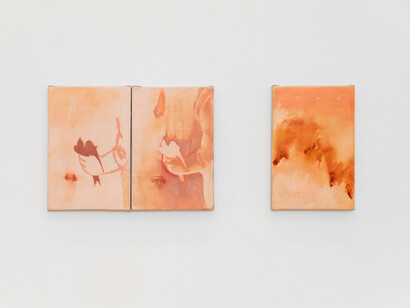
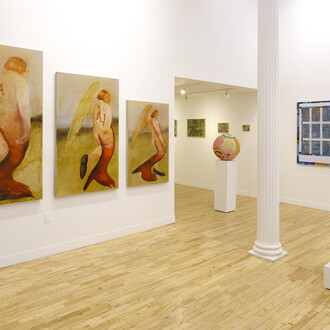
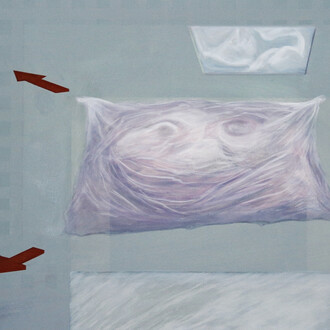
81 Leonard Gallery is pleased to present Manuela Caicedo’s first solo exhibition Asistente de Morfeo, on view from September 10th to October 24th. Manuela’s work hovers in the space between night and day, between looking and seeing. Classical oil painting is applied with the freedom of dreaming; imagination becomes ethereal image in transparent washes, luminous glazes, and fiery hues. Bridging intuition with philosophy, mythology, and art history, Manuela’s paintings merge inner and outer worlds, appearing in various states of clarity or blissful confusion.
An apt place to begin is with Las Evas, or The Eves. Manuela instills her female subjects with the power and wisdom of mythological and biblical heroines. Working from memory of her grandmother Amanda and referencing art historic depictions of Eve and Mary Magdalene (specifically in paintings by Lucas Cranach the Elder, Jean Auguste Dominique Ingres, and Artemisia Gentileschie), Manuela imagines Eve as everyone’s grandmother and each woman as inheritor of the fuego (fire)—the powerful life force and generative energy passed down through women. As an inheritor herself, she applies her vision and imagination to each painting, building upon history to open new ways of seeing and understanding. She considers herself Asistente de Morfeo (Morfeus’ Assistant) for this reason. She steps in for the Greek god of dreams as messenger; subconscious creativity becomes the divine.
Sleeping is represented as a portal to this subconscious creativity; the pillow is the door. La primavera ardiente (The fiery spring) references Edvard Munch’s 1889 painting Spring; however, Manuela’s iteration includes a dog and a flaming red background. In addition to drawing from art history, Greek mythology, and religious iconography, Manuela also builds upon literature and philosophy, including Colombian author Gabriel García Márquez’s magical realism and Spanish philosopher Maria Zambrano’s concept of razón poética (poetic reasoning). Zambrano’s 1986 essay collection De la aurora (Of the dawn) depicts dawn as an in-between period of unstructured time ripe with potential. Dawn is the threshold where ideas emerge outside of our grasp and slowly transition into understanding. Manuela’s work embodies this in material approach as well as concept. Haziness, blur, and various degrees of rendering suggest the elusiveness of clarity and subtle formation of meaning from what appears before our eyes—and that which does not.