English
 Español
 Français
 Deutsch
 Italiano
 Português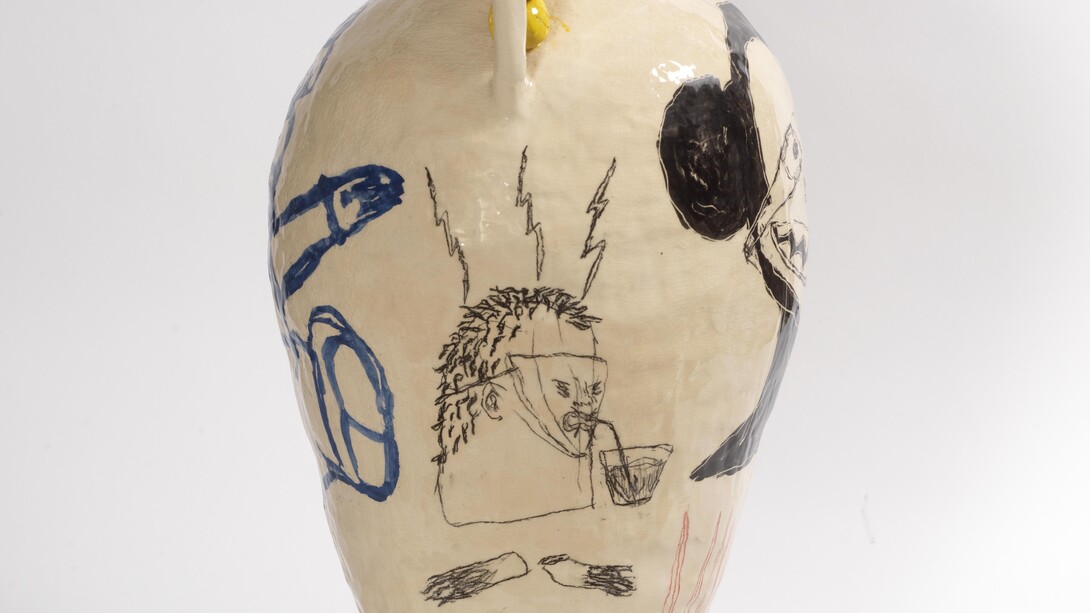
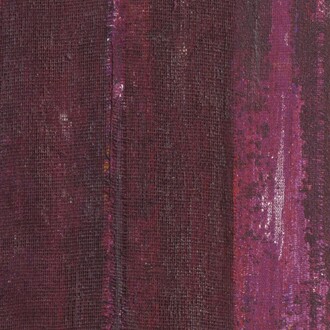
The trajectory may seem expected, but it is by no means a given: painter, sculptor, ceramicist. In this order, from his studies to the present day, these three identities point to the steps that Dimitris Neveskiotis has taken, ultimately arriving at the place from which he essentially began: painting. Even if it may appear that he is devoted to ceramics. For although the practice with which he feels most at home is indeed pottery, in the end everything leads back to painting. It is no coincidence that, whenever he describes his work, the expression “ceramic canvas” repeatedly comes up.
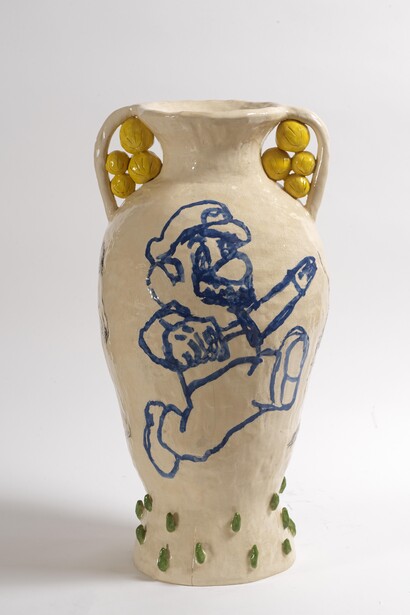
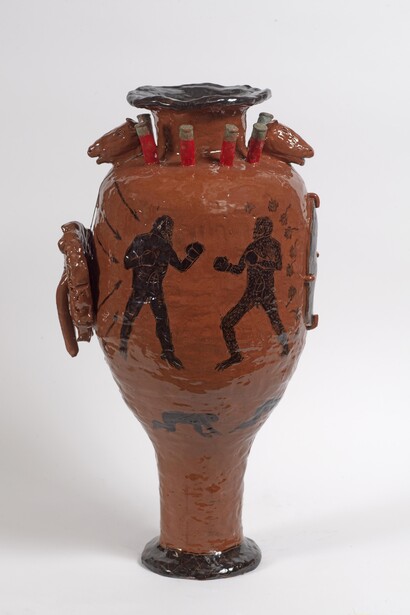
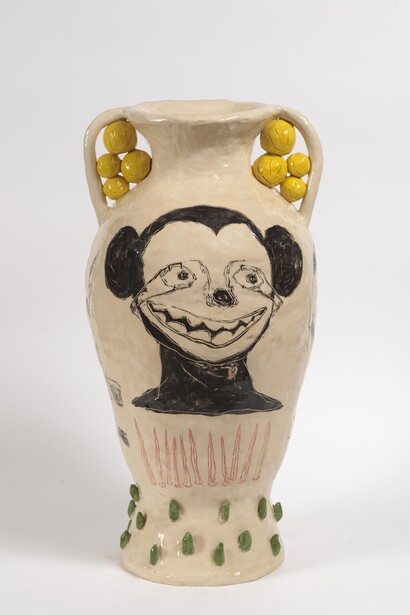
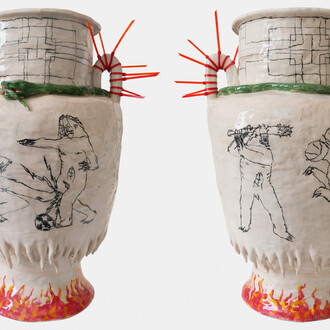
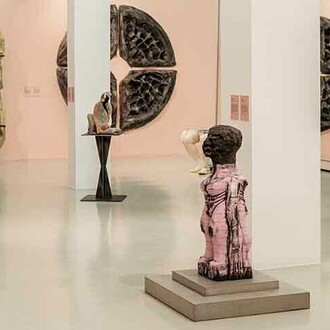
Of course, his vessels are not limited to being ceramic canvases; on the contrary, they possess their own distinct morphological particularities. They are generally medium-sized, sometimes white and sometimes black-figure, with clear references to the techniques of ancient cultures—not necessarily those of the ancient Greek tradition. At the same time, they are characterized by elements that transform them into aggressive objects, entirely unsuitable for “use” of any kind. Nails and thorns, raised protuberances and sharp points often jut out from their surfaces, nevertheless complementing the iconography that unfolds across them. Violent, strange, satirical, caustic, surreal and erotic images, but above all, deeply anthropocentric: dark figures reminiscent of the earliest prehistoric paintings found in the caves of Indonesia and France. A small human epic, condensed into brief scenes of everyday madness, enacted by anthropomorphic presences that leave us uncertain as to whether they are creatures from the caves or their contemporary counterparts.
If one also observes the animals the artist has introduced—at times as prey (goats), at others as creatures roaming freely and proudly through nature (horses and birds), and elsewhere as symbols of power and authority (lions)—one realizes that, for Neveskiotis, the umbilical cord connecting primordial communities with the modern age seems never to have been severed.
Drawing on a remarkable arsenal of ideas inspired by music, but above all by the cinematic universes of Kubrick, Pasolini, Jodorowsky and Lanthimos, he gives form to situations that transcend reality: a flying saucer beside newborn babies; a man boxing with a lobster; a procession of submissive pilgrims advancing into the unknown; sirens and birds with human heads; putti, flowers, meanders. Like a distorting mirror reflecting the human condition and its history, these compositions usually emerge when the ceramic artworks—and, occasionally, the ceramic slabs—have already come out of the kiln. Confronted with them, he works almost automatically, almost reflexively, responding to a fleeting impulse, with his imagination and creativity as his allies. And so, all his stimuli are released, and through his brush parades a circus of half- civilized, strange beings that come to define his iconography, articulating, whether subconsciously or even consciously, his personal social concerns and political perspective.
One cannot help but wonder: if all this rabble and disgrace are indeed real, has nothing truly changed over the centuries, from the origins of humankind to the present day? Or are we simply living through renewed variations of the human species?
(Text by Christos Parides)