English
 Español
 Français
 Deutsch
 Italiano
 Português
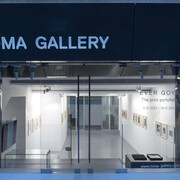
Roma Gallery presents Maria Fragoudaki’s solo exhibition You — Remember me. No blue, no green. Earth — Stand free. Inspire. Care. Curated by art historian Alia Tsagkari, the exhibition runs from 15 October to 14 November 2026 and brings together new works from 2026 that consider how our perception of Earth changes when it is imagined beyond the limits of immediate terrestrial experience, linking planetary scale with ecological interdependence, language and the notion of care.
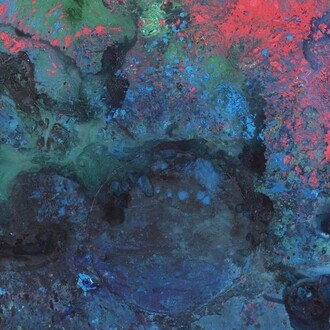
A decisive point of departure for the new body of work was NASA’s Artemis II mission and, in particular, the images recorded during its journey around the Moon in April 2026. Fragoudaki followed this material closely, especially images of Earth as a distant body suspended in darkness. The resulting shift in scale moves from the human to the planetary and, ultimately, the cosmic, with historical precedents in Earthrise (1968) and Blue marble (1972). In Artemis II (2026), two circular bodies are linked by fine curves suggesting orbital paths and set in relation within an expansive blue field. Cosmic distance heightens the sense of Earth’s materiality and fragility as a finite celestial body.
From this position, the return to the ocean continues the same enquiry. Blue links celestial and oceanic imagery and brings Fragoudaki’s work into relation with that of oceanographer and marine biologist Sylvia Earle. Earle’s view that life on Earth depends on ocean systems finds concise expression in the phrase ‘No blue, no green’, which Fragoudaki incorporates, in full or abbreviated form, into the titles of three works. In No blue, no green I and II, dry pigment is combined respectively with fragmented gypsum and found glass from Leros Island, disrupting the homogeneity of the painted surface. In the eponymous No blue, no green, the composition is organised around the phrase ‘No blue / No green’, while in Protecting the Blue a deep blue core is surrounded by a gold contour and a green ground. In Equilibrium, broad fields of blue and green meet along a narrow luminous band, giving pictorial form to their fragile interdependence. Language is equally fundamental to the exhibition.
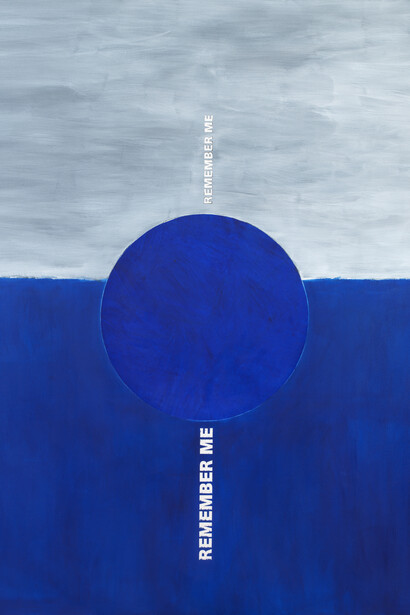
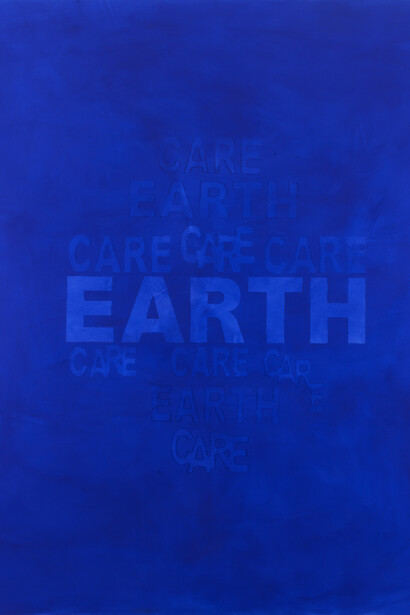
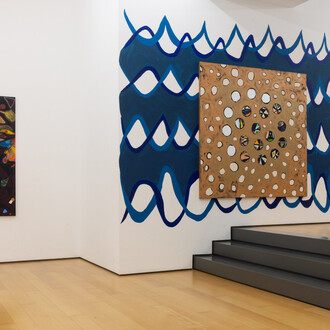
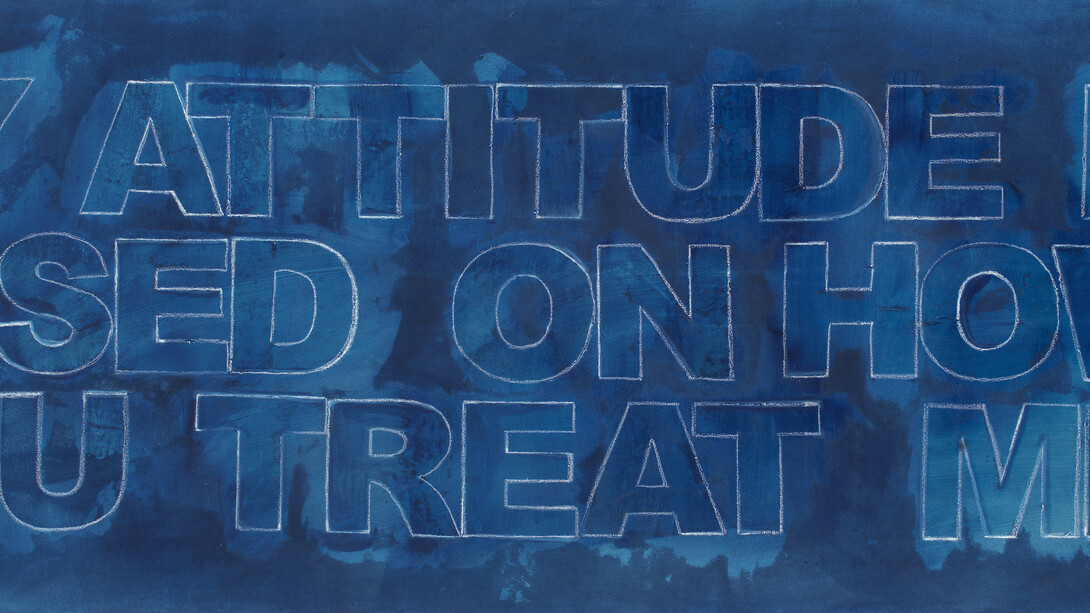
You, Remember me, No blue, no green, Earth, Stand free, Inspire and Care are distributed across separate works, forming a discontinuous syntax that comes together as the viewer moves through the space. In You, the white O expands to function simultaneously as a letter, disc or planetary body. In Echo, Remember me is repeated in horizontal rows and interrupted by a blue disc, while in The Earth said the phrase My attitude is based on how you treat me shifts Earth from an object of environmental concern to a speaking subject addressing the viewer. In Care, Earth Care, Inspire Care and Earth Stand Free, the imperative takes on a different visual and material weight in each work.It shifts the Earth from an object of environmental concern to a speaking subject that addresses the viewer. The ‘you’, together with the imperatives that recur across the other works, establishes a mode of address in which the viewer becomes the addressee, as the works speak in the Earth’s voice, in language that is at once a plea and a command.
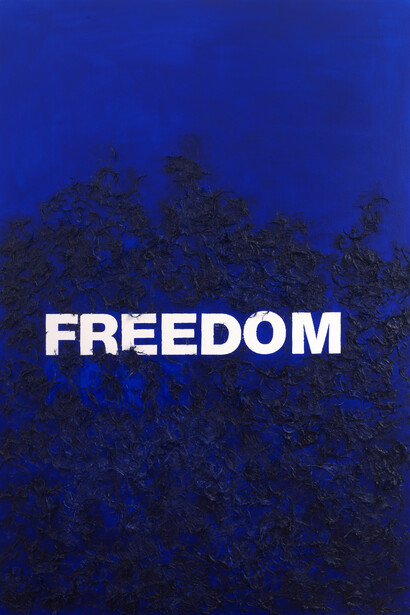
Care has clear precedents in Fragoudaki’s practice. In the Pumping bags series (2022–2024), motherhood was linked to nourishment and to the interdependence of the maternal body and nature. In the new works, care extends beyond the maternal relation to encompass human dependence on water, climate and ecosystems. In Freedom and Earth freedom, language is set against the physical relief of feathers, while in the two works titled Care the same word appears first within a gilded oval and then as a small handwritten inscription above folds of silk. Care thus moves from verbal imperative towards a mode of looking and attending to the fragility of materials and of the systems that sustain life.
The circle, long present in Fragoudaki’s work, functions as a recurring formal element. It becomes the O in You, a gold enclosure in Care, a blue core in Protecting the Blue and a planetary or elliptical form in works such as Remember me and No blue, no green. A useful historical point of reference is Wassily Kandinsky, who described the circle as a balance of concentric and eccentric forces and, among the primary forms, as the one that pointed most clearly towards the fourth dimension. In Questions for the moon (2026), a nine-part work of hand-stamped ink on paper, the same cosmic enquiry shifts from statement to question through short phrases addressed to the Moon, Earth, ocean and clouds.
Fragoudaki’s training in chemistry shapes the way she understands and handles materials. Oil, acrylic, dry pigment, gypsum, glass, feathers, silk, PVC and gold leaf introduce different degrees of absorption, opacity, reflectivity and relief. The same interdisciplinary background extends the enquiry to the black-hole information paradox. Richard Pinčák and the solution to the black hole information paradox takes as its starting point the theoretical model proposed in 2026 by Richard Pinčák and his collaborators, in which halting the final stage of evaporation leaves, within the terms of the model, a stable remnant capable of storing information. A gold disc dominates the deep blue field, while small fragments of text gather within it so that information itself appears already fragmented.
Oceanic, terrestrial and cosmic systems thus emerge as different scales of the same enquiry. Circles, blue fields, words and fragments recur while changing function, material state and meaning. The works remain grounded in the physical presence of painting, collage and paper, while references to Artemis II, Sylvia Earle and scientific research extend their field towards the planetary and the cosmic. Care, finally, does not remain at the level of the imperative; it also enters the act of looking, asking the viewer to attend to relations between colours and materials and to the fragility of the systems the works bring into view.
The exhibition concludes with Inspire care. The word inspire derives from the Latin inspirare, ‘to breathe into’, linking the final imperative to breathe and, by extension, to the condition of life itself. Language thereby acquires a bodily dimension, addressing the viewer directly and calling for a response. Like a letter that, once read, awaits a reply, the sentence running through the exhibition reaches completion only in its addressee. Once it has been read, the question becomes what the person who has heard it will do.