English
 Español
 Français
 Deutsch
 Italiano
 Português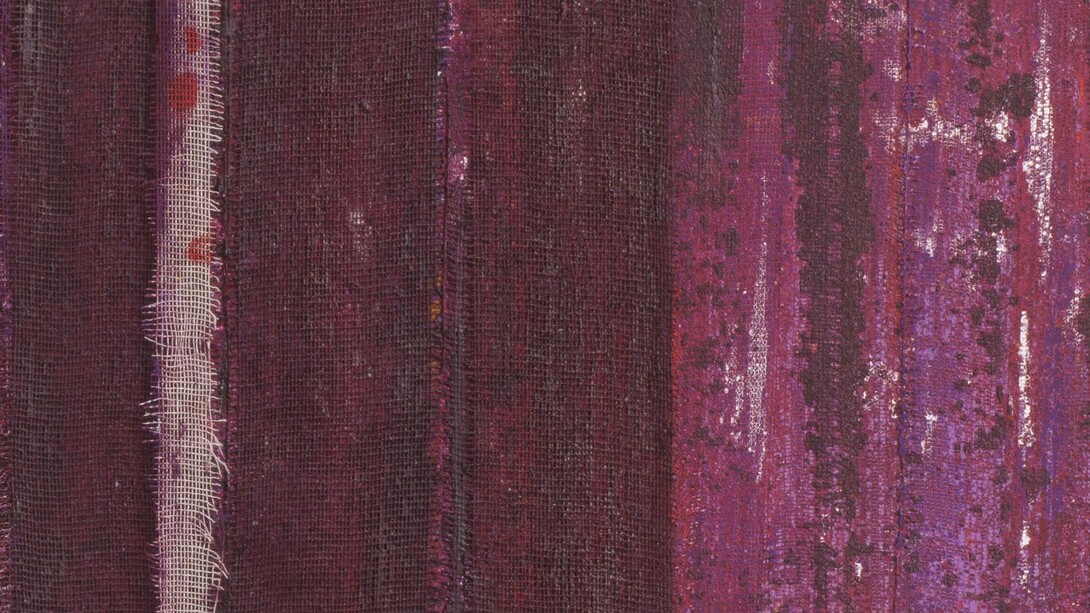
Kalfayan Galleries (11 Charitos Street, Kolonaki, Athens) presents the solo exhibition of Eugenia Apostolou, titled Transience. The opening of the exhibition will take place on Thursday, 19 March 2026, from 18:00 to 21.00.
The text accompanying the exhibition is written by Panos Giannikopoulos (Art Historian – Curator).
“Eugenia Apostolou presents her new solo exhibition Transience, marking her first presentation at Kalfayan Galleries. The exhibition brings together works shaped through recurring transformations of matter, placing process at the centre of the pictorial field. Seriality, the physical act of painting, automatism, conscious gesture and subconscious impulse coexist with a reflective disposition. Apostolou revisits the history of abstraction while developing a practice organised through cycles of deposition, removal and reconfiguration.
Transience operates as a central condition throughout the exhibition, as matter and the ideas that animate it remain in continuous states of change. Apostolou’s works recall Elizabeth Grosz’s reflections on time as a force marked by unpredictability and transformation. Grosz describes time as possessing a quality of intangibility, a fleeting half-life, emitting its duration-particles only in the passing or transformation of objects and events. The works assume a precarious presence that resists stabilisation, indication or direct representation, while matter releases its traces through passage and metamorphosis.1
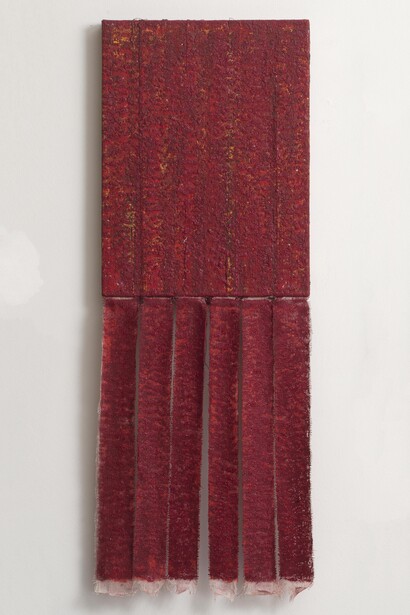
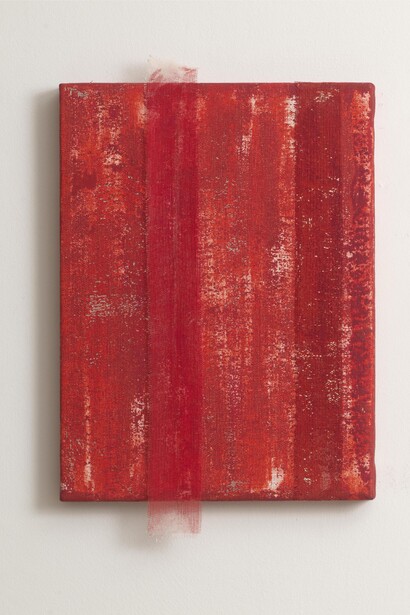
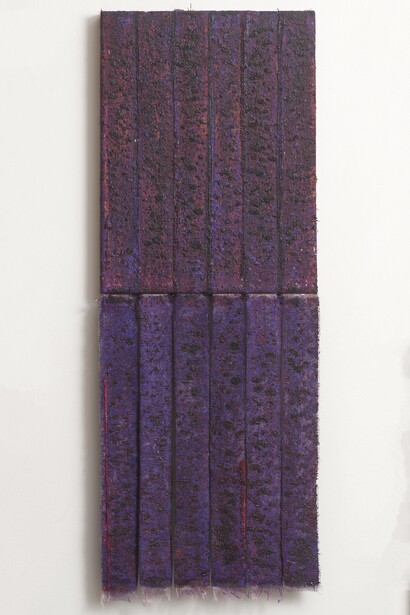
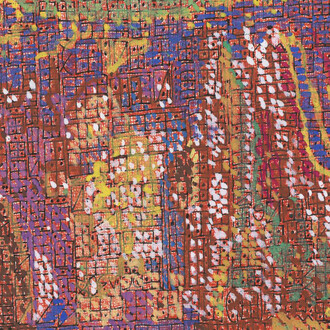
Warm tonalities of colour pass through vertical strips of surgical gauze placed across the canvas. The fabric absorbs pigment into its fibres and gradually transfers it onto the surface beneath, where the weave leaves its imprint. Apostolou employs the material until the pigment thickens and alters the gauze’s capacity to transmit colour. The permeability of these bandages allows multiple phases of the process to coexist, as different temporal layers remain legible across the surface.
Through the use of surgical gauze, the artist evokes cultural and bodily associations, referring to gestures of covering, protection and care. The material recalls wounded surfaces and acts of tending. Red tonalities intensify these resonances, suggesting the interior of the body and a landscape that emerges from within.
The exhibition unfolds through three groups of works corresponding to different moments within this evolving process. In the first, colour settles across the canvas like sediment. Faint impressions remain embedded within the pictorial field while the material of the transfer remains discreetly present: fragments hang from the surface or linger along its edges, functioning as a fragile connective element. In a second configuration the gauze becomes integrated into the structure of the work itself. Saturated with pigment, the fabric retains colour within its weave while folds create areas of greater concentration. Absorption and accumulation coexist on the same surface. The material lifts and folds back, recalling the movement of shedding skin. Painting thus records the stages of its own formation, while the canvas bears the weight of successive layers and gestures. In the final section, strips that had previously absorbed layers of pigment reappear as the primary material of new compositions. Each fragment carries the trace of earlier gestures. Apostolou assembles them into dense configurations that transfer these inscriptions into a renewed pictorial arrangement.
Apostolou’s practice has consistently approached the painted surface as a field of transformation. Earlier works employed gestures of tearing, detaching and recomposing that treated the canvas as a body under negotiation. In Transience, this investigation turns towards an affirmation of change. Successive encounters register duration and the subtle shifts of time, while the tension that animates the work assumes new qualities.
With a delicate attentiveness, Apostolou invites us to confront the fleeting conditions of existence. Destruction and erosion become structural elements within a generative state that binds repetition, attachment, displacement, disappearance and return. The artist persists with the partial, sustaining an open relation to the remainder and organising the work around traces of satisfaction that never close their cycles entirely. The work unsettles the perception of time as a single directional movement and, through transience, brings into view the dynamic impulses that allow life to become, to remain always in the process of becoming something other than what it was.2”
Notes
1 Elizabeth Grosz, ed., Becomings: explorations in time, memory, and futures (Ithaca, NY: Cornell University
Press, 1999), 1.
2 Elizabeth Grosz, Time travels: feminism, nature, power (Sydney, Melbourne, Auckland: Allen & Unwin, 2005), 8.