English
 Español
 Français
 Deutsch
 Italiano
 Português
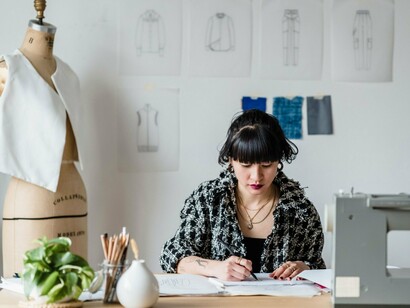
For most of my career as a fashion designer, my toolbox included Adobe Illustrator, Photoshop, InDesign, the Office suite, a sketchbook, my lovely pencils, and, most importantly, my sense of fashion.
A garment would usually begin as an idea or even a feeling and eventually become a two-dimensional technical drawing. To someone outside the fashion industry, a flat sketch might look surprisingly simple: a front view, a back view, some construction details, colors, and fabric information. But to a designer and an experienced supplier, that drawing contains an enormous amount of information. We can look at it and mentally transform it into a three-dimensional garment. We understand how the shoulder will fall, how much volume a sleeve will have, where a waistband will sit and how a particular fabric might affect the silhouette. For years, that was enough. Then came AI. And suddenly, the way I communicate fashion has begun to change.
The problem was never the designer
One of the biggest challenges in fashion development has always been communication. Designers, patternmakers, and experienced suppliers develop a kind of visual language. We don't necessarily need to see a real image of a garment to understand what it will eventually become. But not everyone involved in the process has that ability. Managers, buyers, sales teams, and clients may look at exactly the same drawing and see something completely different or simply struggle to imagine it at all.
I've worked with startup clients who had wonderful ideas but almost no technical fashion knowledge. They knew what they liked and perhaps understood their target customer, but they couldn't always describe a silhouette, proportion, or construction. I could draw something and explain it, but they still wanted to know, "Yes, but what will it actually look like?" In the past, creating realistic mockups could become another totally different job. AI has changed that dramatically.
Suddenly, everyone can visualize
Today, I can take an idea much further visually before a physical sample even exists. Instead of asking a client to imagine how my flat drawing might look on a human body, AI can help me create a visual representation of that concept. For a designer, this is incredibly powerful. A client or a salesperson can understand the commercial potential of a collection before samples arrive. A manager who doesn't speak the technical language of fashion can participate much more confidently in the conversation. AI has essentially created a bridge between the people who can visualize fashion technically and those who cannot. And that alone is transforming my workflow.
AI is also changing the client
Something else interesting has happened. The client now has tools too. A person who might previously have told me, "I want something feminine, oversized, and cool, but I'm not exactly sure what," can now spend an evening experimenting with AI and arrive the next morning with an image, "Something like this," that can be extremely helpful. Instead of trying to decode someone's abstract description, I have a visual starting point.
But this is very important, but AI doesn't necessarily understand how clothing works. An image can look fantastic while being technically unreasonable. A seam may lead nowhere. A pocket may be impossible to construct. A print might magically change scale around the body. Details may disappear between the front and back views. Fabric can behave in a way that the actual textile simply cannot. AI can sometimes create the "illusion of a garment."
A beautiful picture isn't a tech pack
This is where I think some of the anxiety surrounding AI and creative professions becomes oversimplified. Can AI create beautiful fashion images? Absolutely. Can it generate ideas faster than I can sketch them? Sometimes, yes. Can it produce hundreds of variations in the time it would take a human designer to develop a few? Of course.
But fashion is not simply an image. Eventually somebody has to decide how that garment is constructed. What fabric should be used? What weight? What composition? Which stitching technique is appropriate? And then there are costs, production limitations, minimum quantities, fit corrections, wash tests, color approvals, and communication with factories. A beautiful AI model wearing a beautiful AI jacket doesn't have to survive any of those realities. I do.
Creativity hasn't disappeared either
Recently, a colleague and I experimented with creating similar mockups using AI. We were working from essentially the same concept. What fascinated me was that our results were similar, but they weren't the same.
Why?
Because even when we're using the same technology, we're still making choices. We notice different details. We describe things differently. We push the image in different directions. In other words, the machine may generate the image, but our taste is still editing it. And taste is incredibly difficult to automate. Fashion designers don't only create things. We curate. We decide that one shade of pink feels sophisticated while another feels childish. We know when an oversized silhouette looks intentionally relaxed and when it simply looks badly fitted. We understand when a detail should be removed rather than added.
So, will AI replace fashion designers?
Maybe parts of our jobs will disappear. I don't think pretending otherwise helps anyone. Certain visualization tasks that once required considerable time and technical skill can already be completed much faster with AI (Remember 3D designers?). Basic concept generation will become increasingly accessible. Brands may eventually need fewer people for certain stages of design and presentation. The designer who refuses to use these tools may find themselves being left behind.
Perhaps our value will move away from simply producing drawings and toward directing ideas, solving problems, understanding products, editing possibilities and turning fantasy into something that can actually be manufactured and sold. In that sense, AI may make genuine expertise even more important. When anyone can generate a beautiful image, knowing whether that image represents a good product becomes much more valuable.
The funny part? I'm working more
There is, however, one detail nobody warned me about. AI was supposed to save me time. Instead, at the moment, I sometimes feel like I'm working twice as much. Before, I created the design, illustrated it, developed the technical information and communicated it to the supplier.
Now? I still have to do all of that. But I also create beautiful mockups. Because once something becomes possible, very quickly it becomes expected. The standard rises. A two-dimensional illustration that was perfectly acceptable a few years ago can suddenly feel incomplete when everyone knows we can also present a realistic-looking model wearing the garment. So here I am, supposedly watching artificial intelligence take over my profession while simultaneously doing my old job, plus an entirely new one. The irony isn't lost on me.
AI as a creative assistant
For now, however, I don't see AI as my enemy. I see it as one of the most exciting creative tools I've encountered during my career. It helps me communicate and experiment. It lets clients enter my visual world more easily and sometimes helps me enter theirs.
Fashion has always evolved alongside technology. The sewing machine changed fashion. Synthetic fibers changed fashion. Computer-aided design changed fashion. Digital printing changed fashion. E-commerce changed fashion. AI will change it again. And yes, perhaps one day the role of the fashion designer will look completely different from the profession I entered twenty years ago.
But right now, AI still needs something from me: my experience, my technical understanding, my mistakes, my intuition, my eye, and my point of view. And for now, that's still my job. Even if apparently I now have to make a mockup of it too.