English
 Español
 Français
 Deutsch
 Italiano
 Português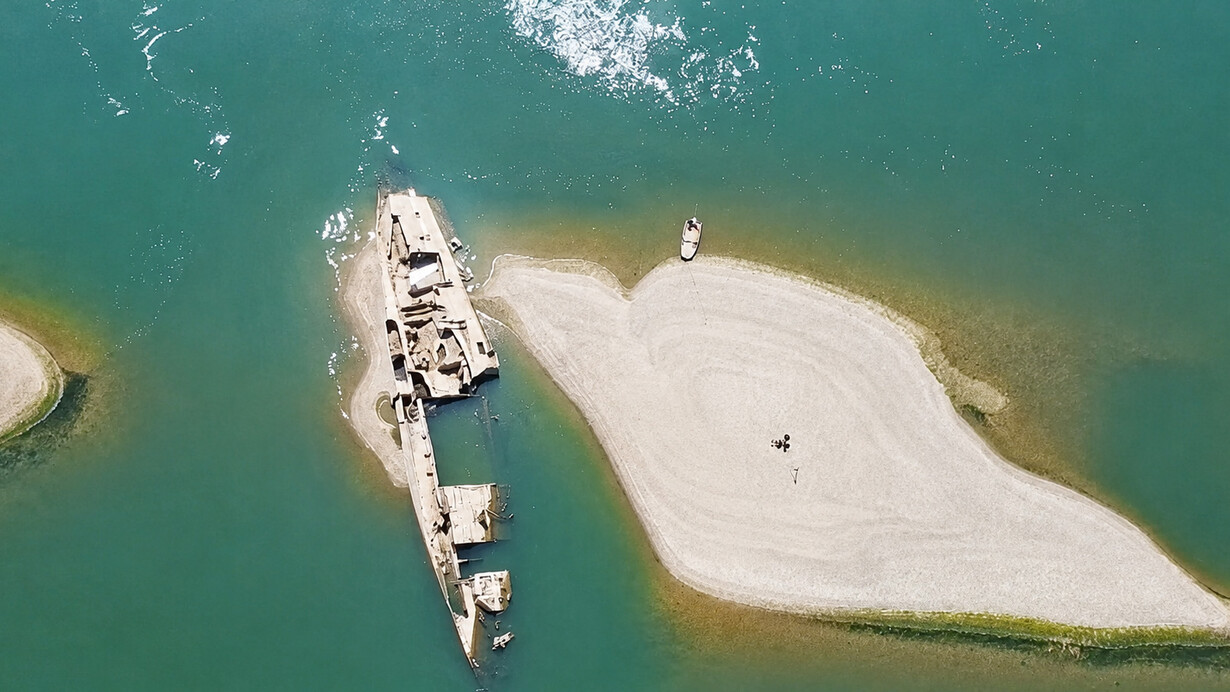
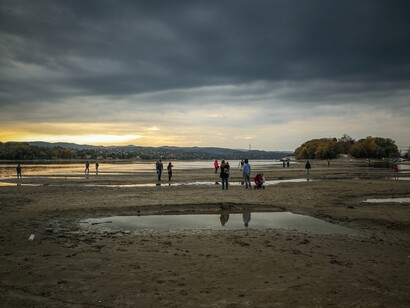
At least 20 ships of a Nazi fleet that were scuttled by the Germans near the Serbian port of Prahova to check Soviet advances toward the end of World War II have emerged from the depths of the Danube—whose exploited waters have reached their lowest level in years due in part to poor land-water management, the damming and dredging of the river, and in large part to global warming.
The event symbolizes the contemporary post-Cold War emergence of new forms of militarism in the midst of an environmental holocaust.
Global warming and firestorms
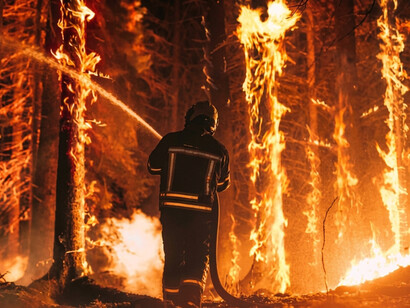
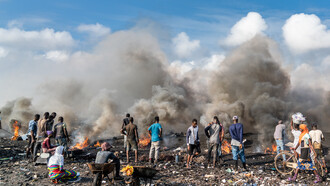
Much as ecologists have warned for years, since 2024, the rise in average global temperatures above 1.6°C above those of the preindustrial period—when humanity began to burn huge amounts of fossil fuels—has now resulted in forest fires blazing across the planet.
Forest fires are just one of many consequences of climate change that is already causing erratic weather conditions. Climate change and war are working hand in hand to destroy crops and networks of food distribution that impact the health and livelihood of millions of people worldwide, representing a factor in provoking global migration while contributing to the destruction of biodiversity, if not the extinction of entire species, upon which humanity depends for its own existence.
Whether set off by man or by nature itself, fires in 2025-2026 have caused major environmental holocausts across the planet.
Parts of the western United States, Mexico, Brazil, and East Africa now have fire seasons that are more than a month longer than they were 35 years ago.
In the US, fires have destroyed homes and lands in southern California, parts of Oregon, New Jersey, and elsewhere. In Canada, fires have erupted in Saskatchewan, Manitoba, and Ontario. In South America, extensive burning of Brazil's Amazon rainforest has consumed millions of acres. In Asia, South Korea suffered major harm to its woodlands in March 2026, while Japan and particularly Australia have suffered from severe blazes causing high degrees of pollution.
In Europe, fires have destroyed millions of acres in France, Belgium, Spain, Portugal, and Italy (notably Sicily, Calabria, Puglia, and Campania). In the Balkans and eastern Europe, fires have raged in Albania, Montenegro, Kosovo, Romania, Greece, and Serbia. Turkey. Syria (Latakia) and Israel have all confronted major fires. In Ukraine, forests have burst into flames while Russia loses two million hectares of forest each year as a result of catastrophic fires. Nine out of ten wildfires in the latter are set off by humans1.
The causes
Mounting global temperatures have been caused primarily2 by burning non-renewable fossil fuels—oil, natural gas, and coal. The latter still supply roughly 80% of the world’s energy even as states seek to develop alternative energy sources. Moreover, forest fires themselves boosted carbon emissions by 60%3 globally between 2001 and 2023.
On the one hand, the burning of fossil fuels causes greenhouse gases that block heat from escaping the earth. On the other hand, the mounting average temperature magnifies “fire weather” in which the warmer atmosphere draws water away from soil and plant tissues like a syringe. As the soil and flora lose water, a cigarette or any kind of spark can help set off an environmental holocaust.
The case of France
In the summer of 2026, given high temperatures and forest fires, nearly 70% of France, for example, was under official water-use restrictions, with 67 departments placed under the highest crisis. Over 40,000 French residents have faced temporary drinking water cut-offs, and supplies for more than 550,000 people have been heavily strained. France may be confronting its lowest4 maize harvest in 50 years with estimates5 of a 1-4% decrease in winter crop yields.
And after the heat wave came the deluge and colder weather―with the soil too dry to absorb the heavy rains. France was not the only country to suffer. And there will be more broiling summers to come.
Global warming and global war
The not-so-indirect link between global warming and global war can be seen in the fact that the US Department of Defense burns more petroleum daily6 than do entire industrialized countries like Sweden or Switzerland. All forms of military equipment, from US fighter jets to the US Navy to tanks and jeeps, burn massive supplies of petroleum.
The US has now achieved energy export predominance—while remaining deeply dependent on oil consumption. With the rise in production of environmentally hazardous US shale oil and gas from hydraulic fracturing and directional drilling since 2010, the US has become the world’s largest oil exporter7.
The relative growth of US oil exports is in part a result of US and European sanctions placed against Moscow for its invasion of Ukraine that have significantly reduced, but not entirely eliminated, Russian oil and gas exports. The US and Israeli war with Iran and with the Yemeni Houthis has also limited Saudi oil production, thereby reducing Saudi oil exports relative to those of the US.
In addition, the US has boosted its actual and potential oil reserves by engaging in "leadership change" (but not "regime change") in Venezuela—so the US can obtain access to heavy Venezuelan crude given President Trump’s efforts to persuade US corporations to invest in Venezuelan oil.
Concurrently, Trump has auctioned over 81 million acres of federal waters in the Gulf of Mexico for oil and gas leases—contradicting the environmental protectionist vision of one of Trump’s own heroes, Teddy Roosevelt.
US oil export predominance can provide Washington strategic leverage to divide and weaken the OPEC oil-producing cartel, while Trump has also sought separate energy deals with countries such as Iraq.
With US oil export predominance, Washington can also pressure energy-dependent countries in Europe—since the US is now the principal supplier of oil to Europe. Although the Europeans still seek energy from Moscow, Europe has increasingly turned away from Russia and to the United States for gas and oil since the Russia-Ukraine war began in 2022. So far in 2026, the Europeans have purchased about 47% of U.S. oil exports—up from 37% in 2021.
US oil export predominance not only gives the US a political-economic tool to pressure European allies but US Asian allies as well. Like the Europeans, Asian countries have also sought to boost oil supplies from the US, purchasing about 46% of U.S. oil exports8 in May 2026, as compared with around 37% last year.
Given its oil export predominance, Washington could possibly pressure China if the latter draws down its reserves and cannot expand energy imports from Russia and Iran. Yet US efforts to check China’s quest for energy resources risk further aggravating geoeconomic tensions between the US, Taiwan, and China—perhaps much as the efforts of the US, Great Britain, China, and Holland to stop selling iron ore, steel, and oil to Japan further militarized Tokyo.
Concurrently, backed by Russia, China, and North Korea, Iran and the Yemeni Houthis seek to counter US energy predominance and Saudi influence by seeking to control the Straits of Hormuz and the Bab el-Mandeb Strait.
Energy, food, and war
If it does not come to a sustainable resolution soon, the Russia-Ukraine war could severely reduce global grain supplies—after the breakdown in the UN/Turkey-brokered Black Sea grain initiative that had been in place from July 2022 to July 2023.
In the past few months, in addition to striking Russian energy production, Kyiv largely closed the route for commercial Russian shipping after its drones hit around 220 vessels in the Sea of Azov and Black Sea, including oil tankers, grain cargo ships, and passenger ferries.
For its part, in addition to striking Ukrainian energy facilities9, Moscow escalated attacks on Odessa and Ukraine’s southern ports, impacting the country’s agricultural sector—and ostensibly leading Kyiv to seek peace10.
A global firestorm ahead?
The above are just a few of the examples where global warming and global war work hand in hand.
Even if the US can sustain oil export predominance, if the Trump administration cannot soon reduce the price of energy at the pump, Trump’s policies risk a global depression—as Trump himself has recognized—if not a global war.
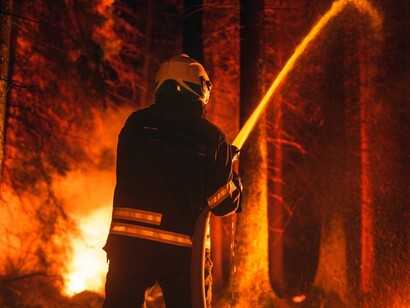
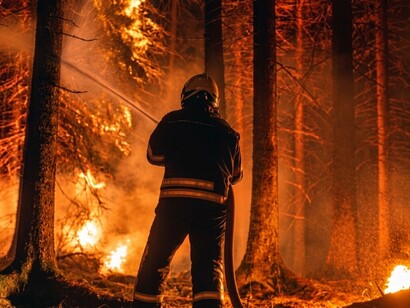
If the US cannot soon act more like a firefighter in seeking peace with Iran, Russia, China, and North Korea—instead of a pyromaniac—the ongoing global firestorms will continue to burn without end in sight— so far without the added ignition of napalm and atomic weapons.
References
The raven’s feast: a song of ashes and wings.
Year of the Earth Serpent Changing Colors. A Novel.: An Anti-Marco Polo Voyage to Cathay.
Militarism Surfacing From an Environmental Holocaust, Capitals Uncovered with Hall Gardner, ep 153.
1 Wildfires in Russia.
2 Causes and Effects of Climate Change.
3 Global rise in forest fire emissions linked to climate change in the extratropics.
4 Increasingly hot Europe faces more severe droughts and growing challenges for water and land management.
5 JRC MARS Bulletin - Crop monitoring in Europe - July 2026 - Vol. 34 No 6.
6 The Pentagon as Global Gas-Guzzler.
7 Once an Arab oil embargo victim, US becomes world's top oil exporter.
8 Once an Arab oil embargo victim, US becomes world's top oil exporter.
9 Ukraine's state energy company says its facilities seriously damaged after 13 Russian strikes in a week.
10 Ukraine offers Russia truce in Black Sea amid rising food supply fears, source says.