English
 Español
 Français
 Deutsch
 Italiano
 Português
One of the most detailed reconstructions of Argentina’s foreign policy comes from Argentine journalist Rodis Recalt, in his investigation “Viceroy Bennett and US Intervention in Argentina1” for the Buenos Aires Times. There, the story does not begin in a foreign ministry or an embassy but in Puerto Madero, where the new offices of OCPTECH are located, a technology company owned by businessman Leonardo Scatturice, a man with privileged access to Javier Milei’s government.
Recalt traces the existence of an informal center of power. In OCP Tech’s offices, a new kind of diplomatic corridor was established: between businessmen, hedge funds, conservative activists, and Argentine officials. Sitting at the center is Barry Bennett, Scatturice’s partner and a veteran Republican operative in the United States with deep ties to Donald Trump. Understanding this network is crucial, because it reveals that some of the most consequential decisions were not being shaped through institutional diplomacy but through private channels.
According to Recalt's reporting, on October 8 of 2025, Bennett chaired a closed door meeting at OCP Tech with influential Argentine lawmakers such as Miguel Ángel Pichetto, Cristian Ritondo, and Rodrigo De Loredo. He spoke as if he were an envoy from Washington, indicating that Trump would support Javier Milei only if two conditions were met: first, that he secured victory in the upcoming elections (26/10/2025), and second, that he could guarantee domestic political stability by reaching agreements with moderate factions and allied governors. The right only with the right.
Bennett’s words would later be confirmed in practice, during Milei’s trips to the United States and the succession of announcements that followed. But there is a structural detail that matters: at that time, the United States did not have an ambassador in Buenos Aires. It was only in September that Lamelas took that post. In that transitional period, Trump’s new envoy had not yet arrived. In that vacuum, a lobbyist landing in a private jet became the closest thing to a presidential representative on Argentine soil.
The Foreign Ministry, the US State Department, and Argentina’s ambassador in Washington were relegated to a secondary role, while a parallel channel built through personal ties, ideological affinity, and private contracts began to shape the most strategic decisions. Bennett stopped being just a consultant. He became, in Recalt’s words, the man who brings news from the United States: its demands and its promised support.
How parallel diplomacy was built
The timeline shows that what is happening today did not emerge overnight. It was patiently constructed throughout 2025 through a sequence of moves, each of them reflecting the gradual shift of key diplomatic functions towards informal and privately mediated channels.
On February 12, at the request of presidential adviser Santiago Caputo, the Argentine intelligence service (SIDE) signed a contract with a Washington-based lobbying firm, Tactic Global, owned by Scatturice and Bennett.
At that time, the company was not fully registered as a foreign agent in the United States, but it was already working for other governments, such as Vietnam and Kazakhstan. The contract placed the management of a key part of Argentina’s relationship with Washington in the hands of a private firm, routed through the intelligence services instead of the Foreign Ministry.
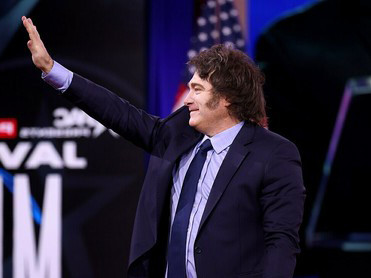
Ten days later, Milei appeared on stage at the Conservative Political Action Conference (CPAC), the annual summit of the US right, where he greeted Trump in front of the cameras.
On March 25, Bennett entered the Casa Rosada to meet once again with Santiago Caputo. Officially, the conversation was about “economic and trade cooperation.” In reality, Milei’s government was desperately seeking financial oxygen and external political backing amidst social conflict and a fragile coalition in Congress. Less than a month later, on April 14, Trump’s Treasury Secretary Scott Bessent arrived in Buenos Aires.
At the same time, hedge fund magnate Rob Citrone, founder of Discovery Capital Management, landed in Argentina aboard Scatturice’s private jet, accompanied by the Tactic Global team, to meet with Milei.
Citrone is not just another investor. He is a personal friend and former colleague of Bessent, with whom he once helped earn more than a billion dollars in currency bets. Discovery Capital has bet heavily on Milei’s Argentina, buying high risk government bonds and shares tied to the country’s macroeconomic performance. In Recalt’s account, Citrone is also an important client of Scatturice and Bennett’s consultancy. Having invested heavily in Argentine bonds and stocks, Citrone was not a neutral observer, but rather an actor with a direct stake in the success of Milei's policies. His privileged access and visible presence in Buenos Aires also sent a strong signal to global markets, shaping investor confidence at a decisive moment.
Things started to move quickly at the highest levels of government. At the beginning of June, Bennett returned to Argentina to help finalize an agreement, and a few days later, he appeared in a photo alongside Scatturice and Trump. Later on, Bennett publicly celebrated a visa waiver agreement as a “great statement of friendship” between both nations.
The money: Bessent, Citrone, and a bailout among "friends," when states behave like companies
While Bennett works the political and ideological front, Scott Bessent, the US Treasury Secretary, operates on the institutional front.
In September of this year, Bessent announced a 20-billion-dollar swap line and rescue package for Argentina2, exchanging US dollars for Argentine pesos to support Milei’s government. Argentina is not a major trading partner for the US, and its recurrent crises have almost no impact on the average American. Reading comments on social media, US citizens question why this aid goes to Argentina and not to the US people themselves.
The logic seems to be: when the Argentine peso is on the brink, a new injection of dollars buys time, raises asset prices, and allows the most sophisticated players to reposition, cash out, or double down under much better conditions than those of ordinary citizens. The risks are capital flight, future adjustment, and new rounds of austerity. The “bailout” becomes an enormous potential benefit for investors like Rob Citrone, who had “loaded up” on Argentine bonds and assets just days before.
This is not the first time Argentina has used this script. In 2018, the International Monetary Fund (IMF) approved a record 57 billion dollar loan to support Mauricio Macri’s government, although many economists, including within the IMF, considered the program’s assumptions unrealistic. The loan failed to stabilize the economy, accelerated capital flight, and left the next administration trapped between debt obligations and domestic demands. What was framed as “assistance” came with conditions that limited political autonomy and reinforced dependency3.
The 2025 package under Trump and Bessent does something similar, but with a new level of transparency, the real interests were unveiled. In a Fox News interview4 before the deal was finalized, Bessent did not pretend it was a neutral technocratic decision. He explained:
“China is all over Central America, Latin America. It's critical that we maintain really good relations and that these are strong economic capitalist systems, and Argentina is rich in rare earths and rich in uranium, and they are committed to U.S. private companies coming in and being good.”4 Financial support is presented as part of a broader project: securing ideologically aligned governments, containing China’s presence in Latin America, and using Argentina as an example of what happens when a country embraces a radical pro-market, pro-US agenda.
During the legislative elections, held on October 26, according to public statements by Donald Trump5, the agreement would move forward only if Javier Milei won. In the weeks before the vote, Trump repeatedly signaled that financial support for Argentina depended on Milei’s victory. After Milei secured the result, the swap was announced. The timing and the explicit conditionality placed the outcome of Argentina’s internal politics at the center of the negotiation.
In addition to this, new contracts landed bringing with them renewed pressure on Argentina’s natural resources, a familiar pattern across Latin America. One example reported by Reuters 6 involves OpenAI and Sur Energy evaluating a USD 25 billion data-center project in Patagonia. The facility would require the extraction of millions of units of water per day for cooling, raising questions about resource governance, environmental impact, and the broader logic of extraction underpinning these deals.
The Argentine state, weakened and indebted, effectively delegates a significant part of its external strategy to a structure whose primary responsibility is not to Argentine citizens but to its own transnational interests. This dynamic raises broader questions about how power operates in contemporary global governance.
A postcolonial lens: neo-imperialism without colonies?
For Latin America, this is not entirely new. It is a different expression of a long-term pattern that postcolonial theorists have described for decades.
In theoretical debates in international relations, the distinction between imperialism and colonialism is discussed. Imperialism is the broader policy or project of building an empire: extending spheres of influence, shaping the political and economic systems of other territories, and imposing hierarchies. Colonialism is a specific way of implementing that project through direct occupation and settlement of territory. Every colonial project is imperial, but not all imperial practices require colonies.
Under this definition, the kind of power currently exercised through the IMF, swap lines, conditional loans, and lobbying mediated agreements is not colonial in the classical sense. No foreign army occupies Buenos Aires. But the logic is recognizable: a powerful center sets the rules, disciplines deviations, defines what is rational and acceptable, and uses economic instruments to ensure compliance.
Postcolonial scholar Siba Grovogui has argued that Western liberal and neoliberal discourses present themselves as universal and rational while rationalizing a hierarchy in which some states are permanently evaluated, corrected, or rescued by others. The language of “stability,” “credibility,” and “market confidence” functions as a moral vocabulary: it decides who is responsible, who deserves support, and which political projects are legitimate. In this sense, financial governance becomes a modern instrument of imperialism.
Words like "friendship," "shared values," "stability," "reform," and "fighting communism" hide the extent to which foreign policy has been outsourced to agents whose rationality is closer to that of a portfolio manager than that of a public servant.
The US–Argentina–China triangle makes this very explicit. On one side, Washington justifies its intervention in Argentina in terms of containing China and supporting a “beacon” of capitalism and liberalism. On the other hand, China expands its presence in Latin America through credits, infrastructure projects, and technology, presenting its actions as equal partnerships and “win-win” cooperation. This competition between major powers gradually turns Argentina into a symbol, and a battleground, of larger geopolitical ambitions.
As Bessent said in the same Fox News4 interview, “Do you want to be shooting at more gunboats like in Venezuela? We do not want a failed state. Argentina is a beacon in Latin America. President Milei has done the right thing. He is also a great ally for the U.S. He is committed to getting China out of Argentina. They're all over the place in Latin America.”
Imperialism can change its form without losing its essence. In the nineteenth century, it involved military interventions, direct rule, and openly racist discourses. Today, it can operate through bank accounts, law firms, rating agencies, and carefully worded press conferences. It is a softer practice, but it remains a practice of domination. For now, we are also waiting to see what is going to happen in Venezuela and what the consequences will be.
The reality is that China is much more present than before on Latin American soil; its main trading partners in Latin America today are Brazil, Argentina, Chile, Peru, Uruguay, and Colombia. Exponential growth began in the late 1970s with China’s economic opening. Before 2000, trade was valued at around 10 billion dollars; in 2012, it reached 270 billion dollars, and, exponentially, the total value of bilateral trade reached 518.47 billion dollars in 2024. The growth has been spectacular, with bilateral trade reaching record figures, characterized by the export of raw materials from Latin America and the import of manufactured goods.
China responded to Bessent’s statements. Its embassy in Buenos Aires issued a statement7 on October 11, 2025, in which, among other things, it says:
“The provocative comments recently made by U.S. Treasury Secretary Scott Bessent regarding relations between the People’s Republic of China and Argentina, and cooperation with Latin America and the Caribbean, once again lay bare the entrenched Cold War mentality that still characterizes some U.S. officials,” the embassy said in a statement released Saturday. “Scott Bessent and the United States must understand that Latin America and the Caribbean are no one’s backyard. They should also know they cannot disrupt cooperation between China and the region, because it is a deep relationship that has never been used to harm third countries,” the Embassy of China in Argentina added.
From a postcolonial perspective, this reconfigures old Cold War narratives, the fight against communism, into a new geopolitical competition. The South becomes the terrain where these global narratives collide most visibly.
Latin America is still seen not as a set of nations with their own agency, but as a battleground between external powers. As Grovogui says, Western powers still claim the right to define what is rational, moral, and legitimate for others. And, with China in the picture now, it is important to remain critical: it is not about replacing one power with another.
Eurocentrism and who gets to speak
Postcolonial theory also reminds us that imperialism is not only about material control but also about who gets to define reality.
Most canonical theories, like realism and liberalism, are built from European and North American experiences and then projected as universal. The Cold War is narrated as a story of two superpowers, with little space for the very real wars fought in Latin America, Africa, or the Middle East. European history becomes world history. European values become “human” values.
Grovogui (2016) and other postcolonial authors argue that this Eurocentrism produces a world in which non-Western experiences enter only as data to be interpreted, not as sources of theory or standards in themselves. Gayatri Spivak’s famous question (1988), “Can the subaltern speak?” points exactly to this: even when the voices of the so-called “Global South” enter academic or policy debates, they tend to be filtered, disciplined, and translated into Western categories.
Latin American perspectives are absent because there is little space to listen. And often its voices are perceived as too loud. This brings us to the next, and more urgent, frontier where these dynamics unfold: Venezuela.
Venezuela and the hard edge of hegemony
The Fox interview with Scott Bessent contains an expression that condenses several decades of US foreign policy: he warns that without interventions like the bailout for Argentina, the alternative would be “shooting at more gunboats like in Venezuela.” In a single sentence, he links financial packages, the fight against communism, the war on drugs, and the threat of military force.
It is not an isolated comment. Trump has repeatedly suggested the possibility of a military intervention in Venezuela to remove Nicolás Maduro, combat drug trafficking, and defend democracy (public statements by Trump).
From a postcolonial perspective, this raises uncomfortable questions. If bailouts and swap lines are the soft tools, what happens when they fail, or when a government refuses to align itself with Washington’s expectations? Where does “supporting democracy” end and regime change begin? When does “preventing state failure” become another justification for intervention?
Argentina and Venezuela appear here as two sides of the same logic. One is rewarded, at least temporarily, for adopting an aggressively pro-market, pro-US stance and promising to displace China. The other is punished and threatened for maintaining an antagonistic position.
As Grovogui suggests, the problem is that this order presents itself as the only rational and moral horizon. Any alternative is immediately coded as irrational, irresponsible, corrupt, or authoritarian. The diversity of political projects in Latin America is reduced to a binary between “good allies” and “failed states.” In this context, financial decisions and military threats are two instruments of the same hegemonic repertoire. Yet beyond these geopolitical narratives, Venezuela faces an internal crisis whose gravity cannot be overlooked.
Colonialism without flags: Argentina and Venezuela on the same geopolitical board
If we look closely at the relationship between the United States and Argentina in 2025, a pattern emerges. There is no formal colonial administration, but there are lobbying firms and hedge funds helping to redesign economic policy in line with external interests.
At the same time, China and other actors deploy their own strategies, adding layers to an already dense map of dependency and competition. Latin America is once again treated as a board on which others play. What is at stake is the real possibility of self-government without tutelage.
Who really speaks? Who truly defends the interests of Latin American peoples?
And when will Latin America be allowed to stop being the testing ground of others, not a backyard or a vassal, but a region whose cultures, ideas, and institutions are recognized as equal, not as problems to be corrected?
On this chessboard, where powers play with the sovereignty of others, Donald Trump’s warlike rhetoric on Venezuela introduces an immediate and tangible threat. The possibility of a military intervention, justified under the pretext of restoring democracy or securing strategic interests, is nothing more than the crudest manifestation of old colonialism: the imposition of brute force to dictate the fate of a sovereign nation. This underscores, in the most urgent way, that the struggle for self-determination remains a matter of life and death and that the region’s aspirations for peace and self-government hang by a fragile thread before the imperial will.
This scenario of external interference becomes even more complex and painful when we acknowledge the grave internal crisis that Venezuela is going through. The permanence of Nicolás Maduro in power has triggered an unprecedented humanitarian catastrophe, which has led to the massive displacement of millions of Venezuelans desperately seeking a future beyond their borders.
One cannot ignore the reality that the current situation is unsustainable for the Venezuelan people. However, the colonial logic of the United States, which manifests itself in Trump’s unilateral threats of military intervention, does not offer a democratic solution that respects sovereignty. On the contrary, it uses the suffering of the Venezuelan people as a pretext to impose its will, leaving the country hanging by a thread, trapped between a severe internal crisis and the imminent threat of a foreign power.
If foreign powers continue to decide what is rational, acceptable, and legitimate for Latin America, can we truly say the region has ever been free from colonial domination?
References
1 Viceroy Bennett and US intervention in Argentina.
2 Bessent, S. @SecScottBessent. (2025, December 1). X.
3 International Monetary Fund. (2021). Argentina: Ex-post evaluation of exceptional access under the 2018 Stand-By Arrangement — Press release and staff report (IMF Country Report No. 21/279).
4 Fox News Network. (2025, October 9). These nations are fueling 'Russia’s war machine,' Treasury Secretary Scott Bessent warns.
5 YouTube. (2025, October 14). Trump says US aid to Argentina depends on Milei’s political success.
6 Reuters. (2025, October 10). OpenAI, Sur Energy weigh $25 billion Argentina data center project.
8 China Embassy in Argentina [@ChinaEmbArg]. (2025, October 11). Declaración del Portavoz de la Embajada de Chin en Argentina sobre las palabras del Secretario del Tesoro de EE.UU., Scott Bessent. X.