English
 Español
 Français
 Deutsch
 Italiano
 Português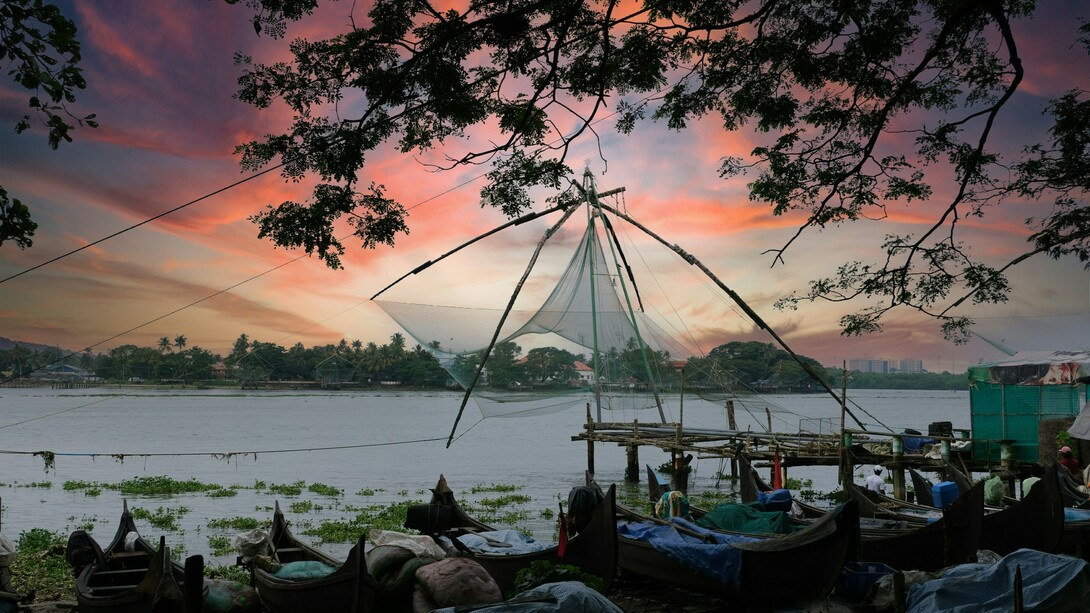
There are journeys we plan, and there are journeys that quietly find us when we least expect them. Kerala—known around the world as God's Own Country—is more than a destination. It is an invitation to discover why many travellers, myself included, leave believing that this celebrated name captures something profoundly real.
My understanding of Kerala has been shaped by two remarkable journeys. The first was the Yoga Ambassadors Tour in 2018, during which I discovered the state through the philosophy and practice of yoga. The second was the International Ayurveda Ambassador’s Tour and B2B Meet in 2019, which revealed Kerala's extraordinary healing traditions and its holistic approach to well-being. Each visit unveiled a different face of Kerala; together, they transformed not only my understanding of the state but also my perception of India itself.
This article is not intended to be a conventional travel guide. Instead, it is the first chapter of a personal journey through a land where nature, spirituality, culture, and wellness have coexisted in remarkable harmony for centuries. It is an invitation to discover Kerala beyond its famous landscapes—to experience the traditions, philosophy, and way of life that make this small state one of India's most fascinating destinations.
Kerala: God's own country
When I first heard Kerala described as "God's own country", I assumed the phrase had ancient origins. It sounded timeless, almost sacred, as though it had been passed down through generations. Only later did I learn that the expression was introduced by Kerala Tourism in 1989 as part of an ambitious international branding campaign. Few could have imagined that those three words would become one of the most successful destination brands in the world.
Yet the more I travelled through Kerala, the more I understood why the slogan has endured for over three decades. Marketing alone cannot sustain a destination's reputation for so long. A place must offer something authentic—something visitors continue to experience long after the advertisements have faded. Kerala possesses that rare authenticity. It is found in the peaceful rhythm of its villages, the warmth of its people, the richness of its traditions, and the profound connection between everyday life and nature.
What makes Kerala so different from the rest of India?
India is often described as a subcontinent rather than simply a country, and nowhere is this extraordinary diversity more evident than in Kerala. Stretching along the Malabar Coast between the Arabian Sea and the majestic Western Ghats, Kerala occupies barely one per cent of India's land area. Yet its influence on world history, commerce, and culture has been far greater than its modest size might suggest.
For more than two thousand years, merchants from Arabia, Africa, China, and later Europe crossed oceans in search of the treasures of this fertile coastline. Pepper—once known as "black gold"—together with cardamom and other spices transformed Kerala into one of the world's earliest centres of international trade. Long before globalisation became a familiar concept, ships from distant civilisations anchored along Kerala's shores, exchanging not only precious goods but also ideas, religions, languages, artistic traditions, and scientific knowledge. This remarkable openness helped shape a society whose identity has always been enriched by cultural exchange.
Unlike many parts of the world where different communities remained separated, Kerala evolved as a true crossroads of civilisations. Hindu temples stand alongside ancient churches, historic mosques, and Jewish synagogues, each bearing witness to centuries of peaceful coexistence and mutual influence.
According to local tradition, the Cheraman Juma Masjid—widely regarded as India's oldest mosque—was established during the seventh century. Christianity reached the Malabar Coast through the tradition associated with Saint Thomas the Apostle, while Jewish merchants established flourishing communities that contributed significantly to the region's commercial and cultural life. Walking through Kerala today, one quickly realizes that diversity is not merely celebrated; it has been woven into the state's identity for centuries.
Kerala also distinguishes itself through remarkable social achievements. It consistently ranks among India's leading states in literacy, healthcare, life expectancy, and overall human development. Education is deeply valued, women have historically played influential roles in society through both matrilineal traditions and modern public life, and local communities remain actively engaged in environmental conservation and responsible tourism initiatives.
These achievements did not emerge by chance. They reflect generations of investment in education, public health, and community well-being—principles that continue to shape everyday life across the state.
Nature, too, has been exceptionally generous. Towering above Kerala, the Western Ghats capture the annual monsoon rains that nourish dense forests, fertile plains, rivers, waterfalls, and the state's legendary backwaters. This intricate network of lakes, canals, lagoons, and rivers forms one of the world's most remarkable freshwater ecosystems, sustaining agriculture, transportation, fishing, biodiversity, and countless local communities.
To glide through these waterways is to understand that, in Kerala, water is far more than scenery. It is an essential part of everyday life, a source of livelihood, and the heartbeat of the landscape itself.
The forests shelter an extraordinary diversity of wildlife, including Asian elephants, Bengal tigers, lion-tailed macaques, Nilgiri tahrs, and thousands of endemic plant species. Many of these medicinal plants have supported traditional healing practices for centuries, making Kerala one of the world's foremost centres of Ayurveda.
Nor are Kerala's contributions limited to wellness. The state is also recognised as the birthplace of Kalaripayattu, one of the world's oldest martial arts still practised today. It is home to classical art forms such as Kathakali, Mohiniyattam, Theyyam, Sopana Sangeetham, colourful temple festivals, exhilarating snake boat races, and a cuisine whose sophistication reflects centuries of cultural exchange and agricultural abundance. Every district possesses its own distinct identity, yet together they create a harmonious cultural mosaic unlike anywhere else in India.
Above all, it is a place where the Sanskrit expression Atithi Devo Bhava—‘the guest is like God’—is not merely a philosophical ideal but a way of life. In June 2018, I stepped out of Thiruvananthapuram International Airport and was immediately welcomed by the organising team of the first-ever Yoga Ambassadors Tour. The warmth of that reception would become my first introduction to Kerala's renowned hospitality.
As we drove through the capital city, I watched Kerala unfold through the window. Brightly coloured temples stood beside churches and mosques. Banana trees lined the roads. Bustling markets overflowed with tropical fruits and fragrant flowers. Families gathered outside cafés, while signboards written in the graceful curves of the Malayalam script reminded me that I had entered a place with its own distinctive cultural identity. It was only the beginning of a journey that would profoundly change my understanding of India.
A journey through yoga: discovering Kerala's spiritual heart
The morning after my arrival, my journey through Kerala truly began. The Yoga Ambassadors Tour was never intended to be a conventional familiarization trip. Rather than simply showcasing tourist attractions, it was designed as an immersive educational and cultural experience, bringing together yoga teachers from around the world to discover Kerala through the lens of yoga, spirituality, nature, and traditional Indian culture.
The beginning of a global yoga conversation
The official inauguration took place in Thiruvananthapuram, where participants from different countries gathered with a common purpose: to deepen their understanding of yoga while discovering one of India's most remarkable wellness destinations.
The opening ceremony reflected India's rich cultural traditions. As in many official events across the country, the programme began with the lighting of the ceremonial lamp, a symbolic act representing the triumph of knowledge over ignorance and light over darkness.
Although simple in appearance, the ritual perfectly reflected the deeper philosophy of yoga itself. Yoga is often described as a journey—from distraction to awareness, from imbalance to harmony, and from the constant noise of the outside world to inner clarity.
Throughout the conference sessions, respected scholars, physicians, and researchers explored yoga from multiple perspectives. Ancient scriptures were discussed alongside modern scientific research. Traditional philosophy met contemporary medicine. Conversations moved naturally between spirituality, psychology, and neuroscience.
The organisers demonstrated that yoga has never been a static tradition frozen in the past. It is a living discipline—one that continues to evolve while remaining faithful to its timeless principles. That balance between preserving tradition and embracing scientific understanding became one of the defining characteristics of my experience in Kerala.
Practising yoga in the land of its origins
One of the most memorable moments came early the following morning. Before sunrise, while much of the city was still asleep, we gathered at Kovalam beach for the Common Yoga Protocol. Kovalam was gaining recognition as one of Kerala’s leading destinations for yoga. There is something profoundly different about practising yoga at dawn. In Kerala, the experience became even more immersive. A gentle tropical breeze moved through the trees, birds announced the arrival of a new day, and the first rays of sunlight slowly illuminated the landscape around us while the devotional singing of a woman echoed softly from a nearby temple. For a brief moment, the boundaries between practitioner and environment seemed to disappear.
Following the path of Swami Sivananda
Among the highlights of the journey was our visit to the Sivananda Ashram. Ashrams occupy a unique place within India's spiritual traditions. They are far more than places of retreat. They are living communities dedicated to learning, discipline, meditation, selfless service, and personal transformation. Our visit introduced us to the teachings of Swami Sivananda, one of the twentieth century's most influential spiritual masters, whose philosophy continues to inspire millions of practitioners around the world. His teachings were remarkably simple yet profoundly practical: Serve. Love. Give. Purify. Meditate. Realise.
Walking through the ashram, I was struck not only by its peaceful surroundings but also by its atmosphere. There was no sense of urgency. Conversations were gentle. Silence was not uncomfortable—it was nourishing. Our visit concluded with a traditional vegetarian lunch served inside the ashram. Sitting cross-legged on the floor alongside fellow participants, we were served simple yet nourishing food on stainless-steel plates. The meal reflected one of the fundamental principles of yogic living—that food is not simply nourishment for the body but also an expression of gratitude, mindfulness, and respect for nature. The simplicity of that meal remains one of my most vivid memories of the entire journey.
Kanyakumari: where three seas meet
Leaving Kerala for a brief excursion into the neighbouring state of Tamil Nadu, our journey continued to one of the most symbolic places in India—Kanyakumari, the southernmost tip of the Indian mainland.
Few places possess such powerful geographical and spiritual significance. Here, the Arabian Sea, the Bay of Bengal, and the Indian Ocean converge, creating a landscape where land seems to surrender gracefully to the endless horizon. Standing at this meeting point, I felt an overwhelming sense of perspective. The vastness of the ocean naturally invites reflection, reminding every traveller how small we are within the immensity of the world.
One of the highlights of our visit was the Vivekananda Rock Memorial, built on the rocky islet where, according to tradition, Swami Vivekananda meditated in December 1892 before embarking on his historic journey to the West. Only a few months later, he would captivate audiences at the Parliament of the World's Religions in Chicago, introducing Indian philosophy and Vedanta to an international audience.
As a graduate of Swami Vivekananda Yoga Anusandhana Samsthana (SVYASA University) in Bengaluru, visiting this place carried a deeply personal meaning. It was far more than another monument on a travel itinerary. It was an opportunity to reconnect with one of the visionaries who helped transform yoga into a universal language of peace and self-discovery.
Inside the meditation hall, silence became almost tangible. Surrounded by the sea and immersed in stillness, it was easy to understand why this place continues to inspire visitors from across the globe. Our visit concluded with a group yoga session overlooking the ocean—a moment that beautifully united practice, nature, and history.
Nearby stands the magnificent 133-foot Thiruvalluvar Statue, honouring the celebrated Tamil poet and philosopher whose masterpiece, the Tirukkural, remains one of the world's timeless works on ethics, virtue, and human values. Looking across the water at these two monuments, one dedicated to spiritual awakening and the other to wisdom and moral philosophy, I was reminded that India's cultural heritage is as diverse as it is profound.
Amritapuri: discovering the power of compassion
Back in Kerala, we travelled to Amritapuri, home of the renowned humanitarian and spiritual leader Mata Amritanandamayi Devi, affectionately known as Amma, or "the Hugging Saint". If yoga teaches self-awareness, Amritapuri teaches something equally important: that inner transformation naturally expresses itself through compassion and service. Walking through the ashram, people from every continent, speaking different languages and representing countless cultures, lived and worked together with remarkable simplicity.
Despite their differences, everyone shared the same purpose—to cultivate kindness, humility, and service to others. This atmosphere reflected one of the fundamental principles of Indian philosophy: spiritual growth cannot remain confined to personal well-being. It finds its fullest expression through generosity, empathy, and meaningful action.
The backwaters: where life moves to the rhythm of water
From Amritapuri, we travelled towards Alappuzha, internationally known as Alleppey, the gateway to Kerala's legendary backwaters. Photographs often capture the beauty of these waterways, but they rarely convey their true significance. The backwaters are not simply one of Kerala's most famous tourist attractions—they are the lifeblood of countless communities. For generations, this intricate network of lakes, rivers, canals, and lagoons served as Kerala's natural highways. Long before modern roads connected villages, people travelled by boat to attend school, transport goods, visit markets, or simply meet neighbouring families. Even today, daily life continues to unfold on the water.
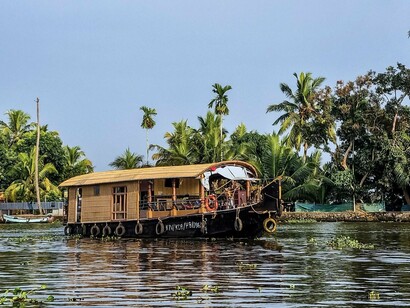
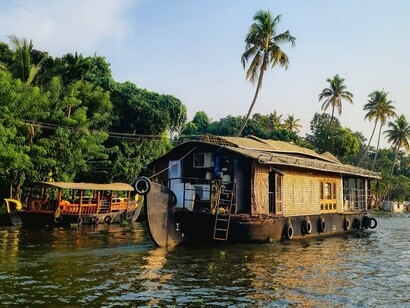
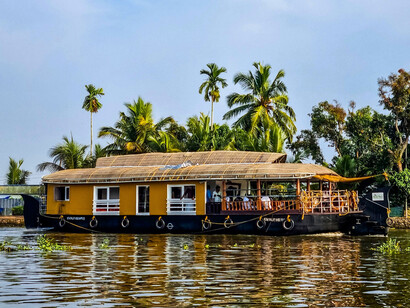
Stepping aboard a traditional Kettuvallam—the iconic Kerala houseboat—felt like entering another world. Originally built to transport rice and spices across the waterways, these elegant wooden boats have been carefully restored as floating homes, allowing visitors to experience one of the most peaceful landscapes in India while preserving an important part of Kerala's cultural heritage.
As our houseboat drifted through narrow canals, the pace of life slowed almost instinctively. Children waved from the riverbanks on their way home from school. Fishermen patiently cast their nets into the calm waters. Women washed clothes at the water's edge while colourful kingfishers darted across the canals with astonishing speed. Rows of coconut palms leaned gracefully over the water, their reflections shimmering beneath the afternoon sun. Nothing appeared hurried. Nothing felt staged. Life simply unfolded at its own gentle rhythm.
A taste of Kerala: the philosophy of Sadhya
One of the highlights of our Kerala experience was sharing a traditional Sadhya, Kerala's celebrated festive meal served on a fresh banana leaf. At first glance, the colourful arrangement appears almost artistic. Small portions of vegetables, curries, pickles, chutneys, rice, papadam, and traditional desserts are carefully placed according to centuries-old customs. Yet Sadhya represents far more than culinary tradition. It embodies Kerala's philosophy of harmony. Each preparation balances flavours, textures, colours, and nutritional qualities. Sweet, sour, bitter, spicy, and savoury coexist in perfect equilibrium, reflecting the Ayurvedic understanding that nourishment should support both physical health and inner balance.
As I tasted each dish, I realised that Kerala's cuisine tells the story of the land itself. Coconut appears in countless forms. Fragrant spices recall centuries of international trade. Fresh vegetables, tropical fruits, and aromatic herbs celebrate the extraordinary abundance of the region. More importantly, Sadhya reminded me that in Indian culture, sharing food is an act of generosity and hospitality. Meals are not simply consumed. They are shared, celebrated, and remembered.
Thekkady: where the story of spices began
Leaving the tranquil backwaters behind, our journey turned inland towards Thekkady, nestled in the lush hills of the Western Ghats. The transformation in the landscape was remarkable. Coconut groves gradually gave way to dense forests, winding mountain roads, and endless plantations stretching across the hillsides.
Long before Europeans discovered the sea route to India, merchants from Arabia, China, and Africa travelled thousands of kilometres in search of the spices that grew abundantly in these fertile highlands. Pepper, cardamom, cinnamon, cloves, nutmeg, and ginger were far more than culinary ingredients—they were among the world's most valuable commodities, shaping global trade, diplomacy, and exploration.
The air itself carried the fragrance of cardamom and pepper vines climbing gracefully around towering trees. Our guide explained how each spice is cultivated, harvested, and carefully processed before reaching kitchens across the world. Only then did I truly appreciate why Kerala became known as the legendary Land of Spices. These forests continue to protect another of Kerala's greatest treasures—its extraordinary biodiversity.
Nearby lies Periyar Wildlife Sanctuary, one of India's most celebrated protected areas, where elephants, gaur, sambar deer, and countless bird species roam freely within one of the country's richest ecosystems. Here, conservation and responsible tourism coexist, reminding visitors that Kerala's greatest wealth lies not only in its cultural heritage but also in its remarkable natural environment.
Munnar: among the clouds
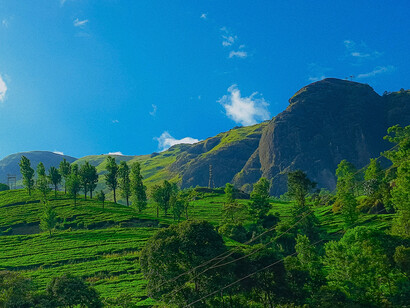
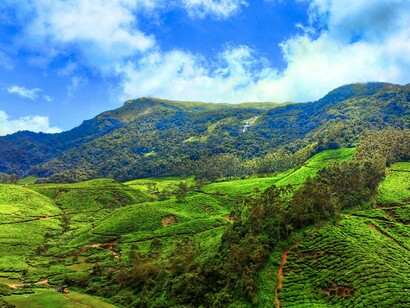
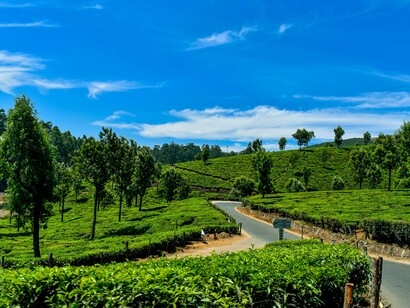
From Thekkady, the road climbed steadily towards Munnar, one of Kerala's most iconic hill stations. The tropical forests slowly disappeared, replaced by rolling hills covered with seemingly endless carpets of emerald-green tea plantations. Wisps of mist drifted across the valleys, waterfalls cascaded down rocky cliffs, and the temperature became noticeably cooler. Situated at an altitude of approximately 1,600 metres, Munnar owes much of its modern history to tea cultivation introduced during the colonial period. Recognising the region's ideal climate, British planters transformed these mountains into one of India's most productive tea-growing regions—a legacy that continues to shape both the local economy and the breathtaking landscape visitors admire today.
One of the most memorable experiences was exploring the region by jeep, allowing us to venture beyond the main roads into landscapes that felt almost untouched. Along the way, we visited the Muniyara Dolmens near Chinnakanal, remarkable prehistoric megalithic burial chambers dating back thousands of years. These silent stone structures, standing patiently through countless generations, offered yet another reminder that Kerala's story extends far beyond its famous beaches, tea plantations, and wellness retreats.
Every layer of the landscape reveals another chapter of human history. Our visit also included a peaceful meditation session overlooking the surrounding mountains. Wrapped in mist and silence, surrounded by rolling hills disappearing into the horizon, meditation felt less like an exercise and more like a natural response to the beauty around us.
Kochi: where Kerala meets the world
Every journey eventually arrives at its final destination. Mine ended in Kochi, historically known as Cochin, a city where centuries of maritime trade have created one of India's most fascinating cultural landscapes. Often referred to as the Queen of the Arabian Sea, Kochi has welcomed merchants, explorers, missionaries, and travellers for more than six hundred years. Arabs, Chinese, Jews, Portuguese, Dutch, and British communities all left lasting impressions on the city's architecture, cuisine, traditions, and multicultural identity.
Walking through Fort Kochi feels less like visiting a modern city and more like turning the pages of a living history book. Colonial buildings stand beside colourful cafés and contemporary art galleries. Ancient churches coexist with temples, mosques, and the historic Jewish quarter. The famous Chinese fishing nets continue to stretch gracefully over the shoreline, silently recalling centuries of maritime exchange across the Indian Ocean.
Our evening began with a relaxing sunset cruise through Kochi's backwaters before attending a captivating performance of Tholpavakoothu, Kerala's traditional shadow puppetry. Through light, music, and intricate leather puppets, ancient stories from the Ramayana came to life, reminding us that Kerala's artistic traditions continue to flourish in the modern world.
The following day coincided with another deeply meaningful moment: the celebration of the International Day of Yoga. Celebrating in India, surrounded by fellow teachers and practitioners from different countries, brought the journey full circle. It was a fitting conclusion to an experience that had begun with curiosity and ended with profound gratitude.
More than a destination
When I boarded my flight home, I realised that I was not simply leaving another beautiful destination behind. Kerala had offered something far more enduring than breathtaking landscapes or memorable photographs. It introduced me to a philosophy of living. A place where wellness is not treated as a luxury but as an integral part of everyday life. Where hospitality remains deeply rooted in culture. Where nature is respected rather than conquered. Where ancient traditions continue to coexist harmoniously with modern aspirations.
Years have passed since this remarkable journey, yet the lessons of Kerala continue to accompany me both personally and professionally. Kerala changed my understanding of India by revealing a country whose greatest treasures cannot always be photographed. They are found in its values, its people, and its timeless traditions. This article marks only the beginning of that journey. In the next chapter of this series, I will explore another defining dimension of Kerala's identity—its extraordinary Ayurvedic heritage, where ancient healing traditions continue to shape one of the world's most respected wellness destinations.