English
 Español
 Français
 Deutsch
 Italiano
 Português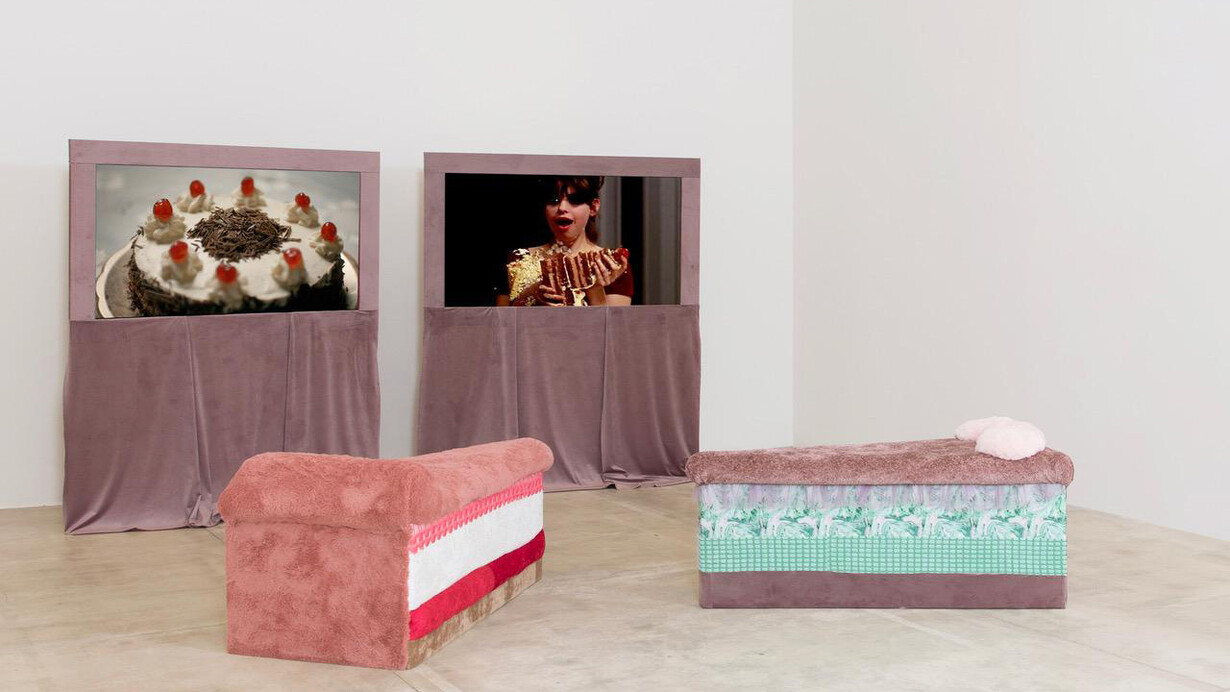
Selva de Carvalho (b. 1986 in São Paulo, Brazil, where she lives and works) graduated in 2009 with a degree in Fine Arts from the Fundação Armando Alvares Penteado (FAAP). Driven by a deep interest in community development, she initially focused on coordinating educational and sustainability projects for schools, nongovernmental organizations, and companies, developing educational, social, and environmental protection programs for communities in the Amazon region.
Rooted in drawing and embroidery, Carvalho’s multidisciplinary practice expands into textiles, body art, and performance. Her research investigates the materiality, expressiveness, and transformative “becomings” of threads, paper, text, and form, exploring the symbolic and fantastical relationships between visible and invisible, human and non-human bodies. Drawing inspiration from dreams, Brazilian landscapes, mythology, and organic structures, she creates hybrid beings and immersive visual worlds that blur the boundaries between nature, body, and imagination. Her work frequently engages themes of transformation, memory, femininity, and interconnected life systems.
Artist statement
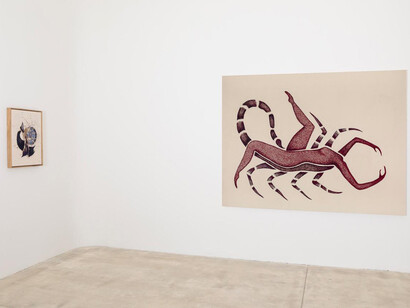
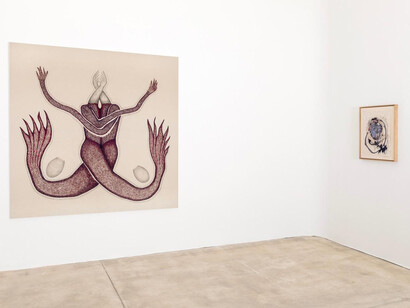
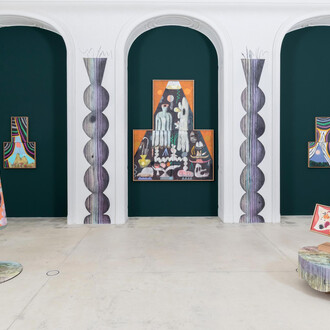
The series Eros crossings was initiated during a residency offered by the Krinzinger gallery in 2025. It is a series composed of 4 works, all made from the scale of the artist's body. The title refers to the idea of crossing or hybridity and also of traversing or being traversed by desire. This series investigates the body not as a closed unit but as a territory of exchange, metamorphosis and fusion. The erotic is seen as a force that dismantles (albeit illusorily) the boundaries between the self and the other, between the human and the animal. The human body hybridizes with the animal not by aesthetic choice, but by a drive-related need. By merging female anatomy with the figure of the scorpion, the work evokes the dual nature of desire. The image of the penetrating stinger speaks of a symbolic self-penetration. Of an encounter with one's own shadow, with the instinct that is, at the same time, dangerous and vital. The relationship between the stinger and the fissure is a metaphor for vulnerability. To transform oneself, one must allow oneself to be traversed; to be reborn as something new (the hybrid), one must let the old form die. The bodies portrayed in this series are in the process of becoming something else. They are figures that celebrate the beauty of estrangement and the sovereignty of desire, reminding us that Eros is, above all, the force that pushes us beyond our own limits.
The works in the Hysteria series stem from the artist's observation of her own internal flows. They are works made with the artist's menstrual blood, collected in different cycles, starting in 2020. The word "hysteria" carries in its etymology (hystera, the uterus) centuries of silencing and control over the female body. Historically, medicine treated the uterus as a wandering organ, an agent of imbalance that justified the diagnosis of "female madness." By using menstrual blood as pigment and embroidery as scar and contour, this work subverts the logic of pathology. Blood, so often hidden and read as "dirt" or "taboo," is presented here as the fluidity of a vital and political cycle. Here, the internal flow is not a symptom of disease or lack of control, but evidence of presence and of a life that overflows. Each stitch embroidered in these works is an attempt to give contour, but also give way and expression, to what is immense: our inner waters, our emotions, our unconscious. The work invites the gaze to confront what has been considered "obscene" or "unstable," revealing that the woman's body, in its various aspects, is not a problem to be solved, but a geography to be respected, a vast, deep, and pulsating ocean of life.
Since 2019, Selva de Carvalho has presented her work in numerous solo and group exhibitions across Brazil. Her major solo exhibitions include Lev(e)iatã at Galeria Karla Osorio in São Paulo (2025), Dar asas às cobras at Residência Fonte (2023), and Jardim das bromélias at the Escola de Botânica de São Paulo (2021). Her work has also been featured in prominent group exhibitions. Alongside her exhibition practice, she has participated in international residencies and collaborative projects.
Bianca Kennedy (b. 1989 in Leipzig, Germany, lives and works in Berlin) is a German multimedia artist whose work explores the relationship between physical and digital spaces through video, stop-motion animation, virtual reality (VR), and miniature model-making. She studied at the Athens School of Fine Arts and the Academy of Fine Arts Munich, graduating as a Meisterschülerin in 2017.
Her work examines human behavior, physical vulnerability, and psychological unease, often combining analytical observation with dark humor. Since 2013, she has collaborated with the Swan Collective under the name kennedy+swan, creating VR and video projects that critically explore the relationship between humans, technology, and the environment.
In her found-footage work Let them eat cake, Bianca Kennedy dissects an overlooked cinematic motif: the cake as a symbol of complex power dynamics. Peering behind the perfectly glazed surfaces, Kennedy reveals that filmic sweetness is often a tool of manipulation. In the baroque splendor of Sofia Coppola’s Marie Antoinette (2006), pastries offer an escape from reality, whereas in The matrix reloaded (2003), the cake functions as a programmed temptation designed to force the biological response of an orgasm.
The two-channels illustrate the connection between creation and destruction. Exclusively women are shown baking in the kitchen (men must be paid for it). In contrast, male figures are shown devouring or deliberately destroying this symbol of domesticity. Kennedy shows how the female body is often treated much like the baked goods: decorated, put on display, or 'sacrificed.'
While films like Daisies (1966) celebrate the destruction of a banquet as a subversive act of liberation, works such as The substance (2024) adopt a more body horror-esque approach. Here, frosting merges with flesh, and the longing for perfection turns into disgust. Through her re-montage, Kennedy unmasks the seductive appeal of sweetness as a complex system of desire and dependency.
Kennedy, who won the Loop discover award in 2018 and the Toy Berlin masters award in 2019, has shown her work in museums and festivals internationally. Her selected exhibitions and festival screenings include presentations at CCBB Rio de Janeiro (2019), the Sundance Film Festival (2020), the Kunsthalle Baden-Baden (2020), the Museum of Fine Arts in Leipzig (2020), the SCAD Museum of Art (2021), the Lyon Biennial (2022), and Galerie Krinzinger Schottenfeld in Vienna (2024).
Martin Sommer (b. 1998 in Graz, Austria) lives and works in Vienna. His artistic practice moves between sculpture installation, material research and conceptual work. He investigates institutional structures, infrastructural systems of order and the mechanisms through which perception is regulated, evidence is produced and meaning is stabilized. His works often take as their point of departure materials that have already been embedded in functional or social contexts and are transferred into new constellations through chemical, technical, or physical processes of transformation.
Artist statement
My artistic practice investigates how materials, objects, and institutional orders produce meaning. The starting point is often things that have already been embedded in functional, social, or infrastructural contexts: school desks, lost keys, slaughterhouse doors, bank vault air, elevator motor oil, or elements of public infrastructure.
I am interested in how things can lose their function without losing their origin. An object carries more than its form, it carries the conditions under which it was used, seen, or overlooked. Through chemical, technical, or physical processes of transformation, materials are transferred into new constellations without fully dissolving their original context.
Transformation is not simply a change in form, but also a shift in legibility. The origin of a material does not disappear with its transformation but changes the way in which it becomes perceptible. The works, therefore, do not rely on illustration or on a contrast between the represented and the non-represented, but instead operate through changes in the functions of existing systems.
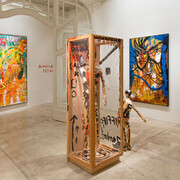
The work S.D.P.S. consists of a personal weighing scale made entirely from reclaimed doors of a slaughterhouse. In its form, it recalls a conventional scale, yet it does not measure weight. The analogue display has been modified so that the pointer moves continuously counterclockwise, like a second hand running backwards. Only when a person steps onto the scale, the direction of movement reverses and the pointer begins to move clockwise.
S.D.P.S. withdraws the scale from its original function without abandoning its structure. What would otherwise be determinable as weight remains without number. The body is not translated into a value but merely changes the direction of an ongoing process. The used doors carry the provenance of a place in which bodies passed a final threshold. In the work, this transition is not represented, but transferred into an altered logic of display, direction and presence. What becomes legible is not the body, but the displacement produced by its presence within the apparat.
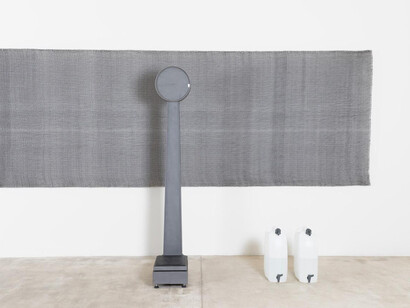
The series F.S.L.K. consists of large black textiles that are presented in different compressed states, either laid out flat or tightly wound on a cardboard roll, placed on the floor or mounted on the wall. Their source materials are wooden school desks and lost keys collected from the Lost & Found Office. The desks are chemically processed, in order to obtain pure cellulose fibres. From these fibres, paper is produced, then cut into narrow strips following a Japanese washi technique, spun into yarn, and finally woven into a fabric. In parallel, the metal of the keys is oxidised and converted into a black iron oxide pigment, which is used to dye the yarn. The result is a fabric roll that deliberately remains in a state of suspension: it refers to the possibility of further use without enacting it. A fabric emerging from fragments of institutional control and lost access.
The series B.S.S.C. consists of different storage units, made from aluminium and plexiglass panels of several dismantled bus shelters, which are coated with street dust and sugar. Its basis is a calculation system that translates the experienced intensity of time into volume: values are entered into a diagram that represents the 24 hours as a ring, and their deviations are transferred into spatial dimensions. In this way, volumes of days, weeks, and months emerge, illustrating the dimensions of individually perceived time.
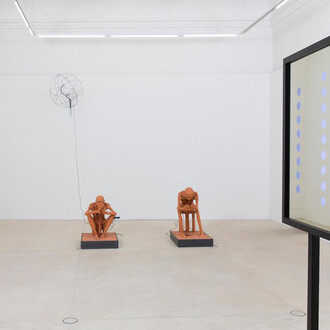
In the mid-twentieth century lithium became part of the emerging field of psychopharmacology. Its effects on mood and behavior brought lithium slats, such as lithium carbonate, in focus of psychiatric research —not as a cure, but as a means of affective stabilization. L.C. shows two containers filled with a liquid based on lithium carbonate. The lithium contained within was extracted from batteries originally developed to regulate energetic processes in technical systems. Through a multi-stage process, the lithium was chemically isolated from the batteries and transformed into a medically usable lithium carbonate solution.
Sommer studied Sculpture and Space with Hans Schabus at the University of Applied Arts Vienna from 2019 to 2025. He attended the HTBLVA Ortweinschule Graz, focusing on classical sculptural techniques and restoration, with a specialization in oil painting restoration. In 2023, he participated in the Contemporary Art Summer School at the Royal College of Art in London. His works have been shown in numerous exhibitions in Austria and internationally, including Art Basel, Salzburger Kunstverein, Galerie Krinzinger, and Vienna Contemporary, as well as in solo exhibitions in Vienna, Athens, Trieste and Berlin. He has received, among others, the Young European Artist Trieste Contemporanea Award 2025, the Diploma Thesis Promotion Award of the University of Applied Arts Vienna and the International Studio Grant of the Province of Styria.