English
 Español
 Français
 Deutsch
 Italiano
 Português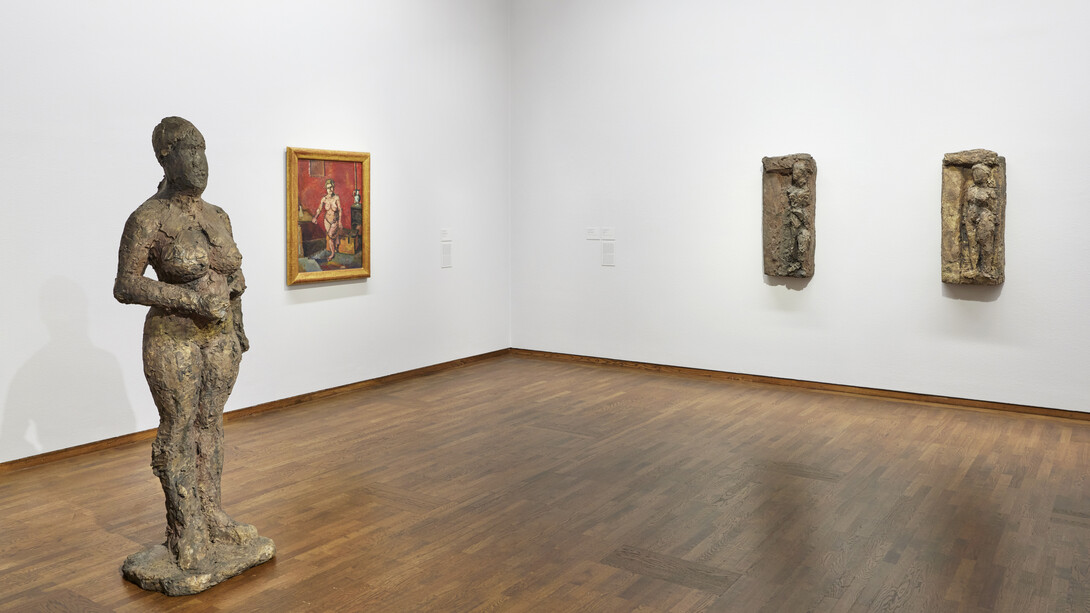
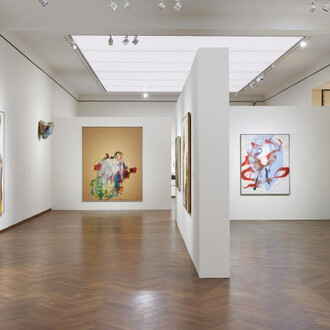
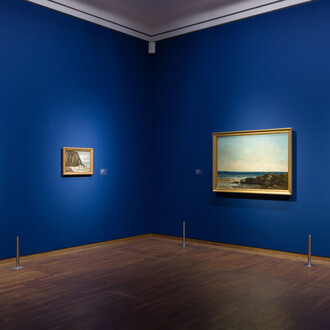
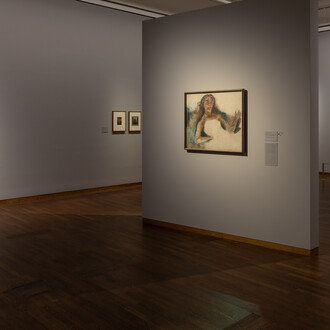
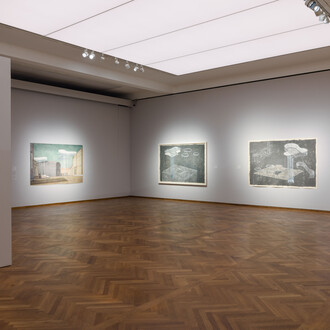
In this exhibition, conceived as a dialogue, the works of the Austrian paint er Herbert Boeckl (1894–1966) and of the Swiss sculptor Hans Josephsohn (1920–2012) are juxtaposed for the first time. Featuring more than 80 paintings, sculptures and works on paper, Herbert Boeckl / Hans Josephsohn. Figural arche types addresses the subjects of form, figure, material accumulation and human existence in an exciting exhibition.
The Leopold Museum is the first Austrian art institution to devote a comprehen sive museum presentation to the work of the Swiss artist Hans Josephsohn in the context of this dialogue exhibition. Herbert Boeckl, meanwhile, is among the main representatives of Austrian Modernism, who, not least on account of his teaching activities, had a decisive influence on the following generation of Austrian art ists. While the oeuvre of Josephsohn only became known to the wider public in the 1990s, it has catapulted him over the past years into the ranks of the most important 20th-century sculptors. The exhibition opens up new perspectives on these two eminent artists of the European avant-garde, whose oeuvres – despite the fact that they never met and that they came from different backgrounds and worked in different artistic media – boast striking parallels.
An encounter between two artists working in such different categories necessi tates an experimental process which affords new insights into their respective genres. This dialogue, highlighting the elective affinity between them, opens up new spaces for associative interpretations, and allows for fresh perspectives on their works’ form and content.
(Hans-Peter Wipplinger, Director of the Leopold Museum and curator of the exhibition)
This unusual juxtaposition allows us to see the oeuvres of the two artists in a new light, and to experience how their works enrich one another. Despite their historical, spatial and cultural differences, their works reveal unexpected com monalities. The oeuvres of both artists were invariably dominated by representa tionalism. Both Boeckl and Josephsohn based their artistic work on their personal environment and on concrete models. Boeckl’s most important muse was his wife Maria who often modeled for him. Josephsohn found his preferred models and sources of inspiration among the people closest to him, including his first wife Mirjam Abeles, his partner Ruth Jacob and his second wife Verena Wunderlin, though his models also included friends or the laborer Ernst Baumann. Both art ists eluded the trends and fashions of the art scene. Josephsohn was an artis tic loner. His work was first represented by a gallery in 2000, when the artist was already 80 years old. Today, Hans Josephsohn is considered the second most important Swiss sculptor after Alberto Giacometti.
Timeless forms
The artists’ similar notions with regards to physicality, materiality and form- finding offer various points of contact between them. Both artists consolidated recollections, encounters and fleeting moments of deep realization into timeless forms. The lives of Boeckl and Josephsohn were shaped by the profound upheaval of the 20th century. Boeckl experienced the horrors of World War I as a young man, while Josephsohn, as a Jew, was forced to flee to Switzerland to escape the persecution by the National Socialists, and lost his parents in the holocaust. Though Josephsohn always rejected a biographical interpretation of his oeuvre, his work – like that of Boeckl – was clearly marked by war, loss and life-threatening experiences.
These existential experiences, which put everything into question, inevitably impacted on the artists’ thinking, lives and work. Their oeuvres are testament to the seriousness, profundity, transience and ephemerality of existence.
(Hans-Peter Wipplinger)
Radical simplification and formal consolidation
For Boeckl and Josephsohn, the human figure as a carrier of artistic ex pression was always a central theme. Both of them at some point expedited a process of abstraction in which people – and, in the case of Boeckl, also objects and landscapes – manifest only in a stylized manner. This radical simplification and formal consolidation was aimed at carving out the essentials, a universally valid human form. Both of them reduced anatomical details, individual characteristics and narrative elements to focus on fundamental structures and archetypal forms.
Existentiality - physicality of the material - processuality
The oeuvres of both artists revolved around universal questions of human existence. Their treatment of the material, meanwhile, reveals further analogies between them. While Boeckl applied thick layers of paint in an almost sculptural manner, Josephsohn molded his clay and plaster models both by add ing and subtracting material. Another parallel resides in the processual nature of their oeuvres: Their works show distinct traces of the creative process, shaped by a search and struggle for the correct form. With Boeckl, these traces are stored in the sediments of the paint layers he applied using an expressive impasto technique; with Josephsohn, they illustrate the process of sculptural molding, the application and removal of plaster, and are also apparent in his casts.
Archaic art as a reference
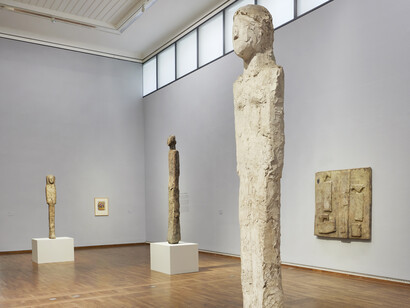
The objects shown in the exhibition – paintings and works on paper by Boeckl which enter into a dialogue with Josephsohn’s plaster and brass sculptures – combine to form a tension-filled overall picture full of unexpected esthetical analo gies. Both artists participated in a reception esthetics inspired by pre-modern, clas sical and medieval visual programs. In the late 1940s and early 1950s, Josephsohn explored the reduction of the human figure. Based on the models, he simplified the bodies into compact, block-like forms. The resulting archaic-looking, reduced and stele-like figures evoke associations with Egyptian, Greek and Etruscan sculp tures. Josephsohn wanted to penetrate to the “very essence of the thing”, and to break away from a mere depiction of external natural impressions. Despite all formal reduction, the human figure always remained his point of departure. The 1950 sculpture Untitled (Mirjam) is exemplary for Josephsohn’s early exploration of figural abstraction. The decisive impetus for this and other works from this group came from Mirjam Abeles, his preferred model during this period. Boeckl also explored classical and medieval art, as well as Baroque formal concepts. His art production was influenced by his travels to Spain, Greece and Egypt where he captured Egyptian wall paintings in watercolors. The timeless significance of the classical and protohistoric art of the Mediterranean region served him as inspiration for the decoration of the Angels’ Chapel of Seckau Abbey for which he created a monumental fresco cycle, depicting the Apocalypse of John (1952–1960).
The effect of paint and form
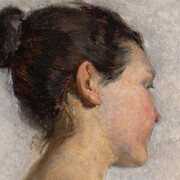
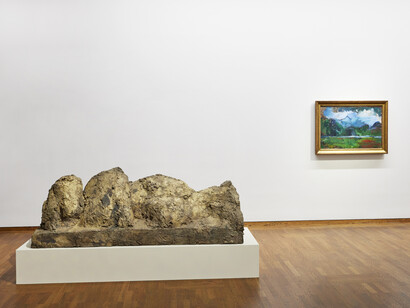
Examples of Boeckl’s early oeuvre are the works Portrait of Kurt Plahna (1918) and The engaged couple, created the same year, in which he depicted himself with his future wife and the mother of their nine children, Maria Plahna. In this work, the artist interweaved short brushstrokes into a scintillating web of glow ing colors. A focus of the exhibition is on Boeckl’s paintings created around 1920. His expressive manner of painting during this time was loosely based on that of Egon Schiele, who died in 1918, and of Oskar Kokoschka, who in 1917 moved from Vienna to Dresden where he recovered from his war injuries and accepted a professorship at the local art academy in 1919. Though there are evident formal elements reminiscent of Schiele and Kokoschka, Boeckl increasingly emancipated his art from these influences from 1920 onwards through an “elementary effect of paint” (Fritz Novotny). In 1924, the art historian Otto Benesch looked upon Boeckl as a successor of Van Gogh, Cezanne and Lovis Corinth. Both Boeckl and Josephsohn appreciated the works of the sculptor Aristide Maillol, especially his reduction to the formal cohesiveness of the human body. Just as the contours in Boeckl’s work gradually disappeared, Josephsohn, too, increasingly dissolved the shapes in his sculptures. In Boeckl’s Still life with dead crow (1921), the paint appears downright physical, while the motif can only be discerned with the help of the work’s title. The works of the two artists reveal a fascinating esthetical convergence: While Boeckl’s landscapes look like bodies, Josephsohn’s sculptures of reclining figures appear like monumental mountain ranges.
Paint masses and reshaping
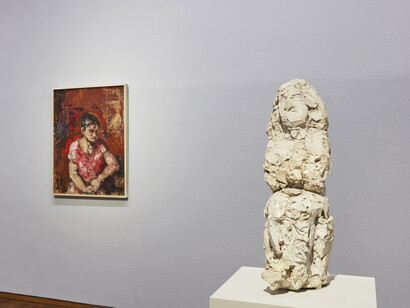
Boeckl’s key work from the collection of the Leopold Museum, the painting Group at the edge of the wood (1920), in which the artist depicted himself alongside his young wife Maria, boasts a radi cal late Expressionism: The summary treatment of physiognomy and landscape levels the border between body and space. Owing to the application of extremely thick paint layers, his painting looks like a relief. While Boeckl layered paint masses, Josephsohn reshaped human anatomy. Boeckl treated paint like a malleable mass, at times squeezing it directly from the tube onto the im age carrier to mold his figures. Josephsohn proceeded in a similar manner with his three-dimensional compositions. In his studio in Zurich, he created a multitude of plaster models. His freestand ing sculptures include seated, standing, reclining and striding figures, as well as heads and busts. In his Portrait of Josef von Wertheimstein (1921), perhaps Boeckl’s most radical likeness, he reduced the depicted to very few pictorial elements. The figure stands out against the darkness of the pastose background as if it had emerged from a viscous pri meval mud. Boeckl wanted to see the real person. Josephsohn, too, was interested in grasping the model as a whole rather than in the true rendering of a person’s appearance.
The search for a new visual language
The unspeakable horrors of World War II shook the art world to its core, and made
it impossible for artists to continue with traditional forms of representation. Boeckl
responded to this humanitarian catastrophe with his “metamorphoses” which her
alded a new period in his oeuvre. Informed by abstract experiments, he searched
for a new visual language. He systematically dissected his objects into planes and
blotches of paint. His series of depictions of Dominicans (1948/49) represents a
climax of this analytical phase. Between 1951 and 1953, Josephsohn created heavily
abstracted and geometrically reduced planar reliefs in connection with the Korean
War which had awakened his own traumas sustained during World War II. The
ostensibly abstract reliefs show ciphers of vulnerability: Arrows stand for
menacing warplanes, rectangular or square blocks intimate objects that come
crashing down, while rod-like segments refer to fragile human bodies. In his late
oeuvre, Josephsohn started a renewed process of abstraction. Instead of reduc
ing his figures, he now chose to reshape them by building up material, condensing
these large-format half-figures into block-like volumes with bodies dominated by
oversized heads. He scaled back anatomical details, individual characteristics and
natural proportions in favor of an archetypical form language.