English
 Español
 Français
 Deutsch
 Italiano
 Português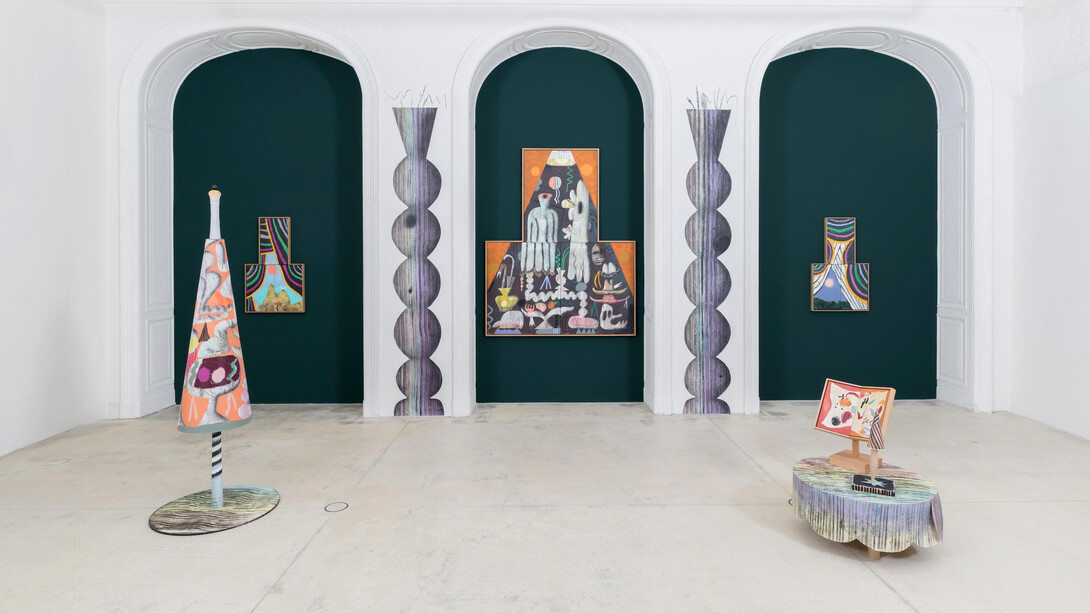
The most merciful thing in the world… is the inability of the human mind to correlate all its contents.
(H.P. Lovecraft)
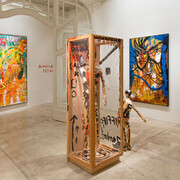
This tension between what we can understand and what lies beyond comprehension resonates deeply in the work of József Csató. On a single surface, a vast collection of objects— anthropomorphic figures, plants, lamps, bones, mushrooms, and fruits—interact in ways both playful and enigmatic. The viewer is drawn into a world that is at once familiar and utterly strange.
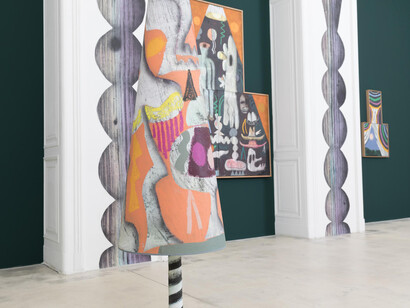
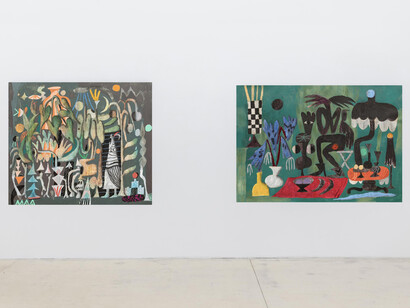
Neither fully abstract nor strictly figurative, József Csató’s botanical and amorphous beings assemble into a kind of legion, parading across frieze-like canvases, as if participating in a demonstration, procession, or collective ritual. High-heeled boots morph into limbs; palm-treelike heads sway above bodies with vessel-shaped noses, exaggerated buttocks, satyr legs, mushroom lamps, and dangling arms. Everything appears organic, animated, and profoundly ambiguous. The figures suggest a hybrid genealogy, a gallery of ancestors that could belong equally to a distant past or to a speculative future.
While preparing this text, a visit to the Kunsthistorisches Museum in Vienna led me to linger before the frieze of the Ilissos Temple from Athens, dated around 420 BCE. The figures carved in stone advance along the surface as if still in motion, caught between narrative and ornament. A similar sense of collective movement animates József Csató’s parades of beings in his painting Even better times. In both cases, figures unfold in a continuous rhythm across the plane, suspended in time yet charged with dynamism. Within this procession, a grand narrative or numerous mini-stories are present, without ever becoming clearly readable.
Density is a defining condition of József Csató’s pictorial world. His paintings feel as if they’ve been approached, withdrawn from, and then re-entered. What emerges is the sensation of traversing the same visual terrain multiple times, altered by shifts in color, form or spatial logic. The viewer senses that the painting has lived through itself, surviving its own becoming. It bears traces of revision. Without being self-referential in a conceptual way, it simply is inhabited by its own history, thick with past nows that haven’t quite let go.
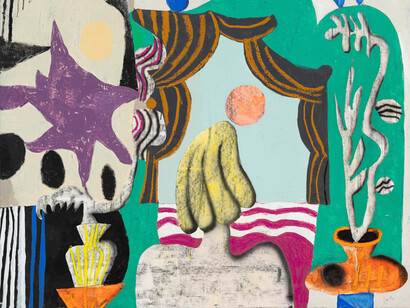
As a viewer, one does not encounter a singular moment but an accumulation of moments unfolding within an unstable spatial field. Tabletops tilt, foreground collapse into backgrounds and forms hover without clear anchoring. These are not depictions of reality but constructed environments, often axonometric, in which hierarchy dissolves. Figures do not claim privileged status. They exist on equal footing with objects, plants, fruits or lamps. Nothing is central. Everything participates.
In several works, canvases are arranged in triangular formations, opening the view like a window partially veiled by striped or dotted curtains. Beyond them, landscapes emerge, volcanic mountains, green expanses, a sun rising or setting. Elsewhere, a lamp illuminates a recurring vocabulary of forms, hats, vases, fruits, eggs, totemic hybrids and biomorphic entities. This lexicon feels at once deeply personal and unmistakably archaic, as if drawn from an internal archive or an inner museum of images accumulated over time.
Past, present and future dissolve within this universe. It is precisely this simultaneity that animates the artist’s brightly colored works. Just as vision shifts through different optical lenses, the artist seems to perceive through layers of color, form, structure and space. Interiors slide toward landscapes. Gardens behave like rooms. Conventional distinctions between inside and outside, near and far, intimate and monumental collapse into one another. This inclination toward sculptural thinking, figures that appear carved from paint and painted forms that extend into actual sculpture, further amplifies the liminal quality of the work.
Paraphrasing H.P. Lovecraft once more, where dead Cthulhu lies dreaming in his sunken house at R’lyeh, József Csató’s works inhabit a similarly threshold like space, timeless, often indescribable, alien yet uncannily familiar. His art gestures toward civilizations long vanished or not yet imagined. In this universe, complexity, ambiguity and play coexist. The works do not demand comprehension. They offer the mind to accept what cannot be fully known, an experience both merciful and exhilarating.
In 1971, the American artist Lee Lozano captured a comparable impression: “It’s not linear thinking but more like cosmic storms which are all over the place.” This notion of dense, multilayered movement resonates strikingly in the work of József Csató.
(Text by Barbara Horvath)