English
 Español
 Français
 Deutsch
 Italiano
 Português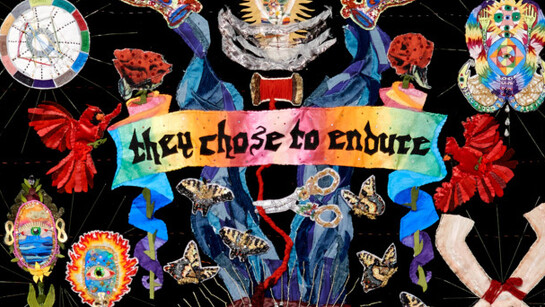
Beyond the veil marks the first exhibition at Mindy Solomon Gallery of Miami-based artists Pangea Kali Virga, Andrea Spiridonakos, and Lisu Vega, curated by Sophia Ballesteros. Bringing together three distinct textile practices, the exhibition considers cloth as both object and conduit, capable of carrying memories that extend beyond a single body or lifetime. Through processes of felting, weaving, stitching, and assemblage, each artist engages fiber not only as material, but also as a structure to record inheritance and reflection.
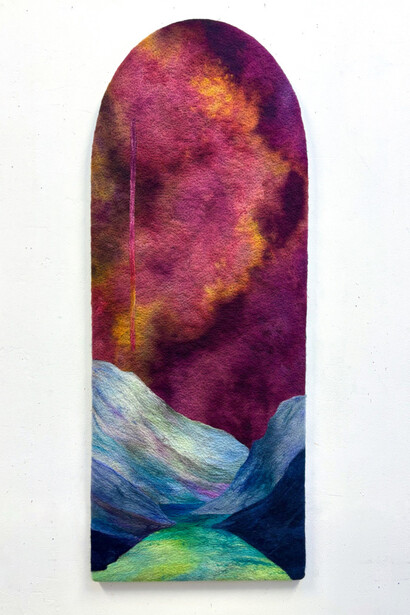
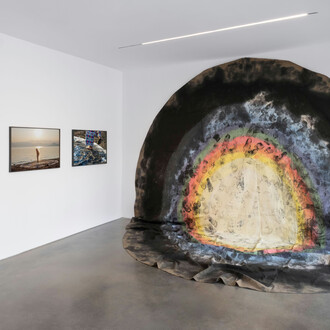
At the center of the exhibition, Andrea Spiridonakos creates a sense of ascension with an twenty-foot hand-painted silk swath shifting from the ground upwards, adorned in colors of turquoise, pink, and red. The silk becomes a metaphorical veil between Heaven and Earth as one walks below the drapery, illuminated from above by the natural skylights of the gallery space. The title wall holds two felt archways, one of which depicts a rocky passage opening onto an expanse of deep blue sky and a soft pink horizon line. The title of this work, Ad te solo (2026), references The canticle of the creatures by St. Francis of Assisi (1225), a poem praising God through the personification of the natural world, including “Brother wind and air,” “Sister Earth,” and later “Sister death, from whose embrace no mortal can escape.” Across these works, the felt becomes a slow accumulation of gesture with simultaneous surrender. There is a peacefulness captured within the bright, scenic, colors of Spiridonakos’ work, complemented by the softness of her choice materials.
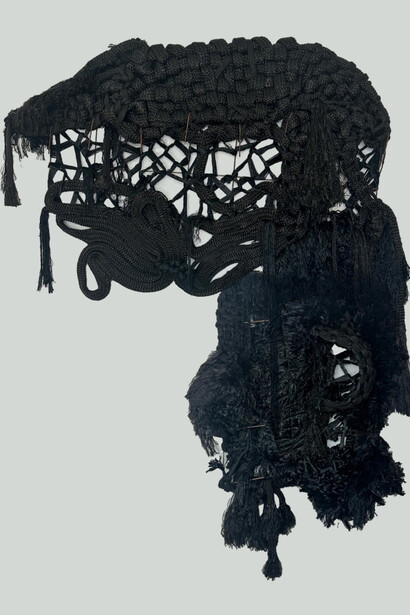
For Lisu Vega, weaving and stitching become acts of remembrance. Her central installation is Tan cerca (So close) (2022 – 2026), a work in which the image of her late grandmother, “Yiya,” emerges through a series of textile transfers stitched together with waxed thread. Taking the form of a hammock, the work recalls memories of being gently rocked beneath the branches of a mango tree. Using vertically paralleled mirrors above and below, the hammock is transformed into a vessel for both nostalgia and grief. Vega further emphasizes the loss of her grandmother in Tarde o temprano siempre llega (Sooner or later, it always comes) (2026), a wall-work made up of stitched and woven black rope lying stark against the white wall. The labor of repair (and healing) is also considered in Vega’s wall-works, which have a habit of growing in size in the studio, yet, in the gallery hang frozen in time.
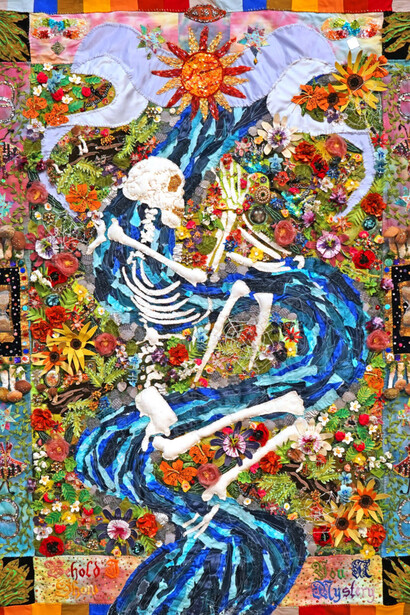
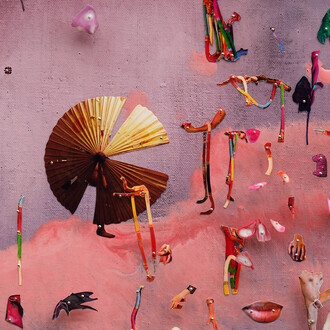
Constructed from materials sourced from community swaps and family heirlooms, as well as up-cycled fashion waste, each panel of Pangea Kali Virga’s triptych carries its own symbolic constellation, representing past, present, and future, respectively: History will always find you and wrap you in its thousand arms (2023), I watch the illusion with unbearable compassion (2022), and Behold I show you a mystery (2026). Together, these tapestries view history as something continually active, reflecting on the roles that “ancestral stories, genetics, childhood, and existence through experience” play in shaping the moment. In these works, inevitability is in the balance — seen precisely in the 2023 panel imagery of a spun thread dangling between the arms of beaded scissors.
In Beyond the veil, the three artists represent textiles as a threshold condition rather than a static form. Between Kali Virga’s observations of conception, love, and destiny, Vega’s memorial of her grandmother and persistence through heartbreak, and Spiridonakos’ release to something greater than oneself, each artist brings life into the exhibition through the lens of passage. Through their works, there is a strong sense that what appears to fade away does not vanish, but rather gets threaded into the next iteration of existence.