English
 Español
 Français
 Deutsch
 Italiano
 Português
I.
The torrential roar...
The gale of exhaust fumes…
Warm the trestle...
Shelter from the driving rains...
The actor trembles and shakes
Inhaling a whiff of foul air
Before pressing through
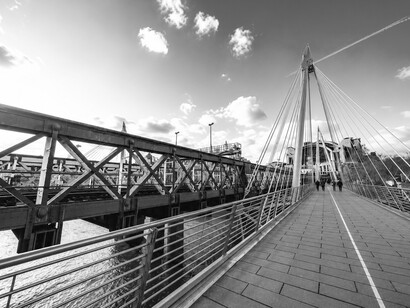
The Charing Cross pathway.
Reeking of booze,
Beefeaters raise
Their feathered bottles of gin
And march crimson beside him.
On both sides
Of the black macadam
The throng murmurs and jeers
Incomprehensible…
Their eyes roll demented
As if suddenly stung
By the sharp prick
Of pure white heroin.
There against the brick wall
Flanked by the royal family
And body guards,
The Queen herself squats
In putrescent splendor
Upon her toilet throne
High above the urine stench
Of moth-eaten bedrolls
Made of newspapers and cloth
Stolen stealthily in the night
From overstuffed garbage cans
By the raccoon paws of her spies.
Her rolls of fat hang
To her sides like a jolly Buddha.
She waves her arms
And her People become silent.
Her King lies there-stiff-by her side;
His armpit clutches a fifth of whiskey.
He kneels upon her blanket
To kiss her stubbed fingers.
II.
It was that very night
That the Actor ―become Hamlet―
Had broken character
And confessed
Before the stunned audience
That he had a mental gap
And had forgotten
Those most famous of the lines…
His startled mind had started
To question by whom
That powerful soliloquy:
Was actually written:
To be or not to be…
That was indeed a question
That impacted his entire being
As a Shakespearean actor
Who had devoted his entire life
To transforming himself
Into other (in)human beings
And who now feared
That old Will himself
Might not even be the person
He was acclaimed to be…
Yes, “to be, or not to be,”
That was truly the question!
Were these most famous lines
Truly conceived by Will?
Or were they scribed by Chris,
Shakespeare’s ghostwriter
And star-crossed lover
Who staged his own death
So theatrically so as to escape
Certain condemnation
For atheistic heresy…=
Because Marlowe simply
Preferred to be
Rather than not to be?
Truly Will/Chris had confessed
Without being tortured
By so wistfully reciting
In Sonnet 163:
Make but my name thy love,
And love that still,
And then thou lovest me,
For my name is Will.
III.
Her Majesty’s
Lamb chop jaw drops
As her ministers rattle…
Incomprehensible…
As the whole Court
Now accuses him
Of disclosing
This secret of all secrets
The revelation—
That once and if known
By the entire world
Would undermine
The cultural,
And existential
Foundation
Of the entire realm.
And it was now revealed:
Chris had become Will
And Will had become Chris!
Each wears the other’s face!
IV.
As her court buffoons
Stammer in manic dances,
Their fat fingers
Jester as they curse
And spit at his feet…
The Actor lashes out
In revolutionary
Condemnation:
Ah, Regina, how did you obtain your throne?
Was it by heritage, divine calling or usurpation?
Or is it that your king lives in such debauchery
That he is no longer fit to rule?Indeed, how do you sustain your power?
By what right do you send your flunkeys
Through the black labyrinth of the underground
To tax the pockets of weary travelers?Is whiskey the reward for their service?
Or is it the Charisma you convey to them
As you twirl your rag doll, your royal scepter,
Majestic, in the air like a cheerleader?(London 1975/ revisited 2026)
Poetic Exegesis
Way back in the spring of 1975, I had the opportunity to study modern poetry in London. It was an amazing experience, as I was able to meet in person some of the greatest poets in the UK at the time: Ted Hughes, Seamus Heaney, Philip Larkin, and many others.
I wrote the first version of this poem, “Beggar Queen” at that time based on a real experience.
I had just seen Macbeth at the Aldwych Theatre (if I remember correctly). The play was incredible; Macbeth was building up the emotional atmosphere for the famous soliloquy.
Suddenly he froze. He broke character and stated he had forgotten his lines—stunning the audience! Then just after breaking character, he suddenly remembered.
Tomorrow, and tomorrow, and tomorrow
Creeps in this petty pace from day to day
To the last syllable of recorded time;
And all our yesterdays have lighted fools
The way to dusty death. Out, out, brief candle!
Life’s but a walking shadow, a poor player
That struts and frets his hour upon the stage
And then is heard no more. It is a tale
Told by an idiot, full of sound and fury
Signifying nothing.
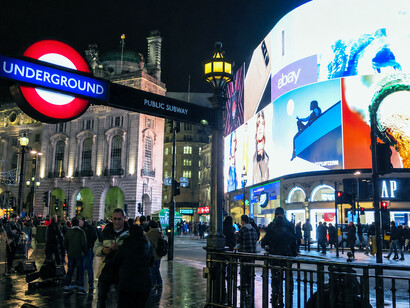
As I really could not believe what had just happened, I left the play in a daze. And there, late at night under the Charing Cross trestle, were dozens of street people. A giant woman squats in the middle on a large chair-like throne with a drunken man beside her. She became the “Beggar Queen.”
In 2026 I took a relook at the original poem, which had consisted of Sections 1 and 4. I decided that the 1975 version really did not capture the significance of my original experience. So I decided to add sections 2 and 3, in order to explain why the actor had forgotten his lines. I had just heard Martin Sieff’s argument as to the possibility that William Shakespeare was really Christopher Marlowe—a theory that had fascinated me back in the 1970s.
So I decided instead to refer to Hamlet’s famous soliloquy rather than that of Macbeth. As the lines that were forgotten by the actor: “To be or not to be”—as that was Marlowe’s truly existential choice if he were to escape certain execution. Makes sense, right? I mean, who really knows? Perhaps Shakespeare and Marlowe secretly collaborated so that Marlowe, assuming he was not killed, became Shakespeare’s ghostwriter—literally?