English
 Español
 Français
 Deutsch
 Italiano
 Português
The "AI hype" phase is over. In 2026, the market has matured beyond "AI hype," and the focus is now on unit economics of intelligence, which represents a fundamental shift in how we measure AI value.
Unit Economics of Intelligence refers to the measurable financial and operational value generated by each AI-driven action relative to the total cost required to run, maintain, and scale that intelligence. It moves AI evaluation from novelty and capability toward profitability, efficiency, and sustainability. It consists of the following core components:
Cost per intelligent action — including compute usage, infrastructure, data processing, and human supervision
Value per intelligent action — measured through revenue generation, productivity gains, workflow acceleration, and cost savings
Automation margin — the net economic value created after subtracting AI operating costs from the total value delivered.
Agentic AI startups sit at the centre of the Unit Economics of Intelligence because their business models are built on autonomous execution that organisations are increasingly willing to invest in, deploy, and scale. The venture capital landscape reflects this shift: global investment in agentic artificial intelligence startups surged to USD 2.8 billion in the first half of 2025, according to a report by Prosus in partnership with Dealroom.co.
The study, The Rise of the Agentic Workforce: How Autonomous AI Agents Will Transform the Workplace, highlights a structural transition in which AI agents work alongside — and in some cases replace — human employees. Capital is no longer flowing toward simple AI tooling but toward systems capable of completing complex, multi-step tasks with minimal oversight. Early enterprise deployments already demonstrate agents performing work previously handled by dozens of full-time employees, delivering measurable cost savings, productivity gains, and scalable operational efficiency.
What makes agentic AI startups different
Agentic AI startups stand out because they build systems that do more than assist — they reason, plan, and act autonomously toward defined goals, rather than simply responding to prompts or executing narrow tasks. Unlike traditional AI models that require repeated human direction or operate within fixed rule sets, agentic AI interprets objectives, decomposes them into subtasks, and executes them across tools and environments with minimal supervision.
At the core of this distinction is true autonomy: agentic systems aren’t just reactive — they are proactive and context-aware, adjusting strategies in real time based on feedback and changing conditions. They can analyse multiple inputs, orchestrate workflows, and make decisions that persist beyond single actions.
From a startup perspective, this means their products don’t just save time — they redefine work. Agentic AI can manage multi-step business processes end-to-end, coordinate across data systems, and autonomously resolve exceptions, enabling companies to automate complex functions that traditionally required large teams.
In this hyper-competitive macro environment, agentic AI startups benefit from dramatically shrinking innovation cycles, enabling them to test, deploy, and refine products at a pace that translates directly into faster speed-to-market. By embedding autonomous execution into their core operations, they also boost operational efficiency at scale, automating complex workflows that once required extensive human coordination. These systems enhance real-time decision-making and responsiveness by continuously analysing data and acting independently, allowing companies to adapt quickly to shifts in customer demand, competitive pressure, and evolving market conditions.
How lean methodology evolved in the agentic AI era
In the Agentic AI era, Lean methodology has evolved to leverage autonomous intelligence, making innovation faster, more efficient, and more measurable:
Accelerated Build‑Measure‑Learn loops
AI automates experimentation and feedback analysis, compressing weeks or months of validation into hours or days.
Startups can iterate more quickly, pivot when necessary, and reduce wasted effort.
Enhanced data-driven decision-making
AI systems process large volumes of real-time user data, detect patterns, and provide actionable insights.
Decisions are evidence-based rather than intuition-driven, minimising risk in product development.
Rapid prototyping and MVP testing
Agentic tools can generate product prototypes, conduct automated A/B tests, and simulate workflows at scale.
Teams can test hypotheses faster and with lower resource costs.
Resource-efficient scaling
Lean teams can achieve outcomes previously requiring large teams by using agentic AI to execute and manage workflows autonomously.
Reduces dependency on proportional headcount growth while maintaining operational efficiency.
Integration of autonomous intelligence across the startup
Lean is no longer just about minimising waste — it now incorporates autonomous execution into every stage of product development, from hypothesis validation to execution and scaling.
This evolution allows startups to innovate faster, optimise resource allocation, and measure tangible outcomes at scale.
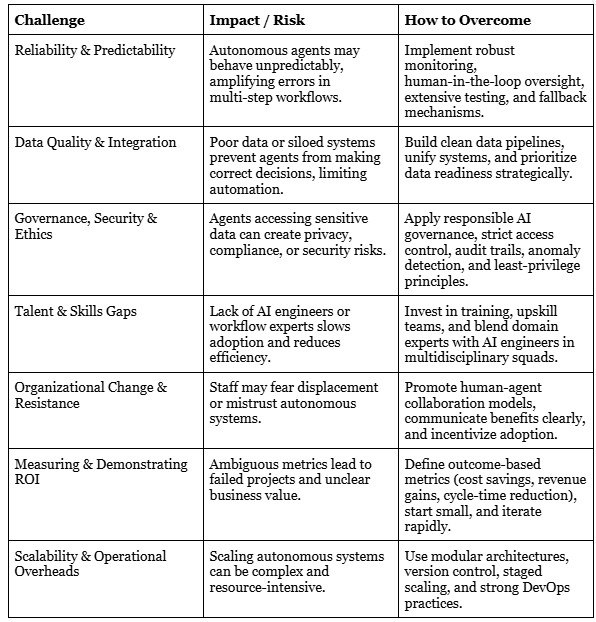
Key challenges for lean agentic AI startups and how to address them
Vertical AI arises as the next opportunity for agentic startups
As general AI matures into a utility provided by hyperscalers like Google, Microsoft, and OpenAI, the frontier for startups has shifted toward vertical AI. The goal is no longer to build a better generic model but to develop a specialised reasoning engine powered by proprietary industry data and domain-specific workflows. If your entire product is merely a clever interface on top of GPT‑4, you’re not building a sustainable company — you’re exploiting a temporary arbitrage that will vanish the moment a hyperscaler releases a new feature, as these platforms have the resources and scale to evolve far faster than any single startup.
Vertical AI delivers value by focusing on tasks that require continuous, high-volume, unstructured analysis — work that human teams find exhausting and general AI struggles to perform efficiently. For example, search algorithms and competitor data change daily, requiring constant monitoring and interpretation, which agentic AI can handle effortlessly. By embedding domain-specific intelligence into workflows, startups can automate complex processes that are otherwise impractical or too slow for humans to manage.
Key advantages of vertical AI include:
Deep domain expertise: Trained on curated data that reflects real industry patterns, terminology, and rules, boosting both accuracy and reliability while enabling the AI to mimic expert-level reasoning and decision-making.
Workflow integration: Designed to embed into specific business processes, enabling automation of complex, multi‑step tasks.
Regulatory readiness: Built to align with industry‑specific standards and compliance needs.
Higher ROI and defensibility: Enterprises are willing to pay a premium for specialised automation that delivers measurable value quickly.
The rise of vertical AI reflects a clear market shift: generic AI is becoming a baseline utility, while domain‑specific intelligence is where true competitive advantage and economic value are created.
Leading lean agentic AI startups: real-world case studies
1. Guard Owl — AI for private security automation
The company recently raised USD 3 million in seed funding and plans to automate up to 50 % of back‑office functions like payroll, billing, and compliance using autonomous systems.
Guard Owl is a U.S. startup using agentic AI to modernise private security operations. It also integrates real‑time GPS tracking and plans future agentic integrations with security cameras and on‑demand guard dispatching.
2. Altan — autonomous software generation
Altan, a Barcelona‑based AI startup, raised USD 2.5 million for its platform where teams of autonomous AI agents build and operate software based on text or voice prompts. These agents simulate roles such as UX designers and full‑stack engineers, enabling businesses to generate fully functional systems (e.g., reservation platforms) in hours instead of weeks.
3. Ciroos — AI SRE teammate for DevOps
Ciroos, based in Pleasanton, California, develops an AI SRE (Site Reliability Engineer) teammate that uses multi‑agent systems to automate incident management, monitoring, and remediation for production systems. By delegating repetitive IT tasks to autonomous agents, operations teams can reduce downtime and focus on strategic work.The company has raised $21 million in seed funding to advance its AI-driven operations platform.
4. Artisan AI — autonomous business automation agents
Artisan AI, a San Francisco-based company, builds specialised autonomous agents (“Artisans”) for business tasks, including sales outreach, email sequencing, and prospecting — often without human approval. Its agents can execute full workflows, freeing teams from repetitive work and acting like “AI digital colleagues” that perform tasks end‑to‑end. In 2024, the company raised $11.5 million in seed funding to expand its AI agent platform. In 2025, Artisan AI secured an additional $25 million in Series A funding, further accelerating its growth and product development.
Why lean agentic AI startups will outperform in 2026
Lean agentic AI startups are positioned to outperform in 2026 not because of hype, but because of structural economic advantages that become increasingly visible as agentic systems move from experimentation to production adoption.
1. Shrinking innovation cycles = compounding speed-to-market advantage
In traditional startups, innovation cycles are constrained by human bandwidth. Testing hypotheses requires manual experimentation, user interviews, engineering cycles, and deployment coordination.
Agentic AI collapses these constraints.
Autonomous systems:
Run continuous experiments
Monitor user behaviour in real time
Detect anomalies and optimisation opportunities
Adjust workflows dynamically
Innovation no longer happens in discrete sprints — it becomes continuous.
This has three economic consequences:
Faster time-to-market
Faster iteration while already scaled
Product improvement occurring during live deployment.
The innovation loop shortens from months → weeks → days → hours.
And in competitive markets, speed compounds into dominance.
2. Expanding automation margin = structural burn reduction
In traditional startups, operational costs rise almost in step with revenue because manual execution — support, maintenance, customer handling, and data tasks — requires more people, more hours, and higher payroll.
Agentic AI changes this cost structure.
Autonomous systems:
Automate routine and repetitive workflows without human labor
Reduce dependence on costly manual coordination
Execute 24/7 with minimal supervision
Continuously optimise task execution for efficiency
This shifts the economic model:
Operational cost per unit falls as autonomous workflows replace manual work
Resource efficiency increases because high-value humans are freed for strategic tasks
Capital runway extends as fixed costs scale more slowly than revenue.
Agentic AI has already reduced operational overhead for many organisations by automating tasks that once required full teams — leading to measurable efficiency gains and cost savings.
Burn rate is no longer predominantly a factor of headcount growth — it becomes a function of how effectively intelligent actions replace manual ones.
3. Continuous calibration = embedded product–market fit
Traditional product–market fit relies on human analysis, user interviews, and retrospective feedback — which creates delays between insight and adaptation.
Agentic AI makes product–market fit continuous and real-time.
Autonomous systems:
Continuously collect and synthesise data across usage and workflows
Detect patterns and unmet demand signals without human prompting
Suggest optimised pathways based on real-world behavior
Adapt product and operational priorities on the fly.
Because agentic intelligence monitors relevance and context automatically, the product evolves with use, not after it.
This produces structural effects:
Reduced wasted development effort
Faster alignment with actual user needs
Higher product relevance and retention
Systems that self-optimise toward value creation.
In competitive settings, startups that embed market fit into execution avoid the lag of conventional build-measure-learn cycles.
4. Asymmetric scaling = revenue growth without headcount gravity
In legacy growth models, revenue expansion triggers corresponding growth in teams — support, product, and marketing — adding coordination overhead and operational drag.
Agentic AI decouples capacity from headcount.
As demand increases:
Autonomous workflows expand
Execution capability grows without new hires
Human teams shift to oversight and orchestration
System complexity is managed through intelligence, not layers of management.
This leads to asymmetric scaling:
Output increases faster than organisational cost
Execution capacity multiplies without proportional payroll rises
Operational complexity is absorbed by agentic infrastructure.
Reports show that organisations using autonomous AI systems are seeing significant productivity increases and lower reliance on specialised hires — highlighting how agentic workflows can scale operations without proportional staffing increases.
In today’s market, where scalability and capital efficiency matter as much as product utility, this decoupling is a distinct competitive advantage.
Key metrics lean agentic AI startups track
Conclusion
Agentic AI startups represent the third wave of AI, moving beyond hype and generic tools to autonomous systems that create measurable economic value, scale efficiently, and collaborate with humans. These startups don’t just automate — they redefine work, innovation, and operational efficiency in real time. What distinguishes leading agentic AI startups today can be summarised in five defining advantages:
1. AI is now considered a co-worker
Human-AI collaboration has become the new norm, with autonomous agents functioning as digital teammates. These systems execute multi-step workflows, support decision-making, and continuously adapt alongside human operators. The shift is not about replacing human capability but amplifying it — improving operational efficiency, enabling teams to handle greater scale and complexity, and generating measurable ROI.
2. Focus on vertical AI for defensibility
Leading agentic AI startups go beyond generic models by building intelligence tailored to specific industries or workflows. For example, an AI agent in finance can analyse regulatory filings, flag compliance risks, and predict market trends, while one in healthcare can interpret clinical notes and optimise patient scheduling. This specialisation produces solutions that are highly accurate, context-aware, and difficult to replicate, as they leverage proprietary data, regulatory knowledge, and industry-specific processes — giving startups a strong, defensible edge.
3. Unit economics of intelligence are the new KPI
In the agentic AI era, success is measured not by technology alone, but by the economic value generated per intelligent action. Startups track metrics such as automation margin, cost per action, and value per intelligent action to ensure that every AI-driven operation scales profitably. Unit economics of Intelligence transforms AI from a tool into a measurable, sustainable driver of growth and operational efficiency.
4. Lean methodology reformed within autonomous intelligence
Lean methodology evolves in the agentic AI era by embedding continuous experimentation and optimisation into autonomous systems. Build-measure-learn cycles are accelerated as AI agents test, analyse, and refine workflows in real time. This approach reduces wasted effort, shortens innovation cycles, and allows startups to iterate rapidly, making product development faster, more efficient, and tightly aligned with measurable outcomes.
5. Lean teams maximise ROI
Small, highly skilled teams paired with autonomous agents can achieve outputs that previously required large, specialised workforces. By leveraging AI to handle complex, repetitive, or high-volume tasks, lean teams amplify productivity, reduce operational overhead, and scale impact without proportional increases in headcount. This combination of human expertise and agentic execution maximises return on investment while maintaining agility and strategic focus.
Agentic AI startups represent the next evolution in technology and business. In 2026 and beyond, success will belong to organisations that harness autonomous intelligence not merely to automate, but to amplify human capability, scale strategically, and deliver measurable impact at speed. In this era, outcomes are defined not by AI capabilities alone but by how effectively organisations integrate, scale, and leverage intelligent action to generate real-world results. Those who embrace this shift will lead in productivity, innovation, and sustainable growth.
References
Prosus. (n.d.). New Prosus report explores the rise of AI agents in the workplace.
Business Standard. (n.d.). Agentic AI startups raise $2.8 billion in 2025, says Prosus.
Entrepreneur. (n.d.). Global Venture Capital Flows Into Agentic AI Startups Reach $2.8 Billion in H1 2025.
Business Insider. (n.d.). AI Private Security Startup Guard Owl Raises $3 Million.
Tech.eu. (n.d.). Altan raises $2.5M to build software that runs itself.
Ciroos. (n.d.). Ciroos Raises $21 M to Bring Agentic AI to Operations Teams.
Forbes. (n.d.). Artisan Raises $25 Million To Replace Repetitive Work With AI Employees.