English
 Español
 Français
 Deutsch
 Italiano
 Português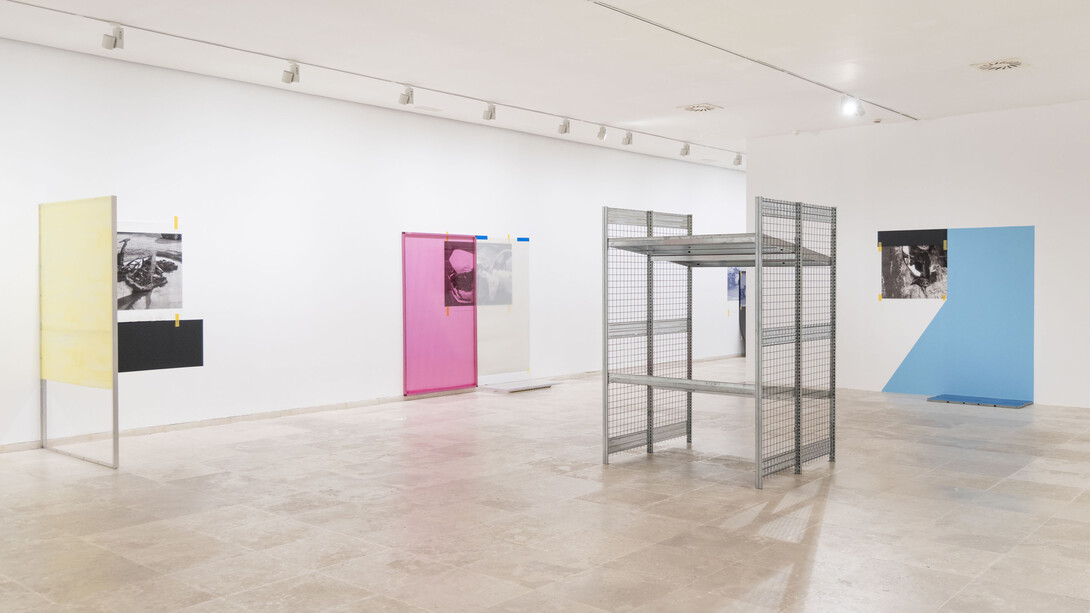
Forget delete, delete slowly is the title of this large-scale exhibition that the Patio Herreriano Museum has devoted to Miquel Mont, a leading figure in the Spanish painting scene in recent decades; an artist rooted in abstraction, yet whose work reveals clear notions of the realism of our times, or rather, an inquisitive exploration of our social space. His work, therefore, is abstract in form, and yet realistic and deeply sceptical in substance. Formally, it delves into a reflection on actual painting, its elements and the very act of painting itself. Concepts such as scale, density, matter, colour, surface, stains, accumulation, rhythm, transparency and opacity are all woven into a body of work that also maintains a close relationship with the body – both his own and that of the people who move around each piece.
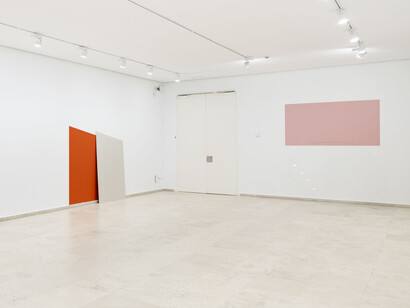
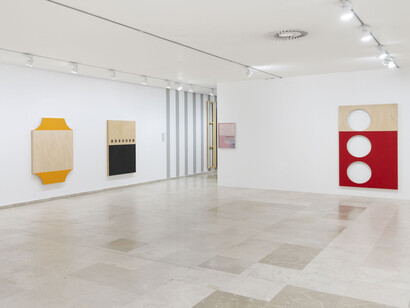
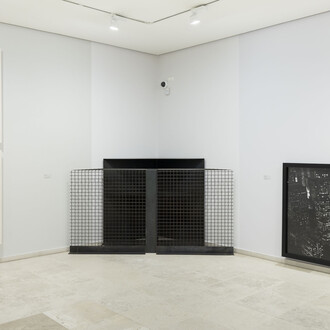
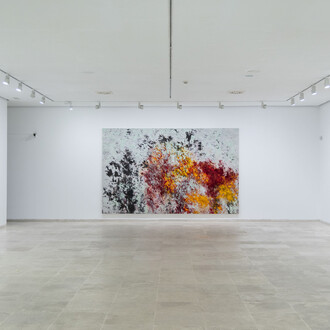
Rooms 3, 4 and 5 on the second floor, which have recently featured pictures by other abstract painters such as Hernández Pijuan and Carlos León, are now hosting pieces from Mont’s major series. Early on in his career, in the early 1990s – with one foot already in Paris after his studies in his native Barcelona – he practised a gestural style of painting, although his choice of medium – plywood – already revealed an interest in industrial materials that recurred so frequently thereafter. We are referring to the Dispersions series, on display in Room 3: paintings that have rarely been seen together in such large numbers and which are emblematic of an early phase in which the artist broke free from the traditions of painting. These are the youthful explorations of someone seeking his place in the world, but with clear goals, for in that profound phase of inquiry he undertook an analysis of great American painting, explored the Spanish tradition and also the history of recent painting in his adopted country, France, where he has lived ever since. These large-format Dispersions are the result of all that early research. It is no coincidence, however, that these pieces are situated alongside the Market Realism series, modular three-dimensional structures, halfway between the functional and the aesthetic. The intensity of the gesture in the Dispersions embraces the cold metal of the sculptures and the flat, impersonal arrangement of the painting within them.
These are now pieces from the mid-2000s, particularly fruitful years that saw the emergence of a number of working groups. Nor is it coincidental that pieces from the Tesla series can be seen alongside them; they allude to the cars of the American firm, a symbol of perfection and a trophy of technology, the epitome of progress that is not achieved free of cost, as every late-capitalist triumph only involves imbalance, disparity and inequality in the societies of our time. Here, Mont presents not only a clearly critical perspective but also a reflection on the device – a term common in contemporary art jargon that refers to the means we employ to put discourse on the table, our way of telling a story, in a word. It generally has a scenographic nature, as the situations in which it occurs tend to be clearly arranged according to a specific criterion. We are not revealing anything new by saying that the way we tell a story is just as important as what is actually told; thus, the device has now almost become a kind of artistic subgenre, in which Mont participates or, at the very least, observes with interest. In his Tesla series, he turns to internet to incorporate images of accidents into a range of materials that are revealed to us in varied arrangements, traversed by different ways of applying and making the paint visible. The accident is veiled, and the image is reconfigured, thereby becoming another visual code.
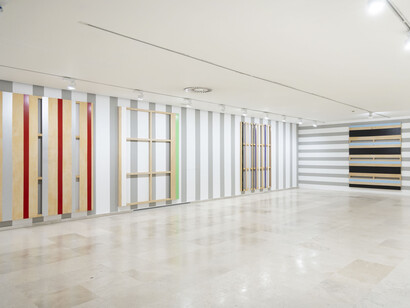
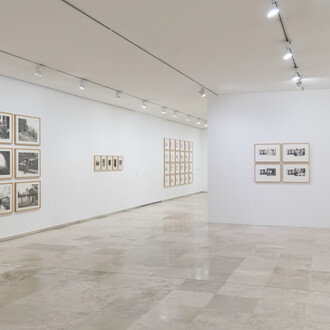
As you go into Room 4 you come across one of the mural paintings that have become Mont’s trademark, reflecting his enduring interest in textuality, the scenographic dimension of writing, typography and the voice of subjectivity. What we read is of interest both in terms of the form of the text itself – halfway between calligraphy and typography, that is, between a hand-crafted voice and one produced in a chain – and in terms of what the text conveys: a reflection that possesses as much political power as poetic depth. The piece has a clear connection with the “ideological collages” found in every room. The text filters into the image, endowing it with a meaning that binds the entire exhibition together. It guides us from the mural towards a space where we can see two highly significant series, the Cooperations and the Lapsus, and finally, at the far end of the room, his well-known Self-portraits. The Cooperations also show with great precision that the artist’s individual solitude, and his historical roots, are inevitably shaped by the social circumstances that determine his work.
The conditions under which the pieces are produced bring us closer to a shifting Baroque style than to classical certainty, for in each of the pieces, Mont seems to dissolve into multiple authorship, as if an entire social heritage could intervene in his creation – hence the title of the series. He himself transfers aspects related to painting, such as transparency and opacity, to the political sphere, weaving a parallel between painting and financial language. These terms could equally well be applied to the current gloomy political climate. The Lapsus that are dotted around the space are, in essence, just that: an interruption, a fracture, a dislocation, slight in form and space, devastating in time, characteristic of language. From the painting, an ethereal stain, applied directly to the wall, emerges a similar form of industrial material – cardboard, methacrylate or plasterboard – and the result is like a phrase that has somehow lost a syllable along the way. At the end of the room, the Self-Portraits are arranged in a sequence of methacrylate tubes. Mont has painted a stain inside them. The size of each tube is intimately related to his body, to his whole body or parts of it – be they torsos, shins, forearms, or palms – arranged in a rhythmic choreography. Everything you will see in the exhibition, and the way in which everything is installed, relates, as we said, to the artist’s body.
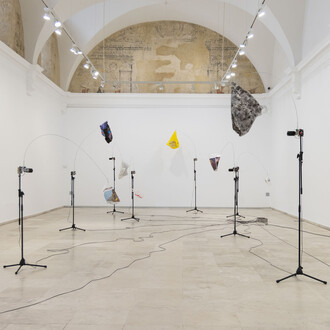
What we see in Room 5 is a significant number of pieces from the Flicker series, arranged over a pictorial intervention on the wall. The word ‘flicker’ means the same as ‘to twinkle’ and is frequently used in relation to light. Thus, a ‘flickering light’ is a blinking light, an expression that could well be applied to Miquel Mont’s work in this space, a container transformed into content where the constituent elements of painting come together in a dynamic, almost frenetic space, with rhythmic tension between solids and voids, between the industrial and the organic, between image and form. Mont traces the origin of his work to the interest he has always had in “Flicker films” – experimental films with their forays into abstraction and the frenetic succession of images. In the next room, taken up by the Pores series, there is an explicit exploration of painting’s skin-deep nature, the relationship between time and the act of painting, and the reflective process of creating a flawless surface – as if detached from human endeavour, yet resulting from the artist’s persistent and attentive labour.