English
 Español
 Français
 Deutsch
 Italiano
 Português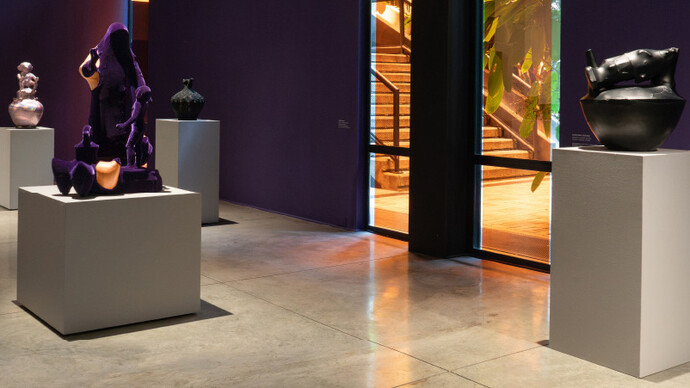
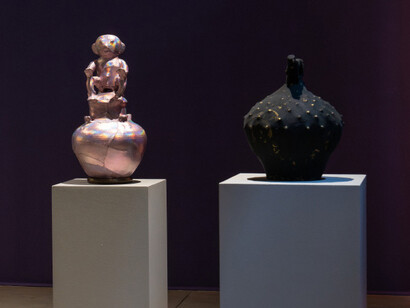
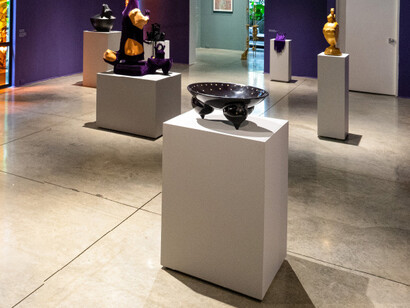
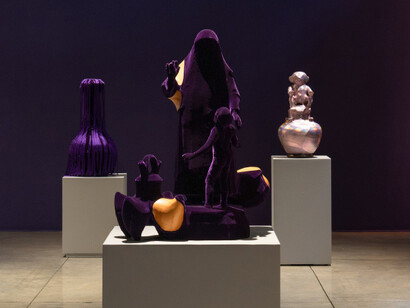
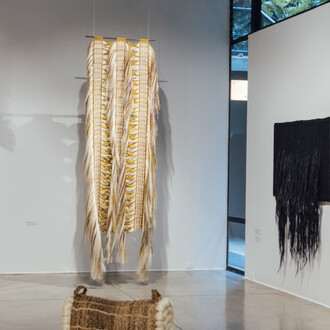
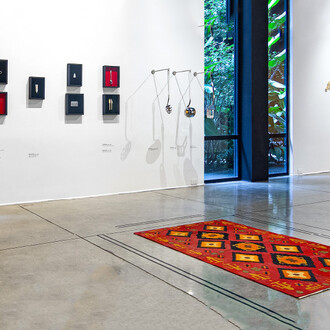
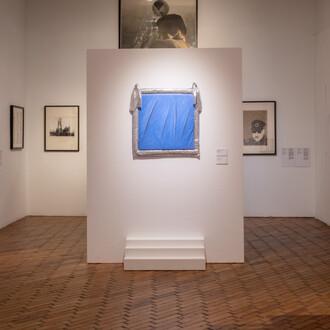
Clothing transforms the body’s surface into a fiction that, sustained over time, can become truer than what lies beneath. Asicaz Monzón-Aguirre (Medellín, Colombia, 1987) covers replicas of pre-Columbian artifacts and Christian iconography with velvet, leather, rayon, silk, spandex, and nail polish. The objects before us — a Tumaco alcarraza, a Quimbaya poporo, a Sacred Heart, a sculpture of Madre Laura — form a kind of disparate archive traversed by musealization practices and rituals. Pieces that archaeology and the Church have agreed upon: what they are, how much they mean, how they are to be displayed. Asicaz wraps this archive in a veil. And in concealing it, seems to make visible the mechanisms of institutional memory: every act of preservation is preceded by a selection, and every selection implies a forgetting.
The act of covering images situates us within Catholic liturgy. During Lent, saints are veiled as a sign of mourning and conversion. A moment of invisibility that prepares the body for revelation. In wrapping the objects, Asicaz dresses them, and in dressing them, deepens an embodied experience. To strip an object of its official garment in order to see what remains, and at the same time put a new one on it to ask what it might yet become.
Purple — the violet that reaches us through the everyday experience of recognizing the color of a flower or a ripe fruit — runs through the entire exhibition. It is the liturgical color of mourning and yearning; it was also, from the early twentieth-century suffragist movement onward, a color charged with political dignity, and later one claimed by queer aesthetics and feminist struggle as their own. First comes the stigma, then the affirmation. In that register, to cover oneself in purple is not to await another’s revelation but to announce oneself. To dress differently, to assume a deliberate surface, is a collective and intimate act; a way of negotiating between an imposed identity and the one we build from the skin outward.
As García Canclini (1990) notes, artifacts in hybrid cultures carry multiple temporalities; they do not belong entirely to any single tradition because they have been claimed and resignified by successive layers of use and meaning. Envoltorios makes this condition visible. It shows that the patrimonial object is a fiction sustained by protocols. A fiction that may be, however, intervened, renamed, dressed.
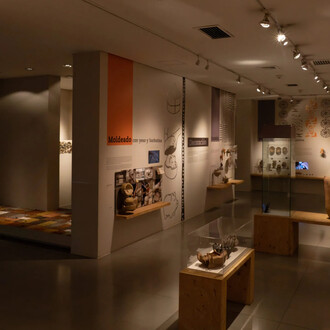
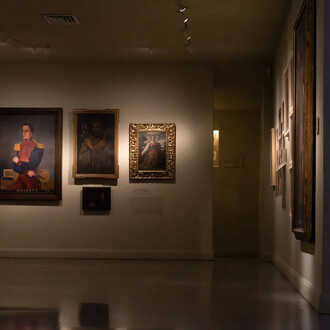
This exhibition had its first iteration at the Museo de Antropología y Arte de Jericó in 2025, an institution whose collection includes some of the pieces that served as references for the replicas. That first context was already a sharp commentary. The museum, as a device for classifying the past, found itself implicated in the work from within. The questions the exhibition leaves open are also those of the archive: who has the right to read the objects? Who to conceal them, to modify them, to give them another name?