English
 Español
 Français
 Deutsch
 Italiano
 Português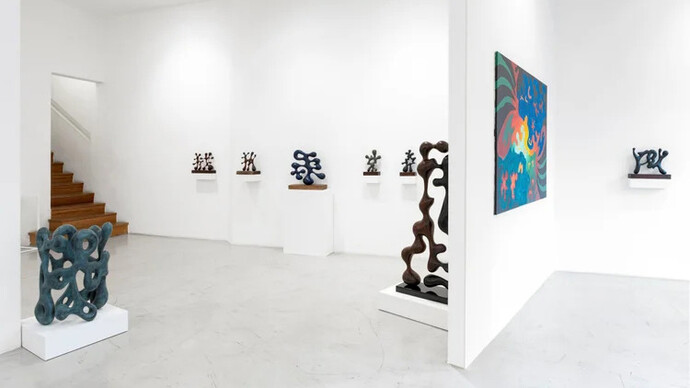
Roberto Vivo is an artist interested in the arts in their broad and diverse sense. From the ages of seven to twenty, drawing and painting were very present in his life, under the direct influence of his maternal grandmother – a painter who, for being a woman born in the nineteenth century, was deprived of the right to be an artist. It was in her company that he created his first canvases. Growing up in an environment marked by a great deal of culture and also by the responsibilities of a business legacy, within the realms of both the sciences and the humanities, he constituted himself as a subject.
In summary, his biography as an artist is marked by a series of events that, at first glance, do not connect. Precisely because of this, because of the eclectic milestones in his life, the path he takes until we arrive at his sculptural work is so interesting and errant. Having attended Architecture school and graduated in Film and Business Administration, among his principal artistic and political achievements are: leading three rock bands; producing a film; writing and publishing two books; and being part of the organization of the first demonstrations in favor of Uruguayan democracy during the military regime. His return to the visual arts occurred eight years ago.
With ideas accumulated throughout an entire adult life, this return took place through acrylic painting. In recent years, on the advice of his great friend and master sculptor Pablo Atchugarry, Roberto began dedicating himself to sculpture, working with bronze and marble. His process always begins with free drawing in his notebooks, which is later rendered on the computer, taking around a year to execute. His collaborative relationship with the rendering specialist, the foundry craftsman, the machines, and the engineers of the metallurgical industry, is characteristic of a method of work deeply marked by his knowledge of architecture and administration.
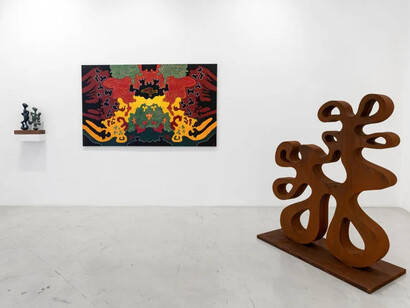
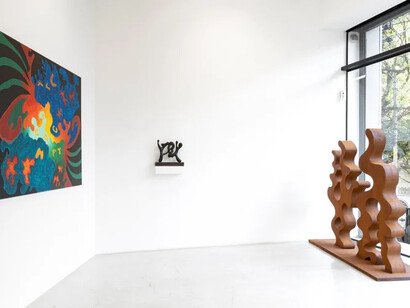
As for the images of his sculptures, which often seem to leap from the two-dimensional field of his canvases into space, a strong influence of dance can be perceived. The latent presence of movement in his sculptures may be interpreted through that which inhabits the depths of his artistic production: love. More specifically, romantic love, that which is poetry’s greatest inspiration.
At the age of eleven, Roberto met the great love of his life, the dancer Soledad García Lagos, one year younger than him. It was at that age that he declared to his mother that he would marry her. Said and done. He had returned to painting only one year before she passed away, at the age of sixty-four. From that moment on, it is possible to affirm that most of his works are dedicated to her, even if unconsciously. Two years later, he named a series of five paintings with the code YAE, which means you are everywhere.
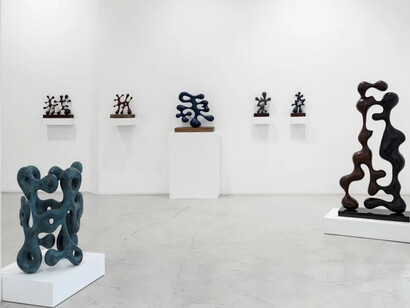
Thus, it is through the movement of form that Roberto once recognized in Soledad’s dancing that his sculptures continue the dance. The artist refers to forms, as he himself says, “as if they were part of a human body,” so that many of his sculptures are abstractions of figurative elements, more specifically of skeletons. They are organic structures that represent life, grasp forms, and move, even if statically. This is because it is love that moves his work.
(Text by Paula Borghi. São Paulo, May 2026)

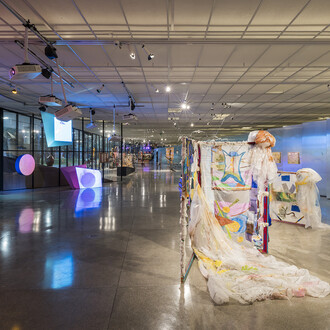
![Various artists, Histórias latino-americanas [Latin american histories], exhibition view. Courtesy of MASP](/attachments/2ec1b7615df2d9b9c3f211de14c70faefd850aea/store/fill/330/330/8481e63599516249cba60f15e188644bb76fc1eec25547e2c4b88b8f1c92/Various-artists-Historias-latino-americanas-Latin-american-histories-exhibition-view-Courtesy-of.jpg)