English
 Español
 Français
 Deutsch
 Italiano
 Português
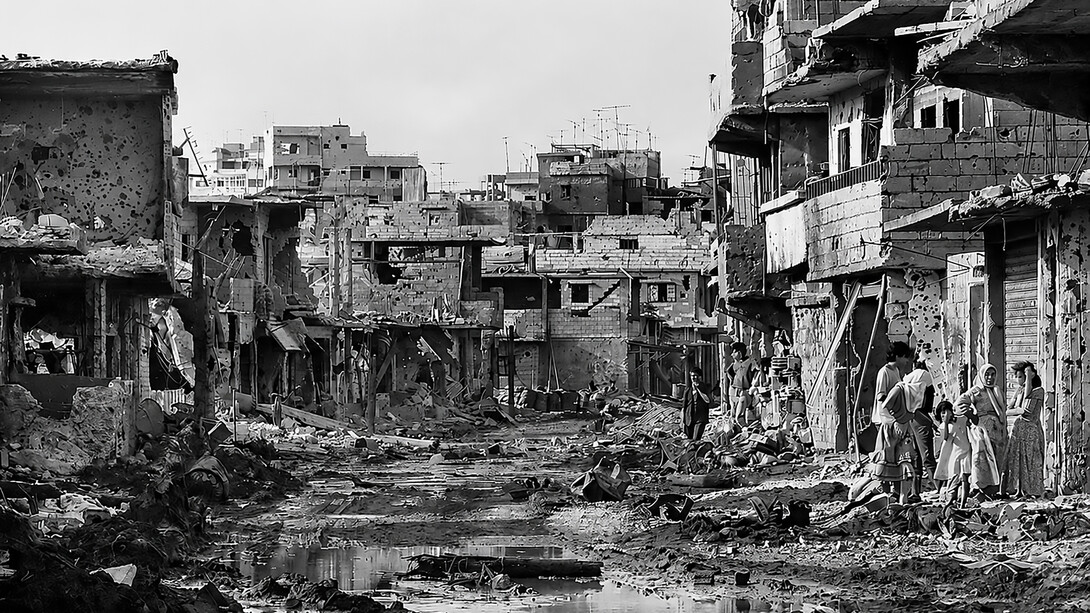
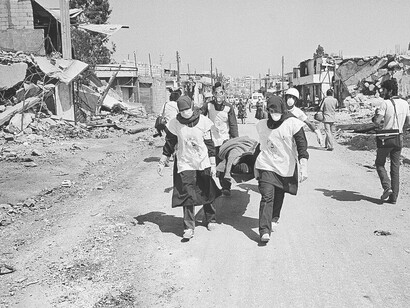
We treated wounds with our hearts when the medicines ran out, but the world watched us with a silence that was harsher than the bombs.
(Testimony from Gaza medical staff (2024/2025))
The memory that refuses erasure
On September 18, 1982, the late British journalist Robert Fisk stood amidst the labyrinthine alleys of the Shatila refugee camp. He was attempting to comprehend the sheer scale of the "human slaughterhouse" meticulously planned by minds corrupted by ideological violence. Today, in 2026, the scenery repeats itself with haunting precision across Gaza and Lebanon. Though the names have shifted—from the era of Sharon to that of Netanyahu—the criminal countenances remain the same. We find ourselves trapped in a vicious cycle of bloodshed aimed at a singular objective: the "erasure of consciousness", the liquidation of existence, and the breaking of a people’s collective will.
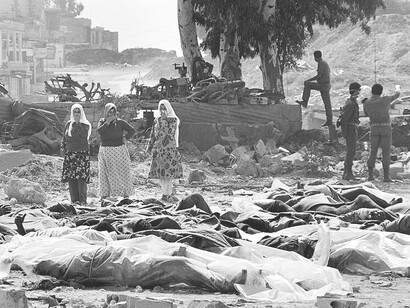
On that morning in 1982, Fisk began his journey into the heart of Shatila. He was greeted first not by sights but by the smell—a thick, pervasive stench of decomposition that filled the humid air, inducing a visceral nausea. As he navigated the narrow corridors, Fisk found no combatants or soldiers. Instead, he encountered living snapshots of a horror the human mind struggles to accept. He saw women killed while wearing simple housecoats; some were lying next to laundry lines, suggesting the killers had invaded the sanctity of their daily lives, transforming domesticity into a butchery in a matter of seconds.
As Fisk delved deeper, the scenes grew increasingly barbaric. He was shocked to find the body of a pregnant woman whose abdomen had been slit with a bayonet, her unborn child cast beside her—a macabre tableau suggesting that the killer was not satisfied with extinguishing present life but sought to assassinate the future before it could draw its first breath. Against one wall, Fisk documented a systematic mass execution: a row of men and youths piled atop one another. The bullet-pitted stone and the positioning of the corpses bore witness to a cold-blooded "lining up" carried out under the artificial glare of Israeli "flare canisters" that turned the camp’s night into a surreal day to facilitate the executioners' task.
The atrocity did not end with the act of killing. It extended to the frantic attempt to conceal the evidence. Fisk described how bulldozers worked with feverish intensity to shove corpses into mass pits or bury them under the rubble of dynamited homes. At one point, he discovered that the ground he was walking on was not solid earth but a soft, yielding mire—he was treading upon bodies freshly interred to hide the scale of the massacre. While this inferno raged within, Fisk could glimpse Israeli occupation soldiers in the distance, calmly observing the scene from the heights of surrounding apartment blocks through binoculars—a silence that was, in many ways, more piercing than the sound of gunfire.
The anatomy of massacres: roots and motives
To understand 2026, one must dissect 1982. The motives behind these "human slaughterhouses" are never merely military; they are deeply rooted in political and demographic engineering.
The Sabra and Shatila massacre (1982)
The massacre occurred within the context of the Israeli invasion of Lebanon. Its causes can be summarised as the following:
Political Vendetta: following the assassination of President-elect Bashir Gemayel, the camps were transformed into arenas for vengeance, venting fury against Palestinian civilians.
The "Purification" doctrine: the Israeli military claimed the presence of "2,000 terrorists" within the camps. This served as a pretext to besiege the area and facilitate the entry of armed militias—specifically elements of the "South Lebanon Army" led by Saad Haddad and the Phalange. These groups were directly funded, armed, and supervised by Israel, acting as its local executive arm.
Forced displacement: the ultimate goal was to terrorise the Palestinian population into a final exodus from Lebanon, thereby liquidating their political and military presence in the country.
The Gaza War (2023–2026)
This conflict is the explosion of decades of structural violence. Its primary drivers include the following:
The suffocating siege: an 18-year blockade that rendered Gaza an "open-air prison", making life structurally impossible.
Settlement expansion and Jerusalem: continuous incursions into the Al-Aqsa Mosque and the relentless expansion of settlements in the West Bank, perceived as an existential threat to Palestinian identity.
The "Generals’ plan" (2024-2026): a strategic initiative aimed at completely emptying Northern Gaza of its inhabitants to transform it into a closed military zone.
Focus: the "Generals’ Plan" (The Eiland Plan)
This strategy, which gained prominence between 2024 and 2026, is essentially a "surrender or starve" doctrine. It involves:
Stifling the North: a total blockade on food, water, and medicine to make the environment uninhabitable.
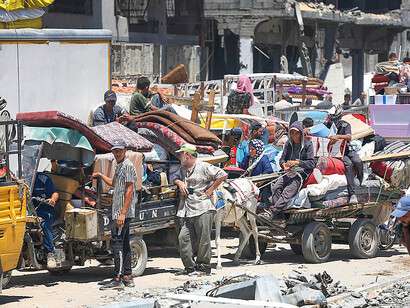
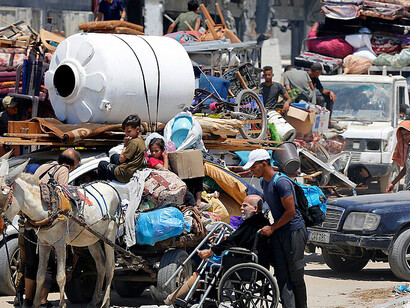
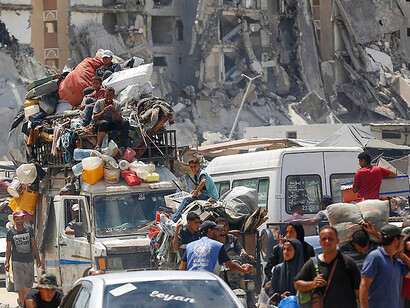
Forced evacuation: ordering all civilians to move south; those who remain are reclassified as "legitimate military targets" to be liquidated.
Geographic erasure: converting the emptied land into a permanent military buffer or a site for future settlement.
The philosophy of genocide: "engineered" death
In Pity the Nation, Fisk posits that death in Shatila was not chaotic; it was organised. This "Engineering of Death" has evolved from the mechanical to the algorithmic.
Planned fatalism: in 1982, death was delivered by hand—bayonets and rifles. In 2026, it is delivered by "Lavender", an AI system used to generate kill lists, and "Where's Daddy?", a tracking system designed to target individuals specifically when they are at home with their families.
Logistic coverage: just as Israeli flares provided the light for the Phalangists in 1982, modern AI provides the "digital light" for massacres in Gaza, offering a veneer of technological precision to what is essentially indiscriminate slaughter.
Comparative mechanisms: 1982 vs. 2026
The transition from a localised massacre to a "digital slaughterhouse" within a regional confrontation reveals a consistent military doctrine:
Demographic targets: in 1982, the goal was to cleanse Beirut of the Palestinian presence. In 2026, the goal is the permanent depopulation of Northern Gaza.
From binoculars to algorithms: the shift from manual observation to automated genocide. AI systems now process "targets" at a speed that precludes human ethical intervention, turning killing into a statistical output.
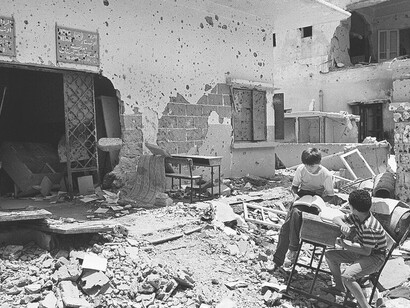
The bulldozer policy: the visual motif of the bulldozer burying bodies in the courtyards of Al-Shifa and Nasser hospitals in 2024-2025 is a direct echo of the bulldozers Fisk saw in the mud of Shatila. It is the physical tool of erasure.
Patterns of shared savagery
History’s most heinous crimes are enabled by three recurring elements:
Dehumanisation: the dehumanisation of the victim involves transforming human beings into mere 'targets' or 'human animals' to facilitate their liquidation. This became starkly evident following October 7, when Prime Minister Benjamin Netanyahu explicitly employed the rhetoric of 'human monsters' in his official addresses. Once a person is stripped of their humanity and rebranded in such a way, their eradication is no longer viewed as a moral atrocity but rather as a mere logistical task."
International complicity: the weapons used in Shatila and the 2,000-pound bombs dropped on Gaza in 2026 share the same origin: "Made in the USA". This logistical support, coupled with diplomatic protection, provides the "green light" for the slaughterhouse to continue operating.
Erasure of evidence: the deliberate targeting of journalists and medics. By killing those who document the truth, the perpetrator seeks to prevent the emergence of a "new Robert Fisk" who might tell the world what is happening behind the smoke.
The blood map: massacres as political tools
Shatila and Gaza are not isolated incidents; they are chapters in a global history of "The Great Erasure":
1890 (Wounded Knee): The demographic erasure of Indigenous populations in America.
1943 (Warsaw Ghetto): The model of annihilation through siege and starvation.
1995 (Srebrenica): The ultimate failure of international "safe zones".
2004 (Fallujah): The scorched earth policy and the use of prohibited incendiary weapons.
Legal reckoning: the crimes of 2026
Under the Rome Statute, the actions witnessed in Gaza between 2023 and 2026 fall into clear criminal categories:
Genocide (Article 6): the targeting of a specific demographic and the systematic killing of infants and pregnant women (as documented by Fisk in 1982 and by medical staff today).
Crimes against humanity (Article 7): widespread forced displacement and systematic murder.
The responsibility of AI: algorithms do not absolve military commanders. Using a "black box" system to wipe out entire families constitutes a premeditated war crime.
Complicity: international law views the provision of weapons, with the knowledge they are used for civilian massacre, as a form of participation in the crime.
Conclusion: witnessing as an act of resistance
The justice that was denied in 1982 is the very factor that emboldened the crimes of 2026. However, the testimonies of the honourable remain the last fortress against forced forgetting. The killer may bury the body with a bulldozer, but they cannot bury the truth. The blood of Shatila flows today through the veins of those standing firm in Gaza and Lebanon. It serves as a reminder that 'survival'—the mere act of remaining in the face of an erasure machine—is the ultimate victory.
Robert Fisk (1946-2020) was a voice that pierced through the fabric of official narratives. His Pity the Nation remains the essential anatomical document of the 1982 invasion. As we look at the ruins of Gaza today, his words remind us that without accountability, the slaughterhouse simply moves to a new location.
References
Fisk, R. (1990). Pity the Nation: Lebanon at War.
UN Special Rapporteur Reports on Gaza (2024-2026).
Human Rights Watch: The Use of AI in Modern Warfare.