English
 Español
 Français
 Deutsch
 Italiano
 Português
Across the layered landscape of Indian thought, where myth, philosophy, ecology, and symbolism intertwine, the Nagas emerge as one of the most intriguing and enduring presences. Neither fully human nor merely animal, they inhabit a liminal space that bridges the visible and invisible worlds. Their stories are woven through sacred texts, temple traditions, folklore, and even living rituals practised today. To understand the Nagas is to enter a realm where nature is not separate from spirit and where serpents are not feared alone but revered, remembered, and invoked.
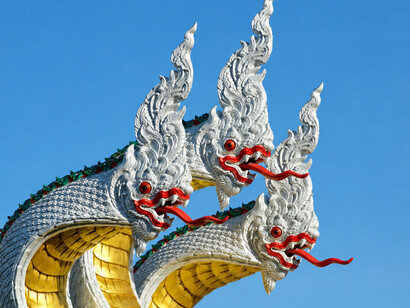
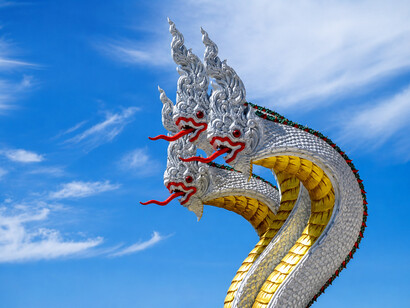
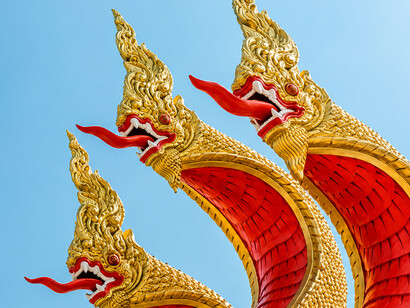
The word “Naga” in Sanskrit primarily means "serpent", but its connotations extend far beyond a simple reptilian identity. Nagas are described as semi-divine beings, often depicted as serpents with human traits or as humans with serpentine features. In visual traditions, they appear with multiple hoods rising behind their heads, signifying power, protection, and heightened awareness. Their form itself communicates duality: earthbound yet cosmic, instinctual yet wise.
The origins of the Nagas are traced to ancient cosmological genealogies recorded in texts like the Vishnu Purana and Mahabharata. They are said to be the offspring of the sage Kashyapa and his wife Kadru. Kashyapa, regarded as a progenitor of many life forms, fathered different beings through various consorts. Kadru gave birth to the Nagas, while her sister Vinata bore Garuda. This lineage establishes one of the most symbolic rivalries in Indian mythology: the tension between Nagas and Garuda, representing opposing yet interdependent forces of nature.
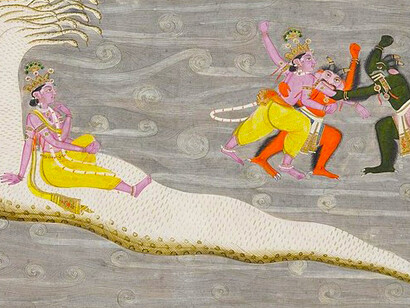
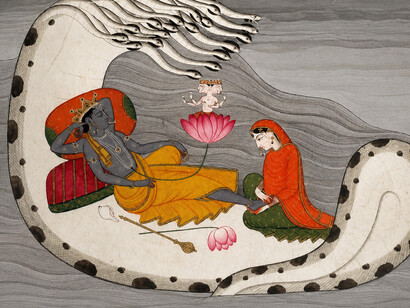
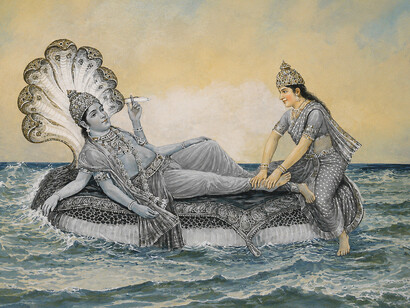
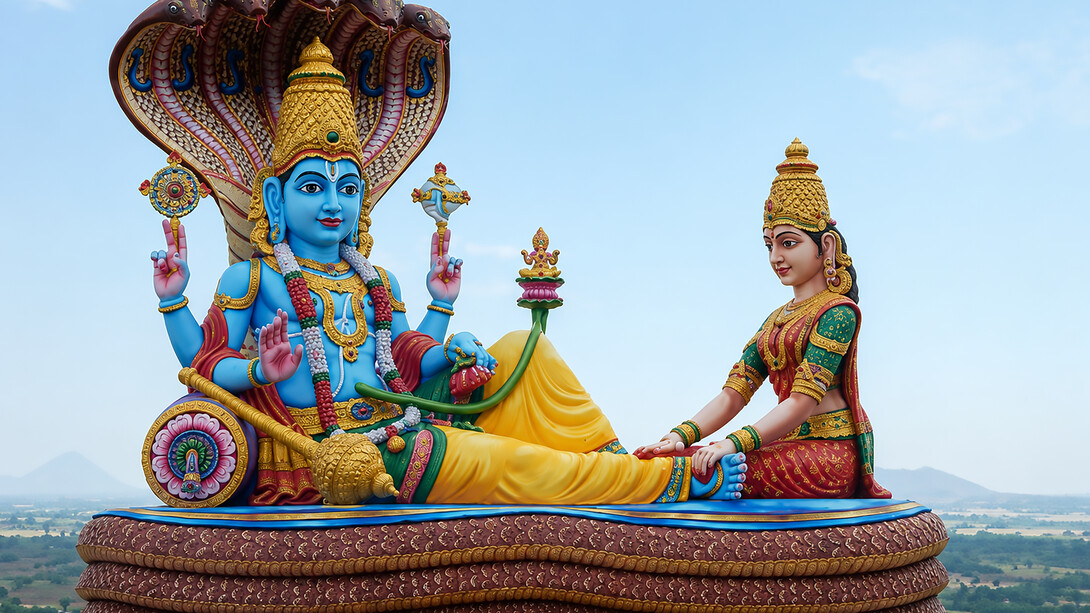
Among the many Nagas described in sacred literature, a few hold particular importance. Shesha, also called Ananta, is depicted as the endless serpent upon whom Lord Vishnu reclines. He is believed to support the universe upon his shoulders, embodying stability and infinity. Vasuki plays a central role in the cosmic episode of the Samudra Manthan, where gods and demons used him as the churning rope. This event, described in texts like the Bhagavata Purana, highlights the Naga’s participation in cosmic balance, where creation emerges through effort, conflict, and cooperation.
Another significant figure is Takshaka, known for his role in the death of King Parikshit, an episode that leads to the great serpent sacrifice narrated in the Mahabharata. This ritual, intended to annihilate all serpents, is eventually halted by the sage Astika, suggesting a philosophical stance against total destruction and in favour of coexistence. Similarly, Karkotaka appears in narratives where transformation and destiny unfold through encounters with serpent beings.
The duties attributed to the Nagas are layered and symbolic. They are often described as guardians of hidden treasures, both material and metaphysical. These treasures, concealed beneath the earth or within watery realms, signify not only wealth but also knowledge, fertility, and life-sustaining forces.
Their close association with rivers, lakes, and subterranean waters reflects an ecological sensitivity deeply embedded in early cultural consciousness. In agrarian societies dependent on rainfall and irrigation, reverence for Nagas may be understood as an acknowledgement of the unseen forces that sustain life.
In spiritual traditions, the serpent takes on an even more inward meaning through the concept of Kundalini. Often visualised as a coiled serpent at the base of the spine, this latent energy rises through disciplined practice, leading to expanded awareness.
The Naga here becomes a symbol of inner awakening rather than an external entity, reflecting the continuity between mythology and experiential knowledge.
The realms inhabited by Nagas further expand their identity. Texts such as the Garuda Purana describe their abode as Nagaloka or Patala, a subterranean realm filled with brilliance and abundance. Contrary to later interpretations of an underworld as a place of suffering, Patala is portrayed as a domain of beauty, adorned with jewels and luminous architecture. It is said to be even more resplendent than the heavens, suggesting that value and divinity are not confined to hierarchical spaces but exist across dimensions.
Nagas are also believed to dwell in rivers, oceans, sacred groves, and anthills. In many parts of India, especially in the south and northeast, serpent worship continues as a living tradition. Sacred groves dedicated to Nagas are preserved as ecological sanctuaries, where human interference is minimal. These spaces function not only as religious sites but also as repositories of biodiversity, reflecting a seamless blending of belief and environmental care.
The presence of Nagas extends across multiple traditions. In the Ramayana, references to serpent beings and their realms contribute to the broader mythic geography. In Buddhist literature such as the Jataka Tales, Nagas appear as protectors of the Buddha. A well-known story recounts how the Naga king Muchalinda sheltered the meditating Buddha from a storm, spreading his hood as a canopy. Such narratives emphasise protection, devotion, and the harmonious relationship between humans and non-human beings.
In Jain texts like the Uttaradhyayana Sutra, serpent imagery is employed symbolically, often reflecting cycles of rebirth and the consequences of karma. Across these traditions, the Naga adapts in form and meaning yet retains its essential qualities of शक्ति (power), संरक्षण (protection), and रहस्य (mystery).
Stories involving Nagas often carry layered meanings. The churning of the ocean illustrates the coexistence of poison and nectar within creation. The serpent sacrifice warns against excessive vengeance and ecological imbalance. These narratives function as moral reflections, philosophical insights, and cultural memory, transmitted through generations.
The question of their origin can also be approached from an anthropological lens. Some scholars, such as J. Ph. Vogel in Indian Serpent-Lore or The Nagas in Hindu Legend and Art, suggest that the Nagas may represent ancient serpent-worshipping communities whose beliefs were gradually absorbed into broader religious systems. This perspective does not diminish their mythic value but instead enriches it by situating them within lived histories and cultural transitions.
Material evidence of Naga reverence is visible in Indian art and architecture. Sites like Ajanta Caves, Ellora Caves, and Sanchi Stupa feature intricate carvings of serpent beings, often depicted in protective or devotional roles. These artistic representations reveal how deeply the Naga motif was embedded in visual culture across regions and time periods.
Even today, the legacy of the Nagas continues through rituals and festivals such as Nag Panchami, where serpents are worshipped and offered milk, prayers, and respect. Such practices are not mere remnants of the past but living expressions of continuity, where ancient beliefs find relevance in contemporary life.
In conclusion, the Nagas are not confined to the realm of myth alone. They represent a worldview that acknowledges the sacredness of nature, the depth of inner transformation, and the interconnectedness of all forms of life. Whether seen as cosmic beings, ecological guardians, or symbols of spiritual awakening, the Nagas continue to inhabit the imagination and practices of the Indian subcontinent. Their stories invite us to look beyond the surface, to recognise the hidden forces that shape existence, and to approach the world with a sense of reverence and balance.
References
Valmiki. The Ramayana. Translated by Bibek Debroy. New Delhi: Penguin Random House India, 2017.
Sukthankar, Vishnu S., et al., eds. The Mahabharata: Critical Edition. Pune: Bhandarkar Oriental Research Institute, 1933–1966.
Doniger, Wendy. Hindu Myths: A Sourcebook Translated from the Sanskrit. London: Penguin Classics, 1975.
Jacobi, Hermann, trans. Jaina Sutras, Part II: The Uttaradhyayana Sutra. Oxford: Clarendon Press, 1895.
Vogel, J. Ph. Indian Serpent-Lore or The Nagas in Hindu Legend and Art. London: Arthur Probsthain, 1926.
Wilson, Horace Hayman, trans. The Vishnu Purana: A System of Hindu Mythology and Tradition. London: John Murray, 1840.
Tagare, G. V., trans. The Bhagavata Purana. Delhi: Motilal Banarsidass, 1978.
Shastri, J. L., ed. The Garuda Purana. Delhi: Motilal Banarsidass, 1978.
Cowell, E. B., ed. The Jataka or Stories of the Buddha’s Former Births. 6 vols. Cambridge: Cambridge University Press, 1895–1907.
Zimmer, Heinrich. Myths and Symbols in Indian Art and Civilization. Edited by Joseph Campbell. Princeton, NJ: Princeton University Press, 1946.