English
 Español
 Français
 Deutsch
 Italiano
 Português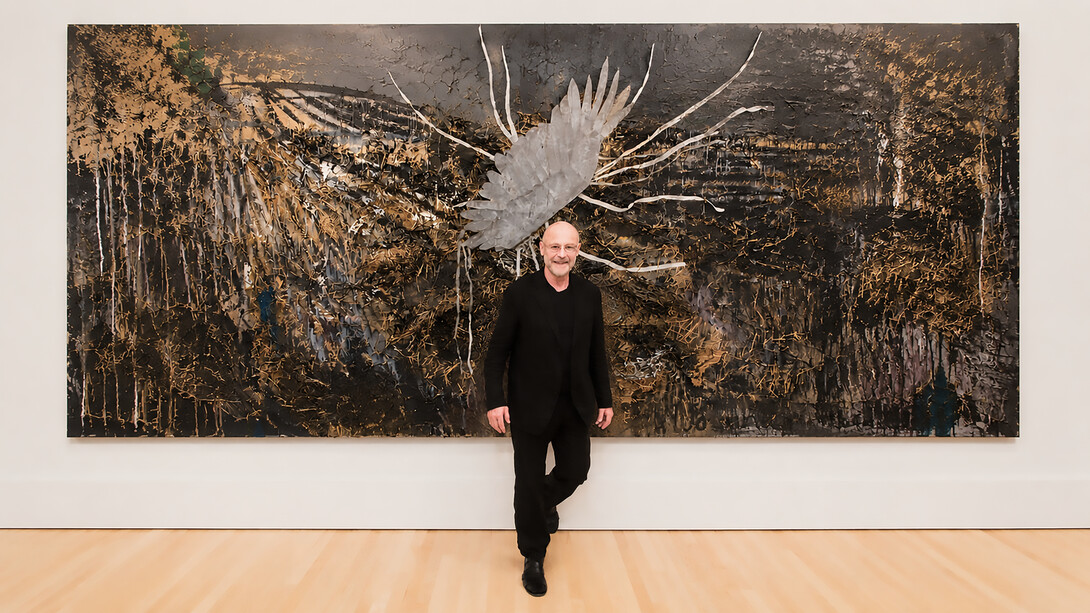
Before any of Anselm Kiefer's works reach a museum wall, they have already been burnt, buried, cut and left out in the rain. Canvases are spread on the ground and flooded with paint and diluted acid. Lead surfaces are placed in electrolytic baths and left to corrode. Some works remain buried for years before Kiefer decides they are ready. This is not preparation. It is a component of the work itself. By the time one of these paintings is encountered at SFMOMA, what is seen has already endured something.
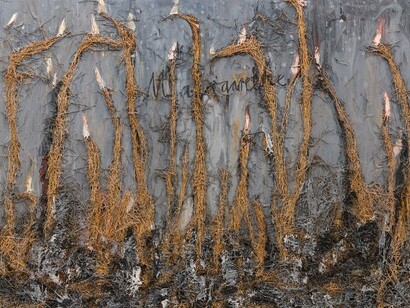
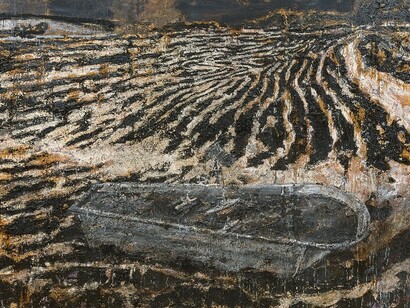
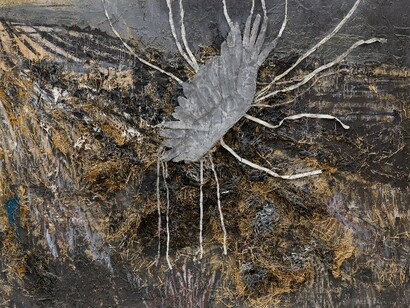
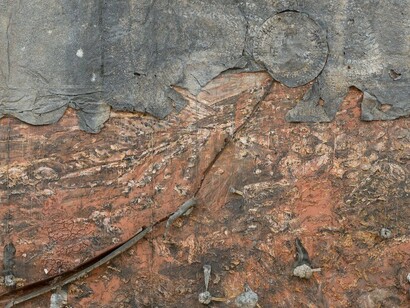
This is apparent upon close inspection. From afar, the works look dark and heavy, even menacing. However, a careful examination of the surfaces suggests otherwise. The surface which appears flat and uniform is found to be layered, cracked and oxidised. Browns and ochres bleed through the darker matter. There is rust, or something that looks like it. Rust means exposure. It means a material has been reacting with its environment over time and may still be. This is not a dried and settled paint. It's a matter that is still unfinished or in process in some way.
That instinct turns out to be correct. Kiefer does not simply paint these surfaces. He subjects them to processes that most artists would consider damage. Canvases are laid on the ground to have paint and diluted acid poured on them, while works on lead are placed into electrolytic baths and left to stand and corrode. He has driven sheets of lead to weather the metal, and entire artworks are burnt with blowtorches. In his own words: "I need nature, the changing weather, the heat and the cold. Sometimes I leave my paintings out in the rain; I throw acid, earth or water over them." The rust on the surfaces of these works is not accidental ageing. It is partly the result of deliberate chemical intervention, which was built in from the beginning.
This raises an obvious question about what these works are doing inside a museum. A basic question in the conservation of a Kiefer is whether or not decay is an integral part of his art. If all loose elements are to be secured, or if the passage of time is to be a part of the artwork, should it be preserved? Kiefer has been clear about the issue. "A painting in my case is never finished, never. It always goes on and on." Change and decay are built into his works, which continue to evolve organically even after they are considered finished. Preservation is the museum's business. Kiefer's process is, in part, controlled destruction. Those two things don't mix well together, and the works at SFMOMA are held in that tension officially but in a material that was never meant to be still.
Kiefer was born in Germany in March 1945, two months before the end of the Second World War, and is technically a contemporary artist, still living and still working. But his concerns belong to an older tradition. He believes that painting can carry moral and historical weight, that materials are never neutral, and that art has a debt to the past. His focus on decaying, cracking, and slowly changing matter is a conscious counterposition at a time when a lot of the art world has turned to the digital and the immaterial. He may be the last major artist still fully committed to the ambitions of modernism.
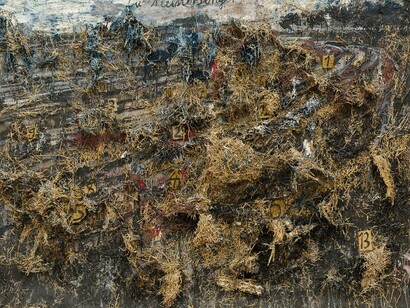
That dedication is evident in the materials of his works. Lead, ash, straw, shellac, copper wire, soil, resin, and photographs embedded in paint. All of these materials are rejected for decoration. Coffins, pipes and bullets contain lead. Ash is the ash left after combustion. Straw is reminiscent of the German countryside, rural and seemingly innocent, but historically charged. If Kiefer is pressing these into a canvas, he is not making a picture of history. He's setting it right into the surface. The work is no longer a representation of the past, but rather a tangible record of it, slowly evolving on the wall.
This is especially evident in the case of Entfaltung der Sefirot (Unfolding of the Sephirot, 1985–88), the largest piece in the collection, which stands more than eleven feet high and is almost twenty-three feet wide. The surface includes oil, acrylic, emulsion, resin, lead, soil, ash and photographs. There are ten lead rocks hanging on the canvas on strings, each of which represents one of the ten Sefirot, the attributes of God in Kabbalistic tradition. The top half is filled with lead sheeting with the Kabbalistic word "Ain Soph" (the infinite and unknowable God) followed by a question mark. In the vicinity stands Melancholia (1990-91), a fighter jet made entirely of lead, which is too heavy to ever fly. Both are things that, logically speaking, should be able to move or rise. A plane that is designed to fly. A theology that stretches towards the heavens. Both are pulled to the ground by lead.
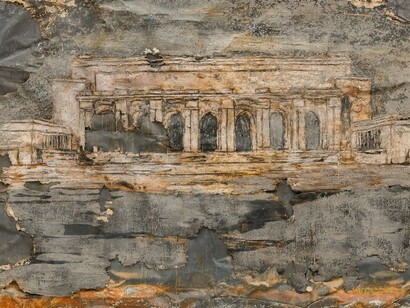
This is where the room starts to make sense as a whole. Kiefer became fascinated with Kabbalah, the poetry of Paul Celan and the literary and mystical traditions of Jewish culture from the 1980s onwards. He's not Jewish; he's German, and that makes a difference. Kabbalistic and Jewish literary traditions inform his work throughout this period, as in Daath (1990), where a bridge is broken down into grey paint, and a sphere for hidden knowledge is created; and Sulamith (1983), an arched interior, modelled on a Nazi mausoleum and reimagined as a tomb for the Jewish woman in Celan's poem Death Fugue.
Sulamith is the most difficult working person to spend time with. The architecture fades to near total darkness, with the brickwork shellacked, strawed, and painted so thick that it feels more like it has been dug out than painted. At the far end of the tunnel, barely visible, small flames burn. The darkness and weight of the surface can only be appreciated in person and the sense of what is being viewed being sealed off and continuing to seal.
The Fisher Collection is not just a collection of significant works of art by one artist. It's a room in which the works speak to each other in a way that they wouldn't if they were spread out over various collections. The floor's lead jet, the giant Kabbalistic painting, the dark tomb of Sulamith, and the crumbling bridge of Daath. Together they argue that materials have the power to store memory, that ash and lead and soil can store history in a way that a digital image can't. At a time when much art is becoming completely immaterial, that's a case to sit with.