English
 Español
 Français
 Deutsch
 Italiano
 Português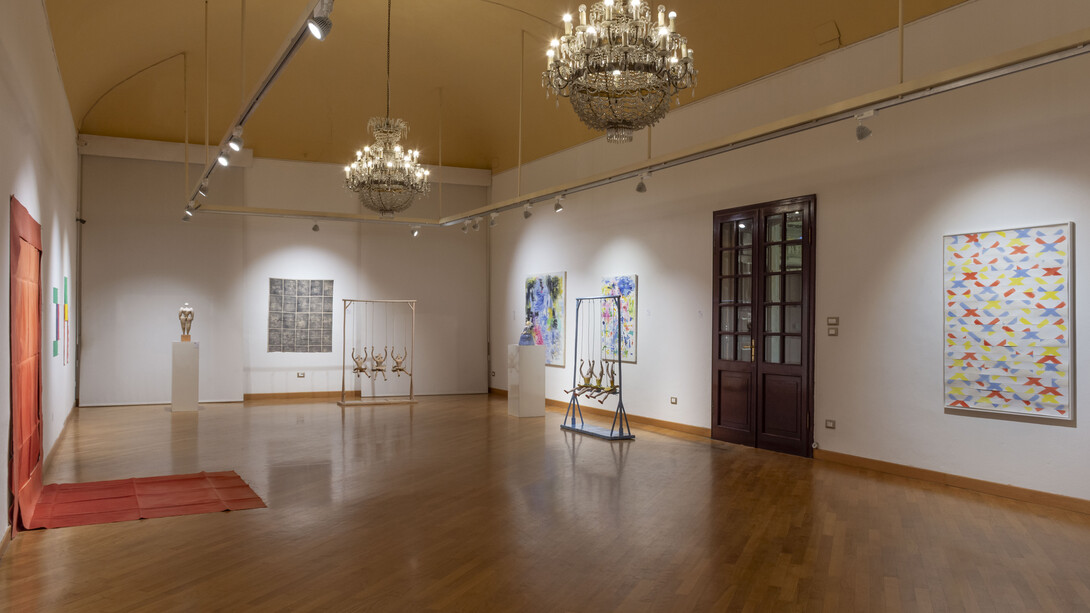
Galleria d’Arte Maggiore g.a.m. presents in Bologna a solo exhibition dedicated to Louis Cane, following the success of his recent show at the gallery’s Paris venue. This second appointment confirms the renewed critical and collectors’ interest in the work of the French artist, a central figure in the European contemporary scene, whose research continues to prove remarkably relevant. The exhibition focuses on two key moments in his production: his beginnings in the late 1960s within the Supports/Surfaces movement, and the shift in the 1990s, marked by a renewed dialogue with art history and the production of a significant body of ceramic sculptures.
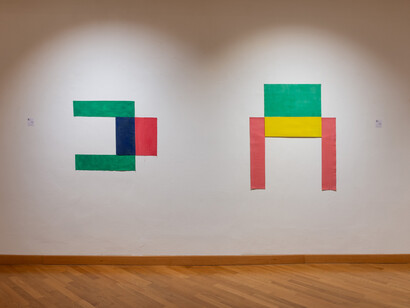
The exhibition path starts with a selection of renowned historical works that demonstrate Cane’s adherence to the principles of Supports/Surfaces, of which he was a founding member. In these works, the artist analyzes and deconstructs the fundamental elements of painting - support, surface, gesture - freeing them from their representational function and placing the process and materiality of the work at the center of his research. The series of toiles and papiers découpées represents one of the most radical moments of this investigation. By cutting and recomposing the canvas, Cane destroys its traditional unity and highlights its physical structure. This gesture is not only formal but also theoretical: it rejects the idea of the painting as a closed and autonomous whole, proposing instead a fragmented and open vision.
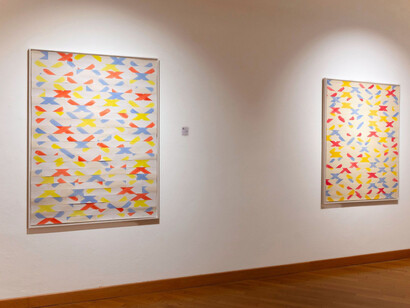
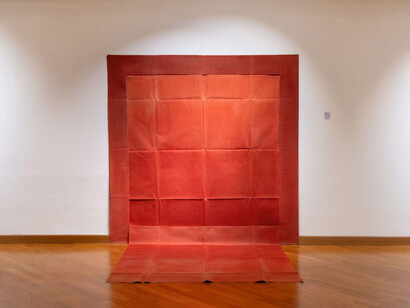
The parts of the canvas gain their own autonomy, and the space between them becomes as significant as the painted material. The Sol/Mur cycle further deepens this reflection. Placing works on the floor or on the wall is not merely an exhibition choice, but a way of redefining the relationship between painting, space, and viewer. By destabilizing perceptual habits, the artist invites a more conscious experience. With the toiles tamponées series, Cane introduces a reflection on gesture and repetition. The use of modules and stamps to apply color partially eliminates individual expressiveness, replacing it with a systematic and repetitive procedure. Yet, within this apparent neutrality, a new form of sensitivity emerges, tied to minimal variation and the perception of time.
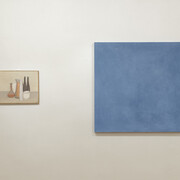
The exhibition then moves to the 1990s, when Cane inaugurated a new phase of his practice characterized by a direct engagement with the great masters of the past. On display are two canvases titled Peinture abstraite traditionnelle, which reinterpret Claude Monet’s celebrated Nymphéas cycle an exploration Cane began in 1994 during a solo exhibition at the Musée de l’Orangerie, where Monet’s masterpieces are housed. Along the same line are the Ménines sculptures, inspired by Diego Velázquez’s work, which open an important section of the exhibition dedicated to ceramic production.
The exhibition is further enriched by sculptures created by Louis Cane for the major exhibition held in 1995 at the MIC – International Museum of Ceramics in Faenza, organized in collaboration with Galleria d’Arte Maggiore g.a.m. and curated by Franco and Roberta Calarota. In addition to the Ménines, the display includes the Veneri, which reinterpret archaic models of Etruscan origin, and the Altalene, works that introduce a dynamic and suspended dimension into space, further expanding Cane’s reflection on the relationship between form, balance, and perception. As with color, in sculpture Cane maintains the same almost “analytical” attention to matter, treating form as a tactile experience rather than an ideal to be achieved. These sculptures are meant to be viewed up close to grasp what remains of the gesture on their surface: imprints, scratches, thickness, and irregularities.
By analyzing multiple aspects of Louis Cane’s art, the exhibition offers a multifaceted reading of his practice, highlighting the coherence and evolution of an artist capable of traversing and renewing the languages of contemporaneity.